
Published
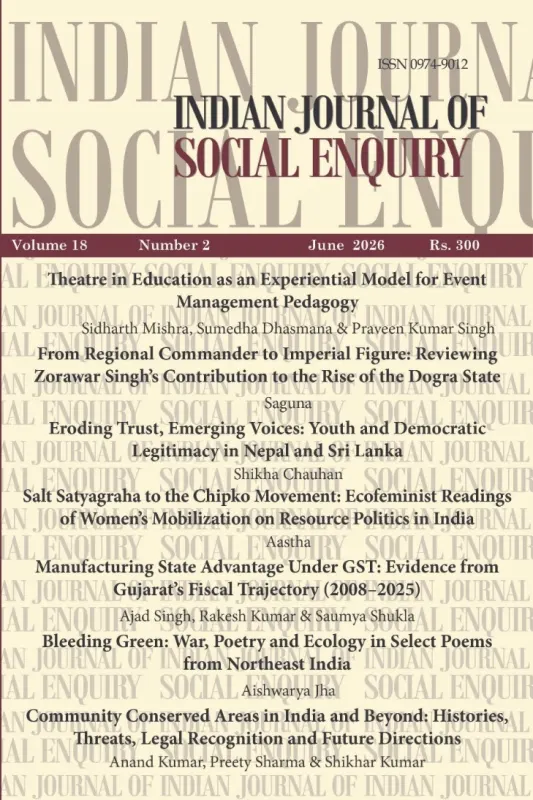
Salt Satyagraha to the Chipko Movement: Ecofeminist Readings of Women’s Mobilization on Resource Politics in India

Published in June 2026 (Vol. 18, Issue 2, 2026)
Keywords
Abstract
Ecofeminism, a significant development in the field of Political theory since the
1970s, offers a fresh and unique vantage point for re-evaluating certain events
in the colonial past of India and offers a premise on which the engagement
of women with politics can be increased. This paper seeks to retrospectively
examine the Salt Satyagraha of 1930 as not just an anti-colonial movement
but also as a nascent ecofeminist assertion as it involved large-scale female
participation to resist capitalist patriarchy encapsulated by colonialism and
its tendency of privatization and monopolization of natural resources like salt.
The Salt Satyagraha has then been compared and contrasted with the Chipko
Movement of 1973 to bring forth their shared ecofeminist underpinnings and
key divergences. Finally, this paper makes a case for revisiting the ideals of
ecofeminism for increasing the participation of Indian women in the political
processes, particularly by positioning women as natural advocates and leaders for fair resource management and challenging the cultural barriers that inhibit
women’s political agency.
Authors (1)
Aastha
Department of Political Scienc...Department of Political Science, University of Luc...Department of Political Science, University of Lucknow, LucknowDepartment of Political Science, University of Lucknow, Lucknow
View all publications →Download Article
Article Information
Published in:
June 2026 (Vol. 18, Issue 2, 2026)Article Impact
Views:84
Downloads:35
scite_
Smart Citations
0Citing Publications
0Supporting
0Mentioning
0Contrasting
View Citations
See how this article has been cited at scite.ai
scite shows how a scientific paper has been cited by providing the context of the citation, a classification describing whether it supports, mentions, or contrasts the cited claim, and a label indicating in which section the citation was made.
scite shows how a scientific paper has been cited by providing the context of the citation, a classification describing whether it supports, mentions, or contrasts the cited claim, and a label indicating in which section the citation was made.

How to Cite
Aastha (2026). Salt Satyagraha to the Chipko Movement: Ecofeminist Readings of Women’s Mobilization on Resource Politics in India. Indian Journal of Social Enquiry, 18(2), 71-83. https://doi.org/10.68221/IJSE.v18.i2.000082