
Digital Society and Social Change in India: Research Priorities for the Platform and AI Era
India’s digital transformation is no longer confined to the adoption of smartphones, online payments or social media. Digital technologies now influence how people work, learn, communicate, consume information, access public services, build communities and participate in political and cultural life. Artificial intelligence has added another layer to this transformation by introducing automated decision-making, generative content, predictive systems and algorithmic management into everyday institutions.
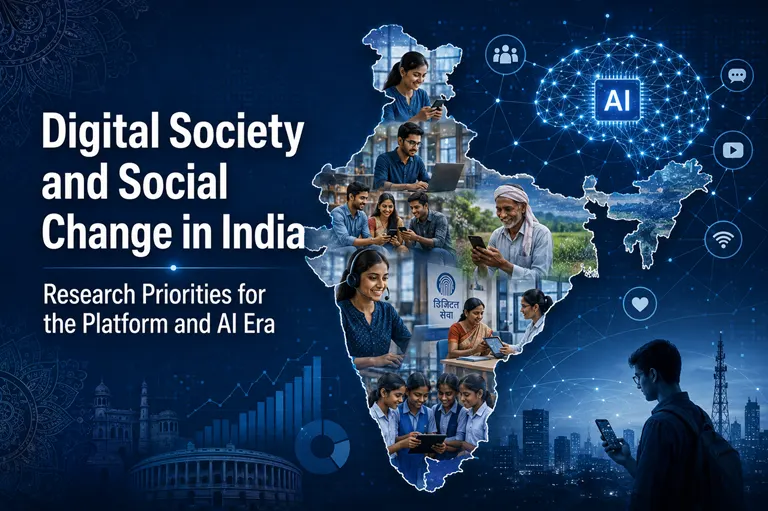
India entered 2026 with a digital ecosystem of exceptional scale. According to the Telecom Regulatory Authority of India, the country’s broadband subscriber base exceeded one billion during the first quarter of 2026. This expanding connectivity creates opportunities for education, entrepreneurship, public-service delivery and social participation, but access alone does not guarantee equality, autonomy or meaningful inclusion. TRAI’s telecom performance reports show the scale of connectivity, while social enquiry must investigate how that connectivity is actually experienced across different communities.
At the same time, the IndiaAI Mission is developing computing capacity, datasets, indigenous models, future skills, startup financing and mechanisms for safe and trusted AI. The mission was approved with an outlay of ₹10,371.92 crore over five years, demonstrating the strategic importance attached to artificial intelligence in national development. IndiaAI describes the programme as an effort to support responsible and inclusive growth across seven interconnected pillars.
These developments create a significant agenda for the social sciences. The central question is not simply whether technology is advancing. Researchers must examine who benefits from technological change, who carries its risks, how institutions use digital power, and how people reinterpret technologies within their own social and cultural environments.
For the Indian Journal of Social Enquiry, the digital transformation of society offers an important interdisciplinary field connecting sociology, economics, political science, psychology, education, cultural studies, media studies, gender studies, public policy and development research.
Why Digital Society Requires Social Enquiry
Technology is often presented as an external force that enters society and produces change. In practice, the relationship is more complex. Technology is designed, financed, regulated and used within existing social structures. Caste, class, gender, language, geography, disability, education and occupational position influence who can access a technology, how it is used and what consequences it produces.
A food-delivery application, for example, may offer convenience to consumers and income opportunities to workers. It may also introduce algorithmic control over work allocation, ratings, incentives, routes and penalties. A generative AI tool may increase productivity for a highly educated urban professional while offering limited value to a user who lacks English proficiency, reliable connectivity or digital literacy. An online welfare portal may improve administrative efficiency but create new barriers for citizens who depend on intermediaries to navigate it.
Social enquiry therefore shifts attention from technological capability to lived experience. It asks:
- Who designs and controls digital systems?
- Which groups are represented in the data used to train AI models?
- How do automated systems affect rights, opportunities and social relationships?
- What new forms of inequality are being produced?
- How do individuals and communities resist, negotiate or adapt to digital power?
- What forms of regulation and institutional accountability are required?
These questions are essential because platforms and AI systems increasingly operate as social institutions rather than neutral tools.
Priority 1: Digital Access, Capability and Meaningful Inclusion
India’s expansion of affordable connectivity represents a major achievement, but a binary distinction between connected and unconnected populations is no longer sufficient. Researchers must move beyond basic access statistics and study the quality, affordability, continuity and practical usefulness of digital access.
A household may have one internet-enabled smartphone shared among several family members. Women or children may receive less time with the device. Connectivity may be available but unreliable. A person may use messaging and entertainment applications confidently while lacking the skills needed to complete an online application, evaluate misinformation or protect personal information.
From digital access to digital capability
Meaningful digital inclusion should be studied across several dimensions:
- Ownership and control of devices
- Reliability and affordability of connectivity
- Language and accessibility of interfaces
- Functional and critical digital literacy
- Ability to complete educational, financial and administrative tasks
- Awareness of privacy, fraud and online safety
- Confidence in using AI-assisted tools
- Availability of assistance when digital systems fail
Research must pay particular attention to rural communities, low-income households, older people, persons with disabilities, linguistic minorities and first-generation users. It should also examine the gendered distribution of digital resources within households.
The digital divide is not a temporary technical gap that will automatically disappear with infrastructure expansion. It is connected to deeper inequalities in income, education, mobility, authority and social recognition.
Priority 2: Platform Labour and Algorithmic Management
Digital platforms have reorganised work across transport, food delivery, domestic services, logistics, retail, professional freelancing and online content creation. They have also created a form of management in which algorithms influence work allocation, visibility, incentives, ratings and disciplinary action.
NITI Aayog’s report on India’s booming gig and platform economy recognised the growing importance of this workforce and highlighted the need for social security, skills development and greater availability of aggregate data. The continuing growth of digitally mediated work makes platform labour one of the most urgent areas of Indian social research.
Research questions about dignity and control at work
Researchers should investigate how workers understand flexibility, independence and risk. Platform work may offer autonomy in one respect while creating dependence in another. Workers may choose when to log in but have little influence over pricing, incentive changes, customer ratings or account suspension.
Important areas of investigation include:
- Income stability and the real cost of platform work
- Working hours, waiting time and unpaid labour
- Occupational safety and access to social protection
- Algorithmic allocation of tasks and incentives
- Transparency in worker ratings and account deactivation
- Gender and caste patterns within platform occupations
- Experiences of migrant and multilingual workers
- Collective organisation and new forms of worker solidarity
- Emotional labour and customer-facing rating systems
- Effects of automation on employment security
Research must include workers’ own interpretations rather than treating them only as data points in a labour-market model. Ethnographic research, worker diaries, interviews, platform-interface analysis and longitudinal studies can reveal dimensions that aggregated employment statistics may overlook.
Priority 3: AI, Employment and the Transformation of Skills
Public discussion frequently treats AI as either a source of mass job displacement or an automatic engine of productivity. Both positions can hide important differences between occupations, sectors, institutions and worker groups.
AI may automate complete tasks in some contexts, assist workers in others and create additional monitoring or verification duties elsewhere. Its effects will depend on how organisations redesign jobs, distribute productivity gains, provide training and evaluate performance.
Social scientists should study the transformation of work at the task level. This includes administrative work, teaching, software development, customer service, translation, journalism, design, healthcare support, legal research and financial analysis.
Unequal capacity to benefit from AI
Access to AI tools does not ensure an equal ability to use them. Workers with strong domain knowledge, English proficiency, digital confidence and institutional support may gain greater benefits than workers without these advantages. This could widen existing wage and occupational inequalities.
Research priorities should include:
- Which occupational tasks are being automated, augmented or intensified
- How AI affects entry-level employment and career progression
- Whether productivity gains are shared with workers
- How employers measure AI-assisted performance
- Which groups receive access to meaningful reskilling
- How AI changes professional identity and expertise
- Whether automation reproduces caste, class, gender or linguistic disadvantage
- How workers verify and take responsibility for AI-generated output
India’s AI-skilling agenda should therefore be evaluated not only through enrolment figures but also through completion, accessibility, employment outcomes and the quality of work created.
Priority 4: Data, Privacy and Everyday Surveillance
Participation in digital society produces extensive data. Smartphones, platforms, digital payments, educational systems, workplace software, connected devices and public-service portals can generate detailed records of behaviour.
India’s Digital Personal Data Protection Act, 2023 established a legal framework for processing digital personal data, while the Digital Personal Data Protection Rules, 2025 provided implementation requirements with phased commencement. Legal development, however, must be accompanied by social research into how privacy is understood and practised.
Consent may have limited meaning when users cannot understand a notice, cannot negotiate its terms or must accept data collection to access an essential service. Privacy is also shaped by household relationships, social expectations and differences in digital literacy.
Privacy as a social question
Researchers should explore:
- How people understand data collection and consent
- Whether consent mechanisms are accessible in Indian languages
- How data practices affect children and adolescents
- Workplace surveillance and employee autonomy
- Data sharing within education, finance, health and welfare systems
- Public awareness of complaint and grievance mechanisms
- The experiences of communities exposed to profiling
- How privacy expectations vary across age, gender, class and locality
Research ethics must extend beyond legal compliance. Researchers using platform data, digital traces or AI-assisted analysis should consider whether information that is technically public was intended by users to become part of an academic dataset.
Priority 5: Algorithmic Bias, Fairness and Accountability
AI systems learn from data shaped by social history. If historical data reflect exclusion or unequal institutional treatment, automated systems may reproduce these patterns. Bias may also arise when models perform poorly for particular languages, accents, regions, identities or social contexts.
The challenge is especially significant in India because of its linguistic diversity, social stratification and uneven availability of high-quality datasets.
Studying fairness within Indian contexts
Algorithmic fairness cannot be reduced to a single universal measurement. Researchers must ask what fairness means in the context of a particular institution and population. A model used for credit assessment raises different concerns from one used in education, employment or public-service delivery.
Research should examine:
- Representation of Indian languages and dialects in training datasets
- Performance differences across regions and population groups
- Bias in recruitment, lending, insurance and educational assessment
- Accessibility for persons with disabilities
- Availability of explanations for automated decisions
- Opportunities for human review and appeal
- Responsibility when an AI-assisted decision causes harm
- Public participation in the design of high-impact systems
UNESCO’s Recommendation on the Ethics of Artificial Intelligence emphasises human dignity, fairness, transparency, sustainability and human oversight. These principles offer a valuable foundation, but Indian research must examine how they can be implemented within specific institutions and social conditions.
Priority 6: Social Media, Information and Democratic Life
Social platforms have expanded public expression, political communication and access to information. They have also enabled misinformation, targeted harassment, polarisation, manipulated media and rapid circulation of content without context.
Generative AI complicates this environment by lowering the cost of creating convincing text, audio, images and video. The distinction between authentic and synthetic content is becoming more difficult for ordinary users to establish.
Research should avoid assuming that users passively absorb whatever appears in their feeds. People interpret information through prior beliefs, community relationships, political identities, language networks and trusted intermediaries.
Key areas for democratic research
- How people evaluate credibility online
- Circulation of misinformation through private messaging groups
- Political communication in regional languages
- Online harassment targeting women and marginalised communities
- Influence of recommendation systems on public attention
- Role of creators, influencers and local digital intermediaries
- Public understanding of synthetic and AI-generated media
- Fact-checking practices and their limits
- Relationship between online participation and offline civic action
Researchers should also investigate positive forms of digital participation, including mutual-aid networks, citizen reporting, public-interest campaigns and community-based knowledge sharing.
Priority 7: Language, Culture and AI Representation
India’s linguistic and cultural diversity presents both an opportunity and a challenge for digital development. AI-supported translation, speech recognition and content generation could expand access to education, governance and economic participation. However, poor representation of regional languages may produce inaccurate, culturally inappropriate or exclusionary results.
Language is not merely a technical input. It carries history, identity, humour, hierarchy and cultural meaning. A model may generate grammatically acceptable text while failing to understand social context or regional usage.
Research priorities include:
- Quality of AI services across Indian languages
- Representation of dialects and oral traditions
- Cultural assumptions embedded in generated content
- Effects of automated translation on meaning and identity
- Visibility of regional knowledge online
- Ownership and governance of language datasets
- Potential homogenisation of cultural expression
- Opportunities for community-led dataset creation
Researchers must also consider whose knowledge becomes machine-readable and whose remains outside formal digital archives.
Priority 8: Education, Learning and Academic Integrity
AI tools are changing how students search for information, write assignments, translate material, solve problems and prepare for examinations. Teachers and institutions are also using digital systems for lesson preparation, assessment and administration.
The central educational question is not simply whether AI should be allowed. It is how educational institutions can preserve intellectual development, fairness and academic integrity while recognising that AI-assisted work will become part of many professional environments.
Research needs in Indian education
Studies should examine:
- Differences in access to paid and free AI tools
- AI literacy among students and teachers
- Effects on writing, reasoning and independent problem-solving
- Reliability of AI-generated information in different subjects
- Regional-language learning applications
- New approaches to assessment
- Teacher workload and professional autonomy
- Institutional policies on disclosure and acceptable use
- Risks of surveillance through automated proctoring
- Effects on rural, low-income and first-generation learners
Universities should avoid policies based only on detection and punishment. Research can help institutions design assessments that value explanation, reflection, evidence, process and oral engagement.
Priority 9: Digital Public Services and Citizen Experience
Digital public infrastructure and online administrative systems can improve efficiency, reduce transaction costs and expand access. Nevertheless, citizens experience public systems through interfaces, documentation requirements, authentication processes and grievance channels.
When a digital service fails, the burden often falls on the citizen. People may need to visit service centres, pay intermediaries or repeatedly correct data. Such experiences are particularly significant for those seeking welfare benefits, identity-related services or essential documentation.
Social enquiry should evaluate digital governance from the perspective of the citizen rather than only through aggregate adoption or transaction figures.
Research should investigate:
- Accessibility and usability of public-service portals
- Reliability of authentication systems
- Exclusion caused by incorrect or mismatched data
- Role of local intermediaries and service centres
- Availability of meaningful offline alternatives
- Grievance redressal and institutional accountability
- Gendered and regional differences in service access
- Public trust in automated administrative systems
A socially responsive digital state must combine technological efficiency with procedural fairness, human assistance and accessible remedies.
Priority 10: Mental Health, Relationships and Digital Well-Being
Digital platforms affect attention, identity, intimacy, family relationships and emotional well-being. Constant comparison, online harassment, compulsive engagement and pressure to remain visible can produce distress. At the same time, digital spaces can provide companionship, support networks and access to mental-health information.
The consequences differ across age groups and social contexts. Young people may experience social media as both a space of belonging and a source of evaluation. Older people may benefit from connection while facing fraud and misinformation risks. Content creators may gain income but become dependent on unpredictable attention and algorithmic visibility.
Research should avoid simplistic measurements based only on screen time. It should study the quality of engagement, purpose of use, social context and relationship between online and offline experiences.
Building a Stronger Research Methodology for Digital Society
Digital society research requires methodological innovation. Conventional surveys and interviews remain essential, but researchers may also use digital ethnography, interface analysis, network analysis, participatory research, computational text analysis and platform audits.
Mixed methods and contextual depth
Quantitative evidence can identify patterns across large populations, while qualitative research can explain how people interpret those patterns. Combining methods can reveal both scale and lived experience.
A study of platform labour, for example, might combine:
- Worker surveys
- In-depth interviews
- Income and expense diaries
- Observation of platform interfaces
- Analysis of contracts and policy documents
- Interviews with platform representatives and regulators
Researchers should be transparent about sampling, data access, analytical assumptions and methodological limitations.
Ethical use of AI in social research
AI tools can support transcription, translation, literature discovery, coding and preliminary analysis. They should not replace researcher accountability. Scholars must verify outputs, protect confidential information and disclose meaningful AI assistance where required.
Sensitive interviews or unpublished participant information should not be entered into third-party AI tools without appropriate safeguards, ethical approval and a clear understanding of how the data may be processed.
From Technology-Centred Research to People-Centred Research
India’s digital future cannot be understood only through infrastructure, investment, adoption or productivity. These indicators are important, but they do not reveal whether technology strengthens dignity, fairness, participation and human capability.
People-centred research begins with communities rather than technologies. Instead of asking only what an AI system can do, researchers should ask:
- Which social problem is being addressed?
- Who defined that problem?
- Who participated in the design process?
- What evidence supports the intervention?
- Who may be excluded or harmed?
- Can affected people understand and challenge decisions?
- Are less intrusive alternatives available?
- How will social consequences be monitored over time?
This approach aligns technological development with democratic accountability and public value.
Frequently Asked Questions
What is digital society?
Digital society refers to a social environment in which digital technologies influence communication, work, education, commerce, culture, governance and interpersonal relationships. It includes both online behaviour and the way digital systems reshape offline institutions and opportunities.
How is AI contributing to social change in India?
AI is changing employment, education, media production, public administration, finance, healthcare support and access to information. Its effects vary according to social position, institutional practices, data quality and access to digital skills.
What are the most important digital-society research priorities in India?
Major priorities include meaningful digital inclusion, platform labour, AI and employment, data privacy, algorithmic bias, misinformation, regional-language technology, education, digital public services and mental well-being.
Why is platform labour important for social science research?
Platform labour introduces new relationships between workers, customers, algorithms and companies. Research is needed to understand income security, algorithmic control, worker rights, social protection, occupational safety and collective representation.
What is algorithmic bias?
Algorithmic bias occurs when an automated system produces systematically unfair or inaccurate outcomes for particular groups. It may result from unrepresentative data, historical inequality, inappropriate design assumptions or differences in how a system performs across populations.
How can researchers study AI responsibly?
Researchers should use transparent methods, protect participant information, assess potential bias, verify AI-generated outputs and disclose significant AI assistance. Communities affected by AI systems should be included in research design wherever possible.
Does increased internet access eliminate the digital divide?
No. Connectivity is only one component of inclusion. Device ownership, affordability, digital literacy, language, accessibility, safety, social permission and the ability to use online services effectively are equally important.
Can scholars submit interdisciplinary digital-society research to IJSE?
Research examining technology through social, economic, political, psychological, educational or cultural perspectives is closely aligned with the journal’s interdisciplinary social-enquiry positioning. Authors should consult the journal’s current aims, scope and author guidelines before submission.
Conclusion
India’s platform and AI era is creating new opportunities for communication, productivity, learning, public administration and social participation. It is also redistributing power, risk, visibility and opportunity in ways that require careful scholarly examination.
The next generation of digital-society research must move beyond technological enthusiasm and technological fear. It should produce grounded evidence about how digital systems interact with caste, class, gender, language, region, occupation, age and institutional authority. It must include the experiences of workers, students, families, citizens and communities whose lives are increasingly organised through platforms and automated systems.
The Indian Journal of Social Enquiry can contribute meaningfully to this field by encouraging rigorous, ethical and interdisciplinary scholarship on digital transformation. Research that combines theoretical insight with empirical evidence can help ensure that India’s digital future is evaluated not only by the sophistication of its technology, but also by its contribution to inclusion, dignity, accountability and social well-being.
For editors, institutions or scholarly societies planning a professional social science journal, support is available for ScholarJMS journal websites and editorial workflows, OJSCloud hosting or migration, GetDOI DOI workflow guidance, and Scholar9 transparent peer-review infrastructure. Contact inquiry@ojscloud.com or WhatsApp +91 82003 85143.