
Researching Inequality in Contemporary India: Caste, Class, Gender, Education and Digital Access
India’s economic, educational and technological development has created important opportunities for social mobility. Access to schooling has expanded, digital infrastructure has grown, financial services have become more accessible and new forms of employment have emerged. Yet the benefits of these changes are not distributed equally.
Caste, class, gender, education and digital access continue to influence where people live, what they learn, which occupations they enter, how institutions treat them and whether they can convert formal opportunities into meaningful social advancement. These dimensions of inequality do not operate independently. They overlap within households, schools, workplaces, communities and public institutions.
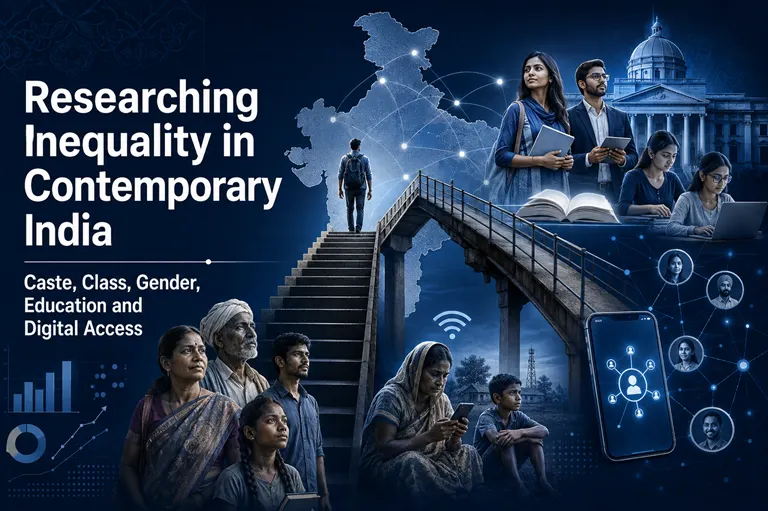
A rural woman from a historically marginalised caste and a low-income household, for example, may encounter several connected disadvantages. Limited control over a digital device can restrict her access to education, employment information, financial services and public programmes. Her experience cannot be explained adequately through gender, caste, class or digital access alone.
This is why contemporary inequality research increasingly requires an intersectional approach. Researchers must examine how different forms of advantage and disadvantage combine, reinforce one another and change across locations and generations.
For the Indian Journal of Social Enquiry, inequality represents a core interdisciplinary research field. It connects sociology, economics, political science, education, gender studies, psychology, development studies, public administration, media studies and digital-society research. Rigorous social enquiry can help move public discussion beyond general claims by showing who experiences inequality, through which institutions and under what conditions.
Understanding Inequality as a Multidimensional Social Process
Inequality is often discussed through income or consumption, but economic resources are only one part of the picture. People may also experience inequality in education, health, housing, safety, political representation, social recognition, digital access and institutional treatment.
NITI Aayog’s National Multidimensional Poverty Index reflects this broader understanding by considering health, education and standards of living through several indicators. India’s 2025 Voluntary National Review reported a substantial reduction in multidimensional poverty between 2015–16 and 2019–21. Such progress is significant, but national averages do not eliminate the need to study continuing differences between regions, social groups and household types.
The Ministry of Statistics and Programme Implementation’s Household Consumption Expenditure Survey provides another important source for examining differences in household consumption and living standards. Researchers must use such data carefully, recognising that expenditure patterns do not capture every form of deprivation, discrimination or social power.
Inequality of resources, opportunity and outcomes
A useful research framework distinguishes among:
- Resource inequality: Differences in income, assets, land, housing, devices and institutional support
- Opportunity inequality: Differences in access to education, employment, healthcare, networks and public services
- Process inequality: Unequal treatment within schools, workplaces, markets or administrative institutions
- Outcome inequality: Differences in learning, earnings, occupational mobility, health or political participation
- Recognition inequality: Differences in dignity, representation, visibility and cultural respect
- Capability inequality: Differences in people’s practical freedom to use available resources and opportunities
A policy may provide formal access to all while producing unequal outcomes because people begin from very different social and economic positions. Equal treatment is therefore not always sufficient to produce substantive equality.
Caste and the Changing Forms of Social Inequality
Caste remains central to understanding Indian society, although its operation varies considerably across regions, communities, occupations and institutions. It may influence residential patterns, marriage, social networks, education, political organisation, employment and access to local resources.
Economic development and urbanisation can weaken some traditional restrictions while producing new expressions of caste. Discrimination may become less explicit but continue through social networks, institutional cultures, residential separation or assumptions about merit and capability.
Moving beyond a traditional versus modern framework
Research should avoid treating caste as a feature that automatically disappears with modernisation. Digital platforms, higher education and professional employment can transform caste relations without necessarily eliminating them.
Contemporary research questions include:
- How caste affects access to quality schooling and higher education
- Experiences of students from marginalised communities within educational institutions
- Caste and recruitment through informal professional networks
- Representation in leadership and decision-making roles
- Residential segregation in urban and peri-urban areas
- Caste in platform-based and digitally mediated work
- Online caste expression, solidarity and harassment
- Changes in inter-caste relationships among younger generations
- Role of caste associations in mobility and political participation
- Regional differences in the operation of caste
Researchers should distinguish among formal access, everyday experience and long-term outcomes. Admission to an institution does not necessarily guarantee belonging, equal treatment or access to mentorship.
Studying discrimination responsibly
Caste research requires careful ethical practice. Researchers should protect participant identities, avoid reproducing stigmatising descriptions and recognise the risks participants may face when discussing discrimination.
Research should also include agency and collective action. Marginalised communities are not simply recipients of disadvantage. They produce knowledge, organise politically, create support networks and challenge unequal institutions.
Class, Wealth and Unequal Life Chances
Class inequality includes income differences, but it also involves property, occupational security, education, social networks and the ability to withstand financial shocks. Two households with similar current incomes may have very different levels of security if one owns a home, has savings and can access family support while the other depends on irregular wages and rented accommodation.
Economic inequality shapes everyday choices. It affects whether a household can afford private tuition, relocate for education, purchase a computer, manage a health emergency or allow a young person to undertake unpaid training.
Consumption does not tell the entire story
Household consumption data are valuable for understanding living standards, but researchers should combine them with evidence on:
- Income stability
- Household debt
- Land and property ownership
- Savings and financial resilience
- Employment contracts and social protection
- Housing quality and location
- Access to healthcare and education
- Unpaid care responsibilities
- Family and professional networks
- Exposure to environmental risks
Class is also experienced relationally. People understand their position by comparing themselves with neighbours, colleagues, peers and online representations of success. Social media can intensify awareness of lifestyles that remain economically inaccessible.
Informal work and economic vulnerability
A large proportion of Indian workers remain connected to informal employment, self-employment, casual labour and small enterprises. These workers may lack predictable income, paid leave, insurance and retirement security.
Platform-based employment adds another layer to class research. Workers may own smartphones and participate in digital markets but remain vulnerable to changing incentives, customer ratings, fuel costs and account suspension. Digital participation should not be mistaken automatically for economic security.
Gender Inequality inside and outside the Household
Gender inequality operates through education, employment, mobility, safety, health, unpaid care work and household decision-making. Formal improvements in enrolment or financial access may coexist with continuing differences in control over time, income and technology.
Research must therefore examine both public institutions and private household relationships.
The unequal distribution of time
Time is an important but frequently overlooked dimension of inequality. Women may combine paid work with childcare, elder care, cooking and household management. This reduces the time available for education, rest, professional networking and digital skill development.
Remote and platform-based work may offer flexibility, but it can also blur the boundary between paid employment and domestic responsibility. Research should ask whether flexibility redistributes care work or simply enables women to perform several roles simultaneously.
Gender and economic participation
Important areas of study include:
- Access to paid employment and occupational mobility
- Gender differences in wages and employment security
- Women’s ownership and control of income
- Participation in non-traditional occupations
- Safety during travel and at work
- Maternity, childcare and elder-care support
- Access to credit and productive assets
- Women’s entrepreneurship and market networks
- Gender bias in recruitment and promotion
- Experiences of transgender and gender-diverse people
NITI Aayog’s work on advancing non-traditional livelihoods for women highlights how education, vocational training and entry into high-growth sectors can challenge occupational segregation. However, skilling initiatives must be supported by safe workplaces, mobility, childcare and fair recruitment.
Gender cannot be isolated from caste and class
The meaning of gender inequality differs across social and economic locations. A professional woman in a metropolitan workplace and a woman engaged in agricultural labour may both experience gender inequality, but the mechanisms and resources available to them differ considerably.
Research should avoid speaking about “Indian women” as a single uniform category.
Educational Inequality beyond Enrolment
Expanded enrolment is an important achievement, but educational equality requires more than admission to a school or college. Students differ in access to qualified teachers, learning materials, language support, safe transport, digital devices, private tutoring and supportive home environments.
Educational inequality develops cumulatively. Small disadvantages in early schooling can affect examination performance, subject selection, higher education and employment.
Access, participation, learning and transition
A comprehensive research framework should examine:
- Access: Can students enter an educational institution?
- Participation: Can they attend regularly and engage fully?
- Learning: Are they acquiring meaningful knowledge and skills?
- Belonging: Do they feel respected and included?
- Completion: Can they remain enrolled until graduation?
- Transition: Can they convert qualifications into further study or employment?
Research limited to enrolment data may miss unequal learning experiences and post-education outcomes.
NITI Aayog’s 2026 analysis of the school education system in India notes that economic disadvantage, social discrimination and lower parental education continue to affect dropout risks among learners from Scheduled Caste, Scheduled Tribe and Other Backward Class communities.
Language and educational opportunity
Language can create another layer of inequality. Students educated in regional-language institutions may possess strong subject knowledge but face disadvantages in entrance examinations, professional communication or English-dominant digital environments.
Research should avoid equating English fluency with intelligence or academic ability. Instead, scholars can examine how language policies and institutional practices influence access to knowledge, confidence and employment.
Higher education and institutional belonging
Participation in higher education does not guarantee equal experience. Students may differ in access to:
- Mentoring and academic guidance
- Research opportunities
- Professional networks
- Financial support
- English-language assistance
- Technology and library resources
- Psychological counselling
- Disability accommodations
- Safe and inclusive accommodation
- Transparent grievance mechanisms
Educational institutions should be studied as social environments, not merely as providers of qualifications.
Digital Access as a New Layer of Inequality
Digital technologies now influence education, employment, finance, healthcare, commerce and access to government services. This makes digital access a fundamental component of contemporary inequality.
The Ministry of Statistics and Programme Implementation’s Comprehensive Modular Survey on Telecom provides national evidence on household access and individual use of telecommunications and the internet. Such statistics are essential, but meaningful digital inclusion involves more than connectivity.
The difference between access and effective use
A person may technically have internet access but still face barriers because:
- The household shares a single device
- The connection is unreliable
- Data costs limit usage
- The interface is not available in a familiar language
- The person lacks digital confidence
- The device is controlled by another household member
- The service is inaccessible to persons with disabilities
- The user is exposed to fraud or online harassment
- There is no assistance when a system fails
Researchers should distinguish among household connectivity, individual access, device ownership, control over use and the ability to achieve meaningful outcomes.
The gendered digital divide
Digital access within households is often shaped by gender norms. Women and girls may have less independent access to smartphones, face greater monitoring of online activity or receive fewer opportunities to build advanced digital skills.
UNESCO’s work on gender equality and digital education emphasises the importance of developing digital capabilities among women and girls. Closing this divide requires more than providing devices. It also requires supportive learning environments, freedom from harassment and encouragement to participate in technology-related fields.
Digital access and education
A student with a personal laptop, reliable broadband and a quiet study space has a different educational experience from one relying on a shared smartphone. Both may be recorded as internet users, but their learning opportunities are not equivalent.
Digital education research should examine:
- Type and ownership of devices
- Quality and continuity of connectivity
- Availability of study space
- Digital skills of students and teachers
- Accessibility of learning platforms
- Quality of regional-language materials
- Use of AI tools and paid subscriptions
- Parental education and support
- Online safety
- Ability to complete assignments independently
The growth of AI-assisted education may widen inequalities if advanced tools remain concentrated among already advantaged learners.
Algorithms and the Automation of Inequality
Artificial intelligence and automated decision systems are increasingly used in recruitment, lending, education, insurance, platform work and public administration. These systems may improve efficiency, but they can also reproduce social patterns contained in historical data.
Algorithms do not need to use caste, gender or class labels directly to produce unequal outcomes. Location, educational history, language, consumption patterns and social networks may function as indirect indicators.
Research priorities for algorithmic inequality
- Performance of AI systems across Indian languages
- Bias in automated recruitment
- Credit scoring and financial exclusion
- Automated educational assessment
- Algorithmic management of platform workers
- Accessibility for persons with disabilities
- Availability of explanations for adverse decisions
- Opportunities for human review
- Public understanding of automated systems
- Institutional responsibility for algorithmic harm
Researchers should examine both technical performance and institutional use. Even an accurate model can produce unfair outcomes if it is used in an inappropriate context or without a meaningful appeals process.
Geography, Region and Uneven Development
National averages can conceal substantial regional differences. Inequality varies between states, districts, cities, towns and villages. It is shaped by public infrastructure, labour markets, educational systems, environmental conditions and local social relations.
Urban areas may offer more institutions and employment opportunities, but access can still be restricted by high housing costs, long commutes and informal work. Rural communities may experience limited institutional access while benefiting from stronger local networks or public programmes.
The importance of place-sensitive research
Researchers should consider:
- Inter-state differences in education and employment
- Rural and urban service access
- Inequality within metropolitan regions
- Conditions in smaller cities and peri-urban areas
- Regional language and cultural context
- Migration and portability of entitlements
- Environmental exposure
- Availability of transport
- Local administrative capacity
- Historical patterns of land and occupation
A study conducted in one metropolitan university should not automatically be generalised to all Indian students. Context must be treated as an explanatory factor rather than background information.
Disability and Other Overlooked Dimensions
Research on inequality should also include disability, age, religion, migration status, sexuality and household structure. These dimensions may interact with caste, class, gender and digital access.
Persons with disabilities may face inaccessible buildings, digital interfaces and educational materials. Migrants may lack local documents or social networks. Older people may have financial resources but struggle with digital-only services. Gender and sexual minorities may experience exclusion within families, workplaces and public institutions.
An intersectional framework allows researchers to examine these experiences without treating any social category as isolated.
Designing Better Research on Inequality
Inequality research requires methodological care because categories, measurements and sampling decisions influence what becomes visible.
Combine quantitative and qualitative methods
Large-scale surveys can identify broad patterns, but qualitative interviews and ethnographic research can explain how inequality is experienced and reproduced. Mixed-methods designs are especially useful when institutional processes are not visible in statistical data.
Disaggregate data responsibly
Researchers should disaggregate findings by gender, caste category, income, region, disability and other relevant characteristics where sample size and ethical considerations permit. Excessive aggregation may hide the experiences of smaller groups.
At the same time, researchers should avoid presenting categories as internally uniform.
Study institutions as well as individuals
Research often asks why disadvantaged individuals do not use available opportunities. It should also ask whether institutions are accessible, responsive and fair.
Schools, universities, employers, platforms and public offices have rules and cultures that may reproduce inequality even without explicit discriminatory intent.
Include affected communities
Participatory research can involve communities in defining research questions, interpreting findings and developing recommendations. This reduces the risk of imposing external assumptions on participants’ experiences.
Avoid deficit-based research
Marginalised communities should not be described only through absence, failure or vulnerability. Research should also recognise knowledge, agency, resilience, aspiration and collective action.
Protect privacy and dignity
Research involving discrimination, income, caste identity, gender-based violence or digital behaviour can expose participants to social risk. Consent, confidentiality, secure data handling and careful publication practices are essential.
From Evidence to Inclusive Public Policy
Research has public value when it helps institutions understand how programmes work across different populations. Policies designed for an average citizen may fail people whose circumstances differ from that assumed model.
Evidence-based inclusion requires:
- Disaggregated monitoring
- Accessible public communication
- Regional and language adaptation
- Offline alternatives to essential digital services
- Transparent eligibility criteria
- Effective grievance mechanisms
- Community participation
- Regular evaluation of unintended consequences
- Institutional accountability
- Policy revision based on evidence
The objective should not be to create separate systems for every group. It should be to design institutions capable of responding fairly to social diversity.
Frequently Asked Questions
What are the main forms of inequality in contemporary India?
Important forms include economic inequality, caste-based exclusion, gender inequality, unequal educational opportunity, digital inequality, regional disparity, disability-related exclusion and differences in access to public institutions.
Why should caste, class and gender be studied together?
These dimensions frequently interact. The consequences of gender inequality, for example, may differ according to caste, income, region and education. Studying them together provides a more accurate account of lived experience.
What is intersectionality?
Intersectionality is an analytical approach that examines how multiple identities and systems of inequality operate together. It avoids assuming that caste, class, gender or disability affects every person in the same way.
Is digital access only about internet connectivity?
No. Meaningful digital access includes device ownership, affordability, connection quality, language, accessibility, digital skills, safety and the ability to use online services effectively.
How does education reproduce inequality?
Educational inequality can arise through differences in school quality, teaching, language, technology, private tutoring, social networks, institutional belonging and the ability to convert qualifications into employment.
Can artificial intelligence reproduce social inequality?
Yes. AI may reproduce inequality when training data reflect historical disadvantage, when systems perform unevenly across groups or when institutions use automated decisions without transparency and human review.
Why are national averages insufficient for inequality research?
National averages may hide differences between regions, social groups and household types. Disaggregated and context-sensitive analysis is needed to understand who benefits and who remains excluded.
Which research methods are most suitable for studying inequality?
Surveys, interviews, ethnography, administrative-data analysis, participatory research, comparative studies and mixed-methods designs can all be valuable. The method should match the specific research question.
How can inequality research avoid stereotyping marginalised communities?
Researchers should use respectful language, recognise variation within communities, include participants’ agency, protect confidentiality and avoid explaining every outcome through presumed cultural deficiency.
Can researchers submit inequality studies to IJSE?
Research on caste, class, gender, education, digital access, public policy and social inclusion aligns closely with the interdisciplinary social-science orientation of the Indian Journal of Social Enquiry. Authors should review the journal’s current aims, scope and submission requirements.
Conclusion
Inequality in contemporary India cannot be understood through a single indicator or social category. Income matters, but so do caste, gender, education, geography, disability, language, digital access and institutional treatment. These factors interact across the life course, influencing the opportunities people receive and their ability to convert those opportunities into meaningful outcomes.
India has made important progress in expanding education, infrastructure, financial access and digital connectivity. The next research challenge is to determine whether these expansions are producing substantive equality. Formal access must be examined alongside quality, control, participation, dignity and long-term social mobility.
Social scientists have a critical role in making hidden inequalities visible. Their work can explain how disadvantage is reproduced, identify where institutions create barriers and document the strategies communities use to pursue justice and advancement.
The Indian Journal of Social Enquiry can contribute to this agenda by supporting rigorous, ethical and interdisciplinary research on inequality. Such scholarship can strengthen both academic understanding and the development of public policies grounded in India’s complex social realities.
Editors, colleges and scholarly institutions planning to launch or modernise a social science journal can seek support for ScholarJMS journal websites and editorial workflows, OJSCloud hosting, migration and ISSN-readiness consulting, GetDOI Crossref DOI workflow guidance, and Scholar9 transparent peer-review infrastructure. Contact inquiry@ojscloud.com or WhatsApp +91 82003 85143.