
ISSN, Editorial Policies and Crossref DOI Readiness for a New Social Science Journal
A new social science journal needs more than a name, an editorial board and a collection of manuscripts. Before it can establish a dependable scholarly identity, the journal must demonstrate that it is a genuine continuing publication supported by transparent governance, credible editorial policies, organised peer review, stable technology and accurate article metadata.
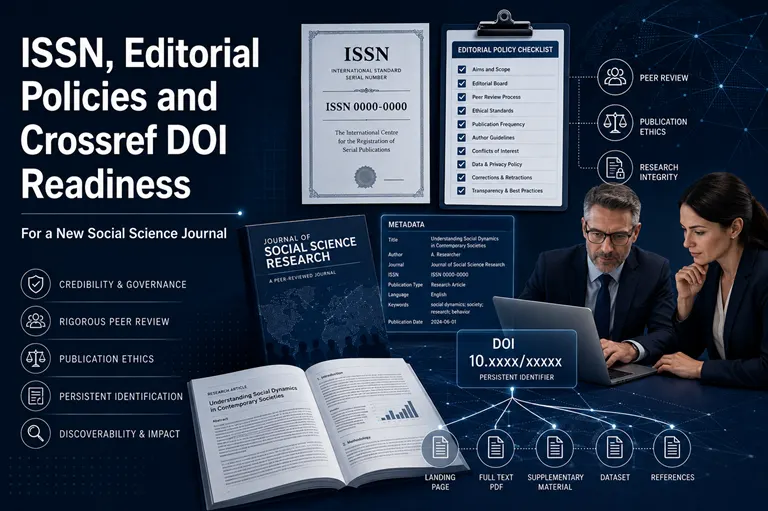
Three components are especially important during the launch process:
- ISSN readiness
- Editorial-policy readiness
- Crossref DOI and metadata readiness
These components are connected, but they serve different purposes.
An International Standard Serial Number identifies a continuing publication. Editorial policies explain how the journal evaluates research and protects scholarly integrity. A Crossref DOI identifies and links an individual scholarly work through structured metadata and a persistent landing page.
None of these components, by itself, guarantees journal quality or indexing. Together, however, they form an important part of the infrastructure required for responsible academic publishing.
For colleges, universities, research centres, scholarly associations and independent publishers launching a social science journal, preparing these systems correctly from the beginning can prevent delays, inconsistent records and expensive technical corrections later.
This guide explains how to make a new social science journal ready for ISSN review, ethical publishing and Crossref DOI registration.
Understanding ISSN, DOI and Editorial Policies
Publishers sometimes treat the ISSN, DOI and editorial policies as interchangeable signs of credibility. They are not interchangeable.
What is an ISSN?
An ISSN is an eight-digit identifier assigned to a serial or continuing publication, such as a journal. It identifies the journal title as a publication.
An ISSN does not:
- Approve the journal
- Certify peer-review quality
- Confirm indexing
- Establish an impact factor
- Guarantee academic integrity
- Provide copyright ownership
- Register individual articles
The ISSN National Centre for India clearly states that assigning an ISSN does not mean that the National Science Library or NIScPR has approved the journal or its contents. The official centre also confirms that ISSN assignment in India is free of charge. Applications are made through the ISSN National Centre, India.
What is a DOI?
A DOI is a persistent identifier for a particular digital or scholarly object. In journal publishing, DOIs are most commonly registered for individual articles.
A DOI helps:
- Identify an article persistently
- Connect the article with bibliographic metadata
- Support citation linking
- Direct users to the article’s current landing page
- Connect authors, institutions, funders and references
- Maintain access when the journal website changes
A DOI is not simply a number placed on a PDF. It must be registered with accurate metadata and linked to a maintained article landing page.
What are editorial policies?
Editorial policies are the public rules governing submission, review, authorship, ethics, publication, corrections, complaints and access.
They explain how the journal operates and what authors, editors, reviewers and readers can expect.
Policies are not merely documents created for an ISSN or indexing application. They must correspond to the journal’s actual editorial practice.
Why Readiness Must Begin before Publication
Many new journals begin by publishing a first issue and then attempt to organise the website, ISSN, policies and DOI records afterwards. This often produces inconsistencies.
Common problems include:
- Different journal titles on the website and PDFs
- Publisher names changing between pages
- Unclear or contradictory publication frequencies
- Editorial-board members listed without consent
- Missing author guidelines
- DOI strings displayed before registration
- Articles without individual landing pages
- Peer-review claims that are not supported by records
- Licensing statements that conflict with copyright forms
- ISSN applications submitted through an incomplete website
- Article metadata that does not match published files
A readiness-first approach reverses this sequence. The journal establishes its identity, policies, website structure and metadata workflow before or alongside publication.
Part One: Preparing a New Journal for ISSN
Confirm That the Publication Is a Continuing Resource
An ISSN is intended for a continuing publication issued over time without a predetermined conclusion.
A scholarly journal normally qualifies because it publishes successive issues or articles under a consistent title.
The journal should have a defined:
- Title
- Publisher
- Subject scope
- Publication frequency or continuing-publication model
- Editorial structure
- Website
- Long-term publication intention
A temporary conference booklet, one-time report or isolated collection of papers is not equivalent to a continuing journal.
Select and Verify the Journal Title
The journal title should be distinctive and stable.
Before approving it, search:
- ISSN Portal
- Google Scholar
- Crossref Metadata Search
- DOAJ
- University and publisher websites
- Major library catalogues
- General web search
- Domain availability
Avoid titles that:
- Closely imitate established publications
- Suggest an institutional association that does not exist
- Claim an international status without justification
- Are so broad that the journal has no recognisable identity
- Use abbreviations already associated with another journal
The title must remain consistent across the website, article PDFs, issue covers, policies, correspondence and application documents.
Title changes and ISSN consequences
An ISSN is connected to a particular journal title. A significant title change generally requires a new ISSN.
This makes early title verification important. Rebranding after publication may require changes to ISSN records, DOI metadata, website navigation, article citations and external catalogue records.
Identify the Responsible Publisher
The website and ISSN application should clearly identify the organisation responsible for the journal.
The publisher may be:
- A university
- A college
- A research institution
- An academic society
- A registered educational trust
- An independent scholarly publisher
- A university press
The publisher’s identity should include:
- Official name
- Postal address
- Country
- Publisher website
- Responsible person
- Institutional email address
- Telephone number
- Relationship to the journal
The publisher should control or have stable authority over the journal’s domain, files, archives and editorial records.
Distinguish Print and Online Versions
A journal available in both print and online formats may require separate ISSNs for each medium.
Publishers should use the correct terminology:
- p-ISSN: ISSN assigned to the print version
- e-ISSN: ISSN assigned to the online version
Do not display an invented or pending number as an ISSN. Until assignment is confirmed, use a transparent statement such as “e-ISSN application in process” only when an application has genuinely been submitted.
Once assigned, the ISSN should be displayed prominently:
- On the journal homepage
- In the website header or journal-information section
- On issue covers
- On article PDFs
- On the About page
- In citation and metadata records
Build an ISSN-Ready Journal Website
An ISSN application for an online journal should be supported by a functioning website that establishes the publication’s identity.
The website should contain:
- Final journal title
- Journal logo
- Publisher name and address
- Aims and scope
- Editorial-board details
- Publication frequency
- Language of publication
- Author guidelines
- Peer-review description
- Publication-ethics policies
- Copyright and licensing terms
- Contact information
- Current or sample published content as required
- Volume and issue information
- Stable website domain
The applicable ISSN centre may request specific documents or published content. Publishers should follow the current official instructions instead of relying on old checklists or third-party promises.
Prepare the First Issue Correctly
The first issue should demonstrate that the publication is operating as a scholarly journal.
Each article should display:
- Journal title
- Article title
- Author names
- Affiliations
- Abstract
- Keywords
- Volume and issue
- Publication date
- Page range or article number
- Copyright information
- Licence information
- References
- Publisher information
- ISSN, if already assigned
If the online ISSN process requires published issues or articles, the content should be live, complete and accessible.
The journal should not publish placeholder articles, incomplete PDFs or artificial issue records merely to support an application.
Applying for ISSN in India
Indian publishers should apply through the official ISSN National Centre at CSIR-NIScPR.
The official centre states that:
- ISSN assignment is free
- Applications must be made online
- It does not have agents or brokers
- Assignment does not mean journal approval
This distinction is important for institutions using professional consulting services. A consultant may help prepare the journal website, documents and application information, but the ISSN itself is assigned by the official National Centre without an assignment fee.
Role of ISSN consulting
OJSCloud can provide ISSN-readiness and application-support consulting by helping institutions:
- Review the journal title
- Check website completeness
- Standardise publisher information
- Identify missing editorial pages
- Review issue and article presentation
- Check consistency across the website and PDFs
- Organise application information
- Understand official procedural requirements
- Respond to requests for corrections or clarification
OJSCloud cannot guarantee ISSN assignment or represent itself as the official ISSN authority. The final decision remains with the ISSN National Centre.
Need help preparing your journal for ISSN review?
OJSCloud can assist with:
- Journal website-readiness assessment
- Journal-title and publisher-information checks
- Editorial-policy preparation
- Issue and article-page readiness
- Application-document organisation
- Website consistency review
- New journal launch consulting
- ScholarJMS or OJS website setup
WhatsApp: +91 82003 85143
Email: inquiry@ojscloud.comISSN assignment in India is free and is decided exclusively by the official ISSN National Centre.
Common Reasons a Journal May Not Be ISSN-Ready
An application may require clarification or further preparation when:
- The journal title resembles another publication
- The website is incomplete
- Publisher information is missing
- The journal has no visible scholarly content
- The publication does not appear to be continuing
- Articles lack dates, volumes or issue details
- Editorial-board information is unverifiable
- Website and PDF titles do not match
- The publication appears to be a one-time collection
- The application contains inconsistent information
- Contact information is not credible
- The journal’s institutional relationship is unclear
The objective should not be to submit the application as quickly as possible. It should be to make the publication genuinely ready.
Part Two: Editorial Policies for a Social Science Journal
Why Editorial Policies Matter
Policies establish the journal’s scholarly and ethical framework. They help editors make consistent decisions and help authors understand their responsibilities.
The Principles of Transparency and Best Practice in Scholarly Publishing identify important areas such as authorship, complaints, conflicts of interest, peer review, data sharing, ethical oversight and post-publication correction.
A new social science journal should prepare these policies before opening submissions.
Aims and Scope Policy
The aims and scope should explain:
- The journal’s scholarly purpose
- Disciplines covered
- Appropriate research topics
- Accepted methodologies
- Types of manuscripts
- Intended audience
- Geographical or thematic focus
- Language of publication
A broad social science journal may cover sociology, economics, political science, public policy, education, psychology, cultural studies, gender studies and interdisciplinary social enquiry. However, the scope should still have a coherent academic identity.
Author Guidelines
Author guidelines should provide practical manuscript instructions, including:
- Accepted article types
- Word limits
- Manuscript structure
- Citation and reference style
- Formatting
- Tables and figures
- Abstract length
- Keyword requirements
- File formats
- Anonymisation requirements
- Supplementary files
- Submission declarations
- Ethics-approval requirements
- Data-availability statement
- Funding disclosure
- AI-use disclosure
- Copyright and licence information
Guidelines should match the fields and files requested by the online submission system.
Authorship and Contributorship Policy
The policy should explain who qualifies as an author and how other contributions should be acknowledged.
Authors should generally have made a meaningful scholarly contribution, participated in drafting or revising the work, approved the final version and accepted accountability for it.
The policy should address:
- Author order
- Corresponding-author responsibilities
- Changes to authorship
- Guest authorship
- Ghost authorship
- Group authorship
- Contributor acknowledgements
- Authorship disputes
COPE provides resources for managing authorship and contributorship.
Peer-Review Policy
The website should state:
- Review model
- Number or expected number of reviewers
- Initial screening procedure
- Reviewer-selection process
- Conflict-of-interest requirements
- Review criteria
- Revision procedure
- Final decision authority
- Confidentiality requirements
- Review process for special issues
- Review process for editor-authored submissions
A journal should not advertise double-anonymous review if author identities remain visible in manuscript files or metadata sent to reviewers.
Transparent review with Scholar9
Scholar9 can support transparent peer review and a broader research-trust ecosystem when this model is appropriate for the journal.
Transparent review may involve publishing review reports, identifying reviewers with consent or recording verified review contributions. The exact model should be defined clearly before implementation.
Research Ethics and Human-Participant Policy
Social science research often involves:
- Interviews
- Surveys
- Focus groups
- Classroom observation
- Community research
- Personal narratives
- Vulnerable participants
- Social-media content
- Sensitive demographic data
- Administrative records
The journal should require authors to explain:
- Whether ethics approval was obtained
- Which body provided approval
- How informed consent was managed
- How confidentiality was protected
- Whether participants can be identified
- How sensitive data were stored
- How risk to participants was minimised
Ethics requirements should reflect the type of research and applicable institutional or legal standards.
Conflict-of-Interest Policy
Authors, reviewers and editors should disclose relationships that may affect, or reasonably appear to affect, judgement.
Conflicts may involve:
- Financial interests
- Employment relationships
- Personal relationships
- Academic competition
- Recent collaboration
- Political or organisational affiliation
- Intellectual commitments
- Institutional disputes
Disclosure does not automatically invalidate a submission or review. It allows the editor to assess and manage the situation transparently.
Plagiarism and Originality Policy
The policy should explain how the journal handles:
- Direct plagiarism
- Inadequate paraphrasing
- Duplicate publication
- Redundant publication
- Undisclosed text reuse
- Fabricated citations
- Manipulated data
- Translated duplication
Similarity-checking software should support editorial assessment, not replace it. A similarity percentage alone cannot determine misconduct.
The journal should avoid promising a single automatic rejection threshold without considering the source and nature of matching content.
Generative AI Policy
A journal launched in 2026 should publish a clear policy on artificial intelligence.
The policy should state that:
- AI tools cannot be credited as authors
- Authors remain responsible for all content
- Material AI assistance should be disclosed
- AI-generated citations must be verified
- Confidential manuscripts must not be uploaded into unauthorised AI tools
- Reviewers must protect manuscript confidentiality
- Editors must retain human responsibility for decisions
- Fabricated data or references are unacceptable
- AI-generated or manipulated images require disclosure and justification
The policy should be reviewed regularly as scholarly practice develops.
Data Availability and Research Transparency
A social science journal should encourage authors to explain whether supporting data are available.
The statement may indicate:
- Data are openly available
- Data are available on reasonable request
- Data cannot be shared because of confidentiality
- Data contain sensitive participant information
- Data belong to a third party
- No new data were created
- Access is restricted by ethics approval or law
Open-data expectations should not pressure researchers into disclosing sensitive interviews, identities or community information.
Copyright and Licensing Policy
The website should explain:
- Who owns copyright
- What publishing rights the journal receives
- Which licence applies
- Whether authors may deposit manuscripts elsewhere
- How readers may reuse content
- How third-party material should be handled
- Whether the journal permits commercial reuse
- Whether derivatives are permitted
The policy, copyright form, article PDF and website licence statement must agree.
Open-Access Policy
If the journal is open access, the policy should explain that readers can access published content without subscription or payment.
It should also state:
- Whether access is immediate
- Which licence is used
- Whether registration is required
- Whether authors retain copyright
- Whether article-processing charges apply
- How content will remain accessible
Do not claim open access while restricting the full text behind mandatory registration.
Publication-Charges Policy
The journal must state every possible author charge, including:
- Submission fee
- Article-processing charge
- Page charge
- Colour-figure charge
- Language-editing charge
- Print charge
- Withdrawal charge
If the journal has no charges, it should state: “The journal does not charge submission or publication fees.”
The timing, amount, refund conditions and waiver policy should be clear. Payment should never determine editorial acceptance.
Complaints and Appeals Policy
Authors should be able to appeal an editorial decision or complain about the journal’s process.
The policy should state:
- What can be appealed
- Where the appeal should be sent
- What information must be provided
- Who will evaluate the appeal
- How conflicts involving the Editor-in-Chief are handled
- Whether appeal decisions are final
- How complaints about published work are managed
An appeal should not simply return to the same decision-maker when the complaint concerns that person.
Corrections, Retractions and Expressions of Concern
The journal should explain how it will correct the scholarly record.
Possible actions include:
- Minor correction
- Formal correction notice
- Retraction
- Expression of concern
- Removal in exceptional legal or safety circumstances
Published notices should be linked clearly to the affected article. The original article should not normally disappear without explanation.
If a DOI has been registered, post-publication updates must also be reflected in the article landing page and relevant metadata.
Privacy and Confidentiality Policy
The journal collects personal data from authors, reviewers and editors. Its privacy policy should explain:
- Information collected
- Purpose of collection
- User access
- Storage and protection
- Retention
- Use of service providers
- Cookies or analytics
- Contact route for privacy questions
Unpublished manuscripts and reviewer reports must be treated as confidential.
Archiving and Preservation Policy
The journal should explain how published content will remain accessible if:
- The website is redesigned
- The platform changes
- The domain changes
- The journal stops publishing
- The publisher changes
- Technical failure occurs
At a minimum, the publisher should maintain regular backups of:
- Article files
- Issue files
- Website content
- Metadata
- DOI records
- Editorial records
- Reviewer reports
- Author agreements
Part Three: Crossref DOI Readiness
Determine Who Will Manage the Crossref Relationship
Organisations must be Crossref members, or work through an appropriate sponsored route, to register Crossref DOI records.
Crossref advises that membership should generally be held by the organisation responsible for the long-term stewardship of the content. For an institutional journal, this may be the university, college, society or publishing body rather than an individual editor.
Crossref membership allows an organisation to create and maintain metadata records for its scholarly content. It also creates continuing responsibilities.
Understand the DOI Structure
A DOI contains:
- A prefix assigned through the Crossref relationship
- A suffix created by the publisher
Example structure:
10.xxxx/ijse.2026.001
The suffix should follow a stable internal pattern. It does not need to contain every bibliographic detail.
Avoid including elements likely to change, such as:
- Current website domain
- Editor initials
- Indexing claims
- Publication-status words
- Unstable page numbers
Once registered, a DOI should not be reassigned to a different article.
Create a Unique Landing Page for Every Article
Crossref requires each registered content item to have its own maintained landing page.
The Crossref landing-page guidance states that a DOI should resolve to a unique page for that specific item.
The landing page should include:
- Article title
- Author names
- Affiliations
- Abstract
- Publication date
- Journal title
- Volume and issue
- Page range or article number
- DOI as a clickable full URL
- Citation information
- Licence
- Access to the full text
- Correction or retraction status, if applicable
The DOI should not normally resolve directly to a PDF because the landing page provides the bibliographic context and stable access route.
Prepare Complete Article Metadata
Crossref registration involves metadata, not only identifiers.
Important fields include:
- Journal title
- ISSN
- Publisher
- Article title
- Contributors
- ORCID identifiers
- Affiliations
- Abstract
- Publication date
- Volume
- Issue
- Page range or article number
- References
- Funding information
- Licence
- Article URL
- DOI
Metadata should match the published article exactly.
Title consistency is critical
When the first article for a journal is registered, the journal-title metadata should be entered carefully. Subsequent records should use the same title consistently.
Differences involving punctuation, abbreviations or title wording can create fragmented records.
Verify DOI Registration before Display
Creating a DOI string internally does not make it active.
The journal should:
- Prepare metadata.
- Create the landing page.
- Submit the DOI record.
- Review the registration result.
- Correct any errors.
- Test resolution through
https://doi.org/. - Display the DOI on the article page and PDF.
Crossref’s member-setup documentation reminds publishers to verify successful registration and display the DOI as a full clickable link.
Do not advertise a DOI until it resolves correctly.
Link Article References
Crossref members are expected to support reference linking. Where references have DOIs, the journal should include the persistent DOI links.
References should be checked for:
- Correct author names
- Accurate article titles
- Correct journal title
- Publication year
- Volume and issue
- Page range
- DOI accuracy
Reference metadata improves connections among scholarly works and strengthens discovery.
Maintain DOI Records after Publication
DOI responsibility does not end after registration.
The publisher must update records when:
- Article URLs change
- The journal moves to a new platform
- Author details are corrected
- Publication metadata are amended
- A correction is published
- A retraction is issued
- Licensing information changes
- The publisher restructures its website
A DOI remains the same when its destination URL changes. The Crossref record should be updated to point to the new landing page.
Plan DOI Continuity during Migration
When moving from OJS to ScholarJMS or another platform:
- Export existing DOI records
- Map old and new article URLs
- Preserve article metadata
- Create new landing pages
- Update DOI destination URLs
- Test every DOI
- Create redirects from old URLs where possible
- Verify issue and article files
- Avoid registering duplicate DOIs
OJSCloud can support OJS migration and technical preparation. ScholarJMS can provide the new publishing and workflow environment. GetDOI can assist with DOI metadata and resolution checks.
Crossref DOI Support through GetDOI
GetDOI can assist social science journals with:
- Crossref membership guidance
- Sponsored DOI routes where applicable
- DOI-prefix planning
- DOI-suffix structure
- Journal metadata preparation
- Article metadata review
- DOI registration workflow
- Landing-page integration
- Metadata corrections
- DOI migration support
Need Crossref DOI and metadata support?
GetDOI can help your journal with:
- Crossref membership or sponsorship guidance
- DOI-prefix and suffix planning
- Journal and article metadata preparation
- DOI registration and verification
- Article landing-page integration
- Reference and metadata workflow
- DOI correction and migration support
WhatsApp: +91 82003 85143
Email: inquiry@ojscloud.com
Part Four: Building the Complete Readiness Workflow
Use ScholarJMS for Integrated Publishing Management
ScholarJMS can bring the journal website, submission process, editorial workflow, peer review, article publication and metadata structure into one managed environment.
A properly configured ScholarJMS journal can support:
- Journal-branded website
- Policy and editorial pages
- Online manuscript submission
- Author accounts
- Editorial screening
- Reviewer assignment
- Revision tracking
- Decision recording
- Article-level publication
- Issue and archive management
- Metadata organisation
- DOI workflow support
- Search-friendly article pages
The system should be configured according to the journal’s approved policies and editorial roles.
Use OJSCloud for OJS and Launch Support
OJSCloud can support institutions that prefer OJS or have an existing OJS journal.
Services may include:
- New OJS installation
- Managed hosting
- Theme and design support
- Workflow configuration
- Version upgrades
- Security and backup support
- OJS migration
- ISSN consulting
- Publishing consultation
- OJS-to-ScholarJMS migration planning
The choice between OJS and ScholarJMS should be based on the institution’s technical capacity, workflow needs and long-term maintenance plan.
Use Scholar9 for Peer-Review Trust
Scholar9 can support transparent peer review and reviewer participation where the journal adopts a suitable model.
The journal should decide whether it uses:
- Anonymous review
- Open review
- Published review reports
- Named reviewer contributions
- A mixed transparency model
The published peer-review policy must match the actual process.
Journal-Readiness Checklist
Before applying for ISSN or registering the first DOI, verify the following.
Journal identity
- Final journal title
- Confirmed publisher
- Stable domain
- Publisher address
- Official contact details
- Defined publication frequency
- Consistent title across all locations
Editorial governance
- Appointed Editor-in-Chief
- Consenting editorial-board members
- Affiliations displayed
- Editorial roles documented
- Conflict procedures established
- External scholarly participation
Website pages
- About
- Aims and Scope
- Editorial Board
- Author Guidelines
- Peer Review
- Publication Ethics
- Charges
- Copyright
- Licensing
- Privacy
- Contact
- Current Issue
- Archive
- Submit Manuscript
Editorial policies
- Authorship
- Conflicts of interest
- Human-participant research
- Plagiarism
- AI use
- Data availability
- Complaints and appeals
- Corrections and retractions
- Withdrawal
- Special issues
- Archiving
Article publishing
- Unique article page
- Accurate author details
- Abstract and keywords
- Volume and issue
- Date
- Full text
- References
- Licence
- DOI field
- Citation information
DOI readiness
- Crossref member or sponsored route
- DOI-prefix access
- Suffix convention
- Complete metadata
- Permanent landing pages
- Registration-verification process
- Metadata-maintenance responsibility
Common Mistakes to Avoid
New social science journals should avoid:
- Claiming that an ISSN means approval
- Paying anyone for the official ISSN assignment itself in India
- Claiming guaranteed ISSN approval
- Using different titles on the website and PDFs
- Displaying a fabricated or unassigned ISSN
- Copying policies without adapting them
- Listing editors without consent
- Promising peer review without maintaining records
- Displaying DOI strings before registration
- Linking DOIs directly to unstable files
- Using incomplete article metadata
- Changing article URLs without updating DOI records
- Hiding publication charges
- Claiming indexing prematurely
- Publishing without correction and retraction procedures
- Depending on one individual for all journal access
- Treating the website as separate from the editorial workflow
Frequently Asked Questions
Is an ISSN mandatory before publishing a journal?
A journal can prepare its website and content before ISSN assignment. The timing and published-content requirements depend on the responsible ISSN National Centre and the publication format.
Is ISSN registration free in India?
Yes. The ISSN National Centre, India states that ISSN assignment is free. Professional consultants may charge for readiness, website or application-support services, but not for the official identifier itself.
Does an ISSN prove that a journal is peer reviewed?
No. An ISSN identifies a continuing publication. It does not certify peer review, academic quality or indexing.
Can OJSCloud guarantee an ISSN?
No. OJSCloud can provide consulting, website preparation and procedural guidance. Only the official ISSN National Centre can assign an ISSN.
What policies should a new social science journal publish?
At minimum, the journal should address aims and scope, author guidelines, peer review, authorship, conflicts of interest, plagiarism, human-participant research, AI use, copyright, licensing, charges, complaints, corrections, retractions, privacy and archiving.
Does every journal article require a DOI?
A DOI is not legally compulsory, but it is highly valuable for persistent identification, metadata, citation linking and scholarly discovery.
Can a journal create its own DOI?
The publisher creates the suffix, but the complete DOI becomes active only when registered through Crossref membership or an appropriate sponsored arrangement.
Is Crossref DOI registration the same as buying a number?
No. DOI registration creates and maintains a metadata record linked to a persistent landing page. It involves continuing publisher responsibilities.
Can GetDOI support a new journal?
GetDOI can assist with Crossref membership or sponsorship guidance, DOI planning, metadata preparation, registration workflow and record maintenance.
Where should a DOI link?
A journal-article DOI should resolve to a unique and maintained article landing page containing bibliographic information and access to the full text.
What happens to DOI links when a journal changes its website?
The DOI remains the same, but its registered destination URL must be updated. Old website URLs should also redirect to the new pages where possible.
Should print and online versions have the same ISSN?
Different media versions may require separate ISSNs. The publisher should follow the instructions of the relevant ISSN authority.
Can ScholarJMS manage ISSN and DOI-related website requirements?
ScholarJMS can provide the journal website, submission workflow, article landing pages and metadata structure. ISSN assignment and Crossref registration remain governed by their respective organisations.
Do ISSN and DOI guarantee indexing?
No. Indexing services apply their own evaluation criteria. ISSN and DOI infrastructure may support readiness, but they do not guarantee acceptance.
Conclusion
ISSN, editorial policies and Crossref DOI registration are three distinct but connected parts of professional journal publishing.
The ISSN establishes the identity of the continuing publication. Editorial policies establish the rules governing authorship, peer review, ethics and the scholarly record. Crossref DOI registration connects individual articles with persistent identifiers and structured metadata.
A new social science journal should prepare all three systems as part of one coordinated launch plan. The journal title, publisher, policies, website, article pages and metadata must remain consistent. Peer review must be genuine and documented. DOI records must be verified and maintained. ISSN claims must be accurate and must never imply official approval.
ScholarJMS can provide an integrated journal website, online submission and editorial workflow. OJSCloud can support OJS hosting, migration, journal launch and ISSN readiness. GetDOI can assist with Crossref DOI and metadata workflows, while Scholar9 can support transparent peer-review infrastructure.
Ready to prepare your social science journal for professional publication?
We can help with:
- ScholarJMS journal website setup
- Online manuscript submission and workflow
- OJS hosting, upgrade and migration
- OJS-to-ScholarJMS migration
- Editorial-policy development
- ISSN-readiness consulting
- Crossref DOI support through GetDOI
- Article metadata and landing-page setup
- Transparent peer review through Scholar9
- Complete journal launch guidance
WhatsApp: +91 82003 85143
Email: inquiry@ojscloud.com