
Emerging Social Science Research Trends in India in 2026: Society, Technology, Policy and Cultural Change
India in 2026 presents social scientists with a research environment shaped by rapid technological adoption, economic transition, demographic change, environmental pressure, cultural negotiation and evolving relationships between citizens and institutions. Artificial intelligence, digital public infrastructure, platform-based employment and data-driven governance are transforming everyday life, but these developments are unfolding within longstanding structures of caste, class, gender, language, region and unequal access to resources.
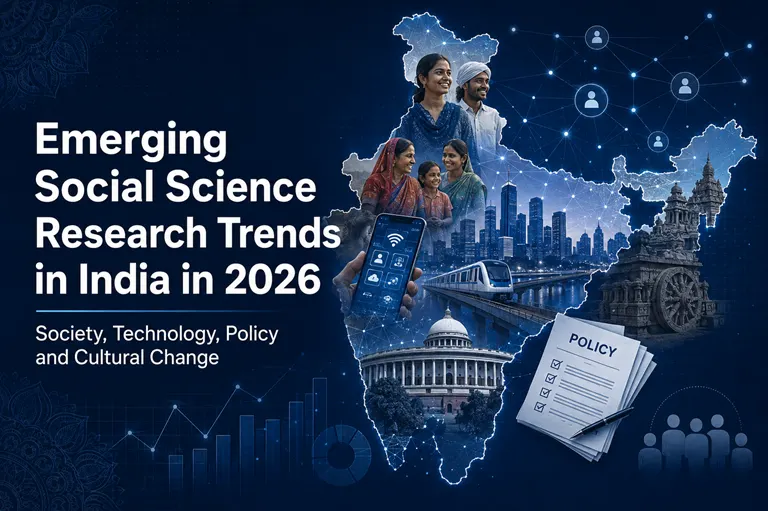
The result is not a simple movement from a traditional society to a digital one. India is experiencing several forms of change simultaneously. Rural communities are engaging with digital finance and online public services while remaining connected to local institutions and informal economies. Young people are participating in global digital culture while negotiating family expectations and regional identities. Workers are entering platform-based employment without necessarily receiving the security associated with conventional employment. Public institutions are adopting data and artificial intelligence while questions of accountability, privacy and inclusion remain central.
These conditions make social science research particularly important. Economic or technological indicators can show the scale of transformation, but they cannot fully explain how people understand change, how benefits and risks are distributed or how institutions respond to new social realities.
The Indian Journal of Social Enquiry provides an appropriate interdisciplinary space for examining these developments. Its social-science orientation allows researchers to connect sociology, economics, political science, psychology, education, cultural studies, gender studies, development studies, public administration and communication research.
The following research trends are likely to shape important social science scholarship in India during 2026 and beyond.
Artificial Intelligence as a Social Institution
Artificial intelligence is no longer relevant only to computer science or engineering. It is becoming embedded in workplaces, schools, financial services, media, public administration, healthcare support and consumer platforms. As AI systems influence decisions and distribute opportunities, they increasingly operate as social institutions.
India’s expanding AI ecosystem makes this a major research field. The IndiaAI Mission supports computing capacity, datasets, indigenous models, future skills, socially relevant applications, startup financing and safe and trusted AI. India’s national AI programme was approved with an outlay of ₹10,371.92 crore over five years, indicating the strategic importance attached to AI-led development.
The UNESCO India AI Readiness Assessment highlights India’s growing talent base, multilingual AI activity and evolving governance framework. At the same time, it reinforces the importance of ethical and human-centred development.
Moving beyond adoption statistics
Social science research must move beyond measuring how many people or organisations use AI. It should investigate:
- Who has access to effective AI tools
- Which languages and social groups are represented in training data
- How AI changes occupational roles and professional authority
- Whether automated decisions can be understood and challenged
- How responsibility is assigned when AI-assisted decisions cause harm
- Whether AI reduces inequality or reproduces it at a larger scale
Researchers can study AI through institutional case studies, worker interviews, classroom observation, algorithmic audits, policy analysis and participatory research with affected communities.
The central research question is not only what AI can do. It is what kind of social order AI systems are helping to create.
Digital Public Infrastructure and Citizen Experience
India’s digital public infrastructure has become central to identity, payments, documents, service delivery and economic participation. The 2026 DPI@2047 roadmap considers how digital infrastructure can expand beyond established applications into livelihoods, productivity and market access.
This expansion creates significant research opportunities. Digital systems may make services faster, more transparent and easier to scale. However, they can also introduce new forms of exclusion when interfaces are inaccessible, data are incorrect, authentication fails or citizens do not have meaningful alternatives.
Evaluating services from the citizen’s perspective
Research should examine digital public services through lived experience rather than relying only on transaction volumes. Important questions include:
- Can citizens understand and navigate the service independently?
- Are interfaces available in appropriate languages and accessible formats?
- What happens when authentication or data matching fails?
- Are offline alternatives available?
- How quickly are complaints resolved?
- Does digitisation reduce dependence on intermediaries, or create new intermediaries?
- How are women, older people, migrants and persons with disabilities affected?
Social enquiry can help ensure that technological efficiency is evaluated alongside procedural fairness, dignity and access to remedies.
Platform Labour, Informality and the Future of Work
Platform-based employment continues to reshape transport, food delivery, logistics, domestic services, retail, freelancing and creative work. It offers new income opportunities but also raises questions about employment classification, algorithmic management, income stability and social protection.
Platform workers may appear independent while having limited control over pricing, task allocation, incentive systems, customer ratings or account suspension. Their working conditions are frequently organised through applications rather than conventional managers.
NITI Aayog’s work on India’s gig and platform economy identifies the growing importance of the sector and the need for skills, social security and better evidence. Its later research on India’s services economy also calls attention to formalisation, fair pay, worker protection and grievance redressal.
New questions for labour research
Priority areas include:
- Real earnings after fuel, equipment and maintenance costs
- Working time, waiting time and unpaid digital labour
- Algorithmic control over tasks and incentives
- Occupational safety and access to insurance
- Worker ratings and account deactivation
- Gender and caste patterns in platform occupations
- Experiences of migrant and multilingual workers
- Collective representation and emerging worker associations
- Mental stress linked to targets, customer ratings and uncertainty
- Effects of AI and automation on entry-level employment
Researchers should avoid treating informal and platform workers only as beneficiaries of technology. Workers are active interpreters of digital systems who develop their own strategies, networks and forms of resistance.
Employment, Skills and the Quality of Economic Transition
Employment research in 2026 is increasingly concerned with the quality of work rather than employment numbers alone. Economic growth can coexist with insecure contracts, informal work, low wages, limited social protection and unequal opportunities for occupational advancement.
Automation and AI are also changing the meaning of skill. Workers may need to combine digital knowledge with communication, judgement, creativity and domain expertise. However, access to reskilling remains uneven.
From training participation to real outcomes
Researchers should examine:
- Whether training leads to employment or higher earnings
- Who can access advanced digital and AI skills
- How employers redesign jobs after adopting technology
- Whether productivity improvements benefit workers
- How entry-level jobs and career pathways are changing
- Whether skill programmes meet local labour-market needs
- How women and marginalised communities experience training systems
- What forms of skill recognition are accepted by employers
India’s skilling challenge cannot be understood only through the number of courses offered or candidates enrolled. Research must evaluate completion, learning quality, accessibility, job placement and long-term occupational mobility.
Digital Inequality beyond Internet Connectivity
India’s expanding internet access is changing education, commerce, employment and public participation. Yet the digital divide cannot be measured only by whether a person is connected.
A household may own one smartphone that is shared by several family members. A woman may have internet access but lack independent control over the device. A student may attend online classes through an unstable connection. A citizen may use entertainment applications confidently but struggle to complete an online government form.
Meaningful digital inclusion
Research must address several dimensions of digital inequality:
- Device ownership and control
- Affordability and reliability of connectivity
- Digital and media literacy
- Availability of regional-language content
- Accessibility for persons with disabilities
- Exposure to fraud, harassment and misinformation
- Ability to use digital services for education and employment
- Confidence in protecting personal information
- Availability of institutional or community assistance
The most useful studies will connect digital access to wider inequalities in education, household power, income, mobility and social status.
Caste, Class, Gender and Intersecting Inequalities
Technology does not remove social inequality automatically. Digital systems enter societies already structured by unequal access to education, capital, networks and institutional authority. As a result, old inequalities may be reproduced through new mechanisms.
A recruitment platform may appear neutral while relying on educational and employment histories shaped by social advantage. An automated credit system may use behavioural data that indirectly reflect class or regional differences. A generative AI system may perform better in dominant languages than in less represented languages and dialects.
Intersectionality as a research necessity
Researchers increasingly need to examine how multiple identities and disadvantages operate together. Gender cannot always be analysed separately from caste, class, region, religion, disability or age.
Priority questions include:
- How caste and class affect access to digital education and employment
- Whether AI systems produce different outcomes across social groups
- How gender shapes device ownership and online participation
- Experiences of marginalised communities in digital public systems
- Representation in technology design and leadership
- Online harassment targeting women and minority groups
- How social networks affect access to jobs and entrepreneurial opportunities
- Whether institutional grievance systems are equally accessible
Research must also avoid treating marginalised communities only as subjects of deprivation. Their agency, innovation, knowledge and collective action deserve equal scholarly attention.
Gender, Care Work and Changing Households
Gender research in India is expanding beyond labour-force participation to include unpaid care work, household decision-making, safety, migration, digital access, reproductive choices and the distribution of time.
Technology may create flexible employment and remote-work opportunities, but flexibility does not necessarily redistribute domestic responsibilities. Women working from home may experience the simultaneous pressure of paid employment, childcare and household management.
AI also creates new gender questions. UNESCO’s 2026 regional research on AI and gender in South Asia examines women’s participation in AI education, research, employment, entrepreneurship and leadership.
Emerging directions in gender research
- Gender gaps in AI education and digital skills
- Women’s participation in platform and remote work
- Online safety and technology-facilitated violence
- Representation of women in datasets and automated systems
- Unpaid care work and time poverty
- Changing family structures and household negotiations
- Financial technology and women’s economic autonomy
- Experiences of women entrepreneurs
- Gender-responsive public services
- Masculinity, mental health and changing expectations of men
Researchers should connect personal experiences with institutional structures rather than describing gender inequality only as an individual problem.
Urbanisation, Migration and Changing Communities
Urban growth is reshaping housing, transport, employment, family life and access to public services. India’s 2025 Voluntary National Review anticipates continuing large-scale urban migration, making the social organisation of cities an important research priority.
Migration should not be understood only as movement from villages to cities. India experiences circular migration, seasonal migration, movement between smaller towns and metropolitan regions, and digitally enabled work that changes the relationship between residence and employment.
Researching the changing urban landscape
Important topics include:
- Affordable housing and informal settlements
- Migrants’ access to documentation and welfare
- Commuting time and transport inequality
- Urban heat, pollution and health
- Gender and safety in public spaces
- Changing neighbourhood relationships
- Platform-based delivery and service economies
- Experiences of street vendors and informal workers
- Growth of smaller cities and peri-urban regions
- Digital surveillance and urban governance
Researchers should also examine how migrants maintain social, economic and cultural ties with their places of origin.
Rural Transformation beyond the Agriculture Narrative
Rural India is frequently discussed only through agriculture, but rural communities are increasingly connected to education, migration, digital platforms, non-farm employment, self-help groups, renewable energy and online marketplaces.
Young people in rural areas may pursue digital skills while remaining linked to family agriculture. Women may participate in collective enterprises or digital finance without experiencing an equal change in household decision-making. Rural producers may gain new market access but become dependent on platforms and logistics systems they do not control.
A broader rural research agenda
- Diversification into non-farm employment
- Rural youth aspirations and migration
- Digital marketplaces and producer bargaining power
- Women’s collectives and financial autonomy
- Access to online education and healthcare
- Climate adaptation in farming communities
- Rural entrepreneurship
- Changing caste relations and local institutions
- Energy transition and livelihood change
- Digital public-service delivery at the local level
Rural research must recognise diversity across regions and avoid presenting rural India as a single, unchanging category.
Climate Change, Social Vulnerability and Just Transition
Climate change is increasingly central to social research because its consequences are distributed through existing inequalities. Heat, drought, flooding, air pollution and environmental degradation affect livelihoods, migration, health, education and household security.
NITI Aayog’s 2026 work on Viksit Bharat and net zero identifies climate change as a risk to agriculture, infrastructure and public health. It also highlights the importance of inclusive growth during the transition to a lower-carbon economy.
Climate change as a social justice question
Research should investigate:
- Who is most exposed to climate hazards
- Which households can afford adaptation
- Effects of extreme heat on informal workers
- Climate-related migration and displacement
- Gendered burdens of water and fuel insecurity
- Effects of renewable-energy projects on local communities
- Employment transitions in carbon-intensive sectors
- Public participation in environmental decision-making
- Indigenous and local environmental knowledge
- Distribution of benefits from green investment
A just transition requires more than replacing one energy source with another. It must consider employment, land, community participation, affordability and regional inequality.
Youth, Education and Changing Aspirations
India’s young population is often presented as a demographic advantage. Whether this potential is realised depends on educational quality, employment opportunities, social mobility and confidence in institutions.
Young people’s aspirations are increasingly shaped by online culture, global employment narratives, competitive examinations, creator economies and visible examples of entrepreneurial success. These aspirations may exceed the opportunities available within local labour markets.
Research priorities concerning youth
- Transition from education to employment
- Mental health and examination pressure
- Use of AI in learning and assessment
- Student migration and regional inequality
- Career expectations and employment insecurity
- Political and civic participation
- Influence of social media on identity and consumption
- Creator work and digital entrepreneurship
- Changing attitudes towards family and marriage
- Youth participation in community and environmental action
Researchers should study young people as social actors who negotiate institutional constraints rather than merely as future workers.
Education, AI and Academic Integrity
Generative AI has created new questions for schools, colleges and universities. Students use AI for explanation, translation, writing, coding and examination preparation. Teachers use it for lesson planning, assessment and administration.
The challenge is not simply to allow or prohibit these tools. Educational institutions must determine which uses support learning and which undermine independent thinking, authorship or fairness.
Research priorities include:
- Differences in access to high-quality AI tools
- AI literacy among students and teachers
- Reliability of AI-generated educational content
- Effects on writing and critical reasoning
- Regional-language learning support
- New forms of assessment
- Automated proctoring and student privacy
- Institutional disclosure policies
- Teacher autonomy and workload
- Understanding of academic integrity
Universities should consider assessments that value reasoning, evidence, reflection, process and oral explanation rather than relying entirely on conventional written submissions.
Data Protection, Surveillance and Digital Rights
Digital participation generates extensive personal information. Educational platforms, workplaces, financial services, social media, connected devices and government systems may all collect behavioural data.
India’s Digital Personal Data Protection framework has made data governance a central policy issue. Social scientists should now examine how privacy, consent and accountability operate in practice.
Priority questions include:
- Whether users understand consent notices
- Accessibility of notices across languages and literacy levels
- Data practices affecting children
- Workplace monitoring and employee autonomy
- Use of biometric and behavioural information
- Public awareness of grievance mechanisms
- Experiences of communities exposed to profiling
- Public trust in digital institutions
Privacy should not be treated only as a legal or technical matter. It is also shaped by social relationships, power and the practical ability to refuse data collection.
Misinformation, Media Trust and Democratic Communication
Digital platforms have expanded access to information and public expression, but they have also transformed the speed and structure of misinformation. Generative AI makes it easier to create synthetic text, audio, images and video at scale.
Research must explore why people trust and share particular information. Credibility is influenced by family networks, political identity, language, religious community, local leaders and trusted online creators.
Emerging media-research questions
- How misinformation travels through private messaging groups
- Public recognition of AI-generated media
- Political communication in regional languages
- Online harassment and silencing
- Influence of recommendation systems
- Role of local creators and influencers
- Effectiveness and limitations of fact-checking
- Relationship between online content and offline action
- Trust in journalists, institutions and digital platforms
- Community-led responses to misinformation
Research should also examine constructive uses of digital media, including citizen reporting, emergency communication, public-interest campaigns and mutual-aid networks.
Language, Identity and Cultural Change
India’s linguistic diversity is central to its digital future. Translation tools, speech recognition and multilingual AI can expand access to education, services and knowledge. At the same time, poorly represented languages may receive inaccurate or culturally inappropriate outputs.
UNESCO’s work on India’s AI readiness notes the importance of linguistic inclusion and initiatives such as Bhashini. However, language should not be approached only as a technical problem. Language carries identity, history, humour, hierarchy and cultural memory.
Research opportunities include:
- Quality of digital services across Indian languages
- Representation of dialects and oral traditions
- Cultural assumptions embedded in AI output
- Effects of automated translation on meaning
- Digital preservation of regional knowledge
- Ownership of language datasets
- Online revival or decline of minority languages
- Globalisation of popular culture
- Hybrid cultural identities among young people
- Changing consumption of film, music and literature
Cultural change does not necessarily mean cultural disappearance. Communities often adapt technologies to preserve, reinterpret and circulate their traditions.
Mental Health, Digital Life and Social Relationships
Digital life affects attention, self-image, friendship, family relationships, intimacy and emotional well-being. Social media may create community and support while also intensifying comparison, harassment and pressure to remain constantly visible.
A useful research approach should move beyond screen-time measurements. The effects of digital participation depend on what people do online, why they do it and what social support they have offline.
Priority areas include:
- Social media and adolescent well-being
- Online loneliness and digital companionship
- Workplace connectivity and burnout
- Harassment and emotional safety
- Creator work and algorithmic pressure
- Digital support communities
- Online mental-health information
- Use of AI companions or advice systems
- Family negotiation of children’s digital use
- Digital exclusion and isolation among older people
Researchers should avoid assuming that technology produces identical psychological effects across all users.
Public Policy Implementation and Institutional Trust
Policy research is increasingly moving beyond formal policy design towards implementation, frontline institutions and citizen experience. A policy may be technically sound but produce uneven outcomes because of administrative capacity, documentation barriers or weak grievance mechanisms.
In 2026, researchers should pay greater attention to:
- Differences between policy intention and local implementation
- Experiences of frontline public servants
- Citizen understanding of eligibility and entitlements
- Administrative burden placed on beneficiaries
- Grievance redressal
- Coordination between levels of government
- Role of local institutions and civil society
- Public trust in data-driven governance
- Regional variation in programme outcomes
- Use of evidence in policy revision
Policy research becomes more socially valuable when it identifies not only whether a programme works, but for whom, under what conditions and why.
Methodological Trends in Indian Social Science Research
The complexity of current social change requires stronger methodological integration. Surveys and interviews remain essential, but researchers are increasingly combining them with digital ethnography, administrative data, geospatial analysis, platform analysis, participatory research and computational methods.
Mixed-methods research
Mixed methods allow researchers to connect broad patterns with lived experience. Quantitative evidence may reveal unequal access to a service, while qualitative interviews can explain how the inequality is produced.
Longitudinal research
Many effects of AI, digital employment, migration or climate adaptation emerge over time. Longitudinal designs can distinguish temporary responses from lasting social transformation.
Comparative regional research
India’s diversity means findings from one city or state cannot automatically be generalised nationally. Comparative research can reveal how institutions, cultures and economic conditions shape outcomes differently.
Participatory research
Communities should not always be treated only as sources of data. Participatory methods can involve workers, students, women’s groups, rural producers or marginalised communities in defining questions and interpreting findings.
Responsible computational research
Digital traces, platform data and AI-assisted analysis can expand research possibilities, but researchers must consider consent, privacy, representativeness and interpretive limits. Information that is publicly visible online is not automatically ethically unrestricted.
Strengthening Research Quality and Public Relevance
Emerging topics alone do not guarantee valuable scholarship. High-quality social research requires clear questions, appropriate methods, ethical safeguards and transparent reporting.
Researchers should:
- Define concepts carefully
- Avoid unsupported national generalisations
- Explain sampling and methodological limitations
- Distinguish evidence from interpretation
- Include regional and linguistic context
- Protect participant confidentiality
- Verify AI-generated research assistance
- Report negative or unexpected findings
- Connect conclusions directly to evidence
- Communicate findings beyond academic audiences where appropriate
Institutions and journals also have a responsibility to support transparent peer review, research integrity and accessible dissemination.
Frequently Asked Questions
What are the leading social science research trends in India in 2026?
Major trends include AI and society, digital public infrastructure, platform labour, digital inequality, intersecting social inequalities, climate vulnerability, urbanisation, youth aspirations, multilingual technology, data rights and policy implementation.
Why is artificial intelligence now a social science topic?
AI affects employment, education, media, public services and access to opportunities. Its outcomes depend on institutional decisions, data quality and existing social inequalities, making it an important subject for sociology, economics, politics, psychology and public policy.
Which social research topics are especially relevant to India?
Research on caste, class, gender, informality, migration, rural transformation, regional inequality, multilingualism, digital governance and climate vulnerability is particularly important within the Indian context.
What is interdisciplinary social enquiry?
Interdisciplinary social enquiry combines theories or methods from more than one discipline to understand complex social problems. For example, platform labour can be studied through sociology, economics, law, psychology and technology policy.
How can researchers study digital inequality?
Researchers should examine device ownership, affordability, connection quality, language, accessibility, digital skills, online safety and the ability to use digital services effectively.
Why is platform labour an important research area?
Platform labour creates new income opportunities but raises questions about algorithmic control, income stability, worker classification, occupational safety, grievance redressal and social protection.
How is climate change connected to social science?
Climate change affects employment, migration, health, housing, food security and access to resources. These effects are shaped by social inequality and therefore require social, economic and policy analysis.
Which research methods are suitable for emerging social trends?
Mixed methods, digital ethnography, longitudinal studies, comparative regional research, participatory research, surveys, interviews and responsible computational analysis can all be useful, depending on the research question.
Can interdisciplinary research be submitted to IJSE?
Research examining Indian society through sociological, economic, political, psychological, educational, cultural or policy perspectives is aligned with IJSE’s interdisciplinary social-science orientation. Authors should review the journal’s current aims, scope and submission guidelines before submitting.
Conclusion
Social science research in India in 2026 is being shaped by the interaction of technological innovation, institutional change and persistent social inequality. Artificial intelligence, digital public infrastructure and platform economies are creating new opportunities, but their effects cannot be understood separately from caste, class, gender, language, geography, employment status and access to education.
At the same time, urbanisation, migration, climate vulnerability, changing family structures and new forms of cultural expression are expanding the social research agenda. Scholars must move beyond isolated descriptions of change and investigate how different transformations interact.
The most valuable research will be empirically grounded, methodologically transparent and attentive to regional diversity. It will include the voices of communities affected by policy and technology, examine both benefits and risks, and connect academic analysis with questions of dignity, justice and public accountability.
The Indian Journal of Social Enquiry can strengthen its scholarly authority by encouraging rigorous research across these emerging areas. Through interdisciplinary dialogue and evidence-based analysis, the journal can contribute to a deeper understanding of Indian society during a period of significant transformation.
Editors, colleges and scholarly institutions planning to establish or modernise a social science journal can seek support for ScholarJMS journal websites and editorial workflows, OJSCloud hosting, migration and ISSN-readiness consulting, GetDOI Crossref DOI workflow guidance, and Scholar9 transparent peer-review infrastructure. Contact inquiry@ojscloud.com or WhatsApp +91 82003 85143.