Current Issue
Volume 18, Issue 2 - 2026 (June 2026)
Issue Details:
Volume 18 Issue 2 (June 2026)Editor-in-Chief
Editor
Articles in This Issue
 Open Access
Editorial v18 n2
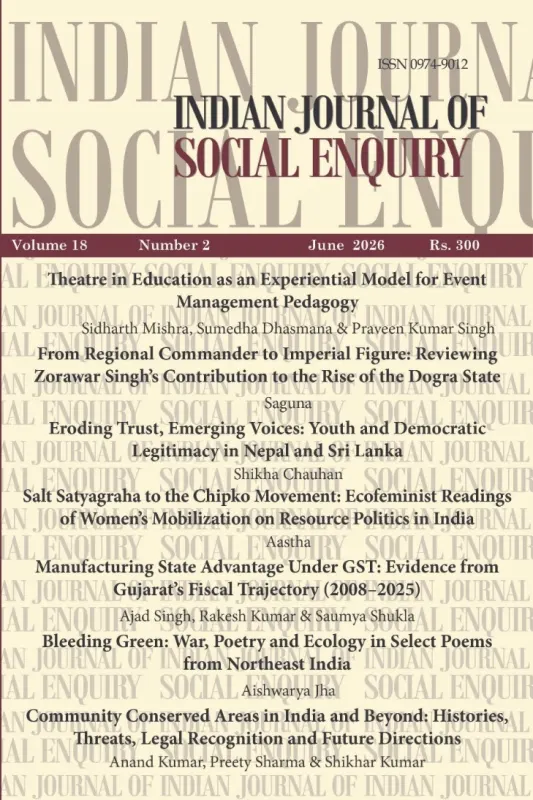
This editorial examines the expanding influence of artificial intelligence on contemporary social, professional, cultural, and environmental life. It considers both the opportunities and risks associated with the rapid development and normalization of AI, with particular attention to human connection, critical thinking, artistic expression, employment, algorithmic bias, discrimination, and environmental sustainability. The discussion highlights concerns surrounding dependence on personalized AI systems, the reproduction of biases through data driven algorithms, the growing resource demands of data centres, and the changing nature of employment in an increasingly technology driven economy. Alongside these contemporary concerns, the issue of the Indian Journal of Social Enquiry presents a diverse collection of scholarly contributions addressing education, history, democracy, gender, environmental movements, public finance, literature, ecology, and community based conservation. The featured studies examine theatre based education, the historical contribution of Zorawar Singh, democratic legitimacy among youth in Nepal and Sri Lanka, ecofeminist interpretations of Indian environmental movements, the fiscal impact of GST in Gujarat, poetry and ecological conflict in Northeast India, and community conserved areas. Collectively, the issue encourages critical social enquiry by connecting contemporary challenges with historical experiences and emerging perspectives on progress, development, citizenship, culture, and sustainability.
Contributors:
Open AccessTheatre in Education as an Experiential Model for Event Management Pedagogy
Event Management is the process of planning, marketing, producing, analysing and evaluating an event. It is a crucial part of the course curriculum for the students of Journalism and Mass Communication at various colleges and universities. In 2021,Vivekananda School of Journalism and Mass Communication (VSJMC), Vivekananda Institute of Professional Studies - Technical Campus, brought an innovative pedagogical intervention in the teaching of Event Management. It integrated Theatre in Education (TiE) with Event Management curriculum. TiE is the structured use of theatrical performance and participatory drama strategies and nurtures emotional, cognitive, emotional, and social learning. In the last five years, VSJMC implemented this pedagogical experiment and created five prominent theatre productions. This paper brings forth the enhanced learning outcomes which were possible through the application of TiE in Event Management pedagogy.
Contributors:
Open AccessFrom Regional Commander to Imperial Figure: Reviewing Zorawar Singh’s Contribution to the Rise of the Dogra State
This review article summarises the literature on the role of Zorawar Singh in the development of the Dogra State in its military strategies, political influence, historical impact, and regional politics in order to fill gaps in the context of his multifaceted contribution to state formation in the Himalayas of the 19th century. The purpose of the review was to examine the knowledge of his military strategies, political impact, historical impacts, regional politics, and socialpolitical changes. The interdisciplinary studies that used archival research and historiographical critique were systematically analysed to incorporate the military, political, and socio-cultural viewpoints. Results have shown that the novel high-altitude military operations of Zorawar Singh played a central role in the expansion of the territory despite logistics problems; his political destiny, which was mainly military, helped him internalize Dogra and define its relationship with the neighbouring states and Britain. This review highlights the importance of military, political, and social analysis to understand the influence of Zorawar Singh on Himalayan geopolitics and contributes to modern discussions about state formation in the region and the politics of the border.
Contributors:
Open AccessEroding Trust, Emerging Voices: Youth and Democratic Legitimacy in Nepal and Sri Lanka
This paper delves into the trajectory of democracy in Nepal and Sri Lanka which represent two distinct yet converging stories of political transformation in South Asia. While Nepal’s journey has been defined by a transition from monarchy to a federal democratic republic, Sri Lanka’s post-independence experience reflects a long-standing electoral democracy grappling with majoritarian politics, economic crises, and institutional stress. Despite their differing historical paths, both countries today face a common challenge: the erosion of democratic trust, particularly among younger citizens. Increasing corruption and mismanagement of public funds, the wide age gap between the rising Gen Z and ageing political leaders and the ensuing gap in aspirations, amongst other glaring problems has led to a trust deficit. The paper posits a multi-dimensional approach through civic and democratic engagement with Gen Z in both countries for a synergic renewal.
Contributors:
Open AccessSalt Satyagraha to the Chipko Movement: Ecofeminist Readings of Women’s Mobilization on Resource Politics in India
Ecofeminism, a significant development in the field of Political theory since the 1970s, offers a fresh and unique vantage point for re-evaluating certain events in the colonial past of India and offers a premise on which the engagement of women with politics can be increased. This paper seeks to retrospectively examine the Salt Satyagraha of 1930 as not just an anti-colonial movement but also as a nascent ecofeminist assertion as it involved large-scale female participation to resist capitalist patriarchy encapsulated by colonialism and its tendency of privatization and monopolization of natural resources like salt. The Salt Satyagraha has then been compared and contrasted with the Chipko Movement of 1973 to bring forth their shared ecofeminist underpinnings and key divergences. Finally, this paper makes a case for revisiting the ideals of ecofeminism for increasing the participation of Indian women in the political processes, particularly by positioning women as natural advocates and leaders for fair resource management and challenging the cultural barriers that inhibit women’s political agency.
Contributors:
Open AccessManufacturing State Advantage Under GST: Evidence from Gujarat’s Fiscal Trajectory (2008–2025)
This paper examines the examines the fiscal impact of Goods and Services Tax (GST) in Gujarat which is a strong base of manufacturing activities. The paper covers the time period from 2008–09 to 2024–25 and uses an Interrupted Time Series model with Newey-West HAC standard errors. The paper finds evidence of persistent but moderate fiscal deceleration post-GST. During the study period, revenue growth decelerated by 4.0 percentage points annually and expenditure by 3.2 points. Chow test confirms structural breaks for both revenue and expenditure. Though the revenue CAGR had declined from 13.94% preGST to 9.29% post-GST, SGST achieved remarkable 18.05% CAGR compared to pre-GST Sales Tax at 13.51%. A decline in fiscal Autonomy Index was also registered during the study period from 66.1% to 60.3%, which can be attributed to increased transfer dependence from the centre. Developmental expenditure share had remained stable, while the interest burden declined from 17.9% to 15.5%. Revenue buoyancy improved from 1.01 to 1.22, the highest among major states. Findings reveal a manufacturing state paradox: destination-based GST created initial revenue losses requiring large compensation, yet improved buoyancy. It suggests long-term SGST potential exceeds pre-GST Sales Tax/ VAT performance.
Contributors:
Open AccessBleeding Green: War, Poetry and Ecology in Select Poems from Northeast India
Peter Nicholls’s essay ‘Wars I have Seen’ explores the mediation of war through the medium of poetry, visuals and technology, comments on its ramification and the alteration in the perception of war in the popular imagination. By extrapolating salient themes from the essay, specifically, the interrelation of visuality and violence and the adoption of poetry as the mode of creative expression and representation in a conflict-ridden landscape, this paper will reread poetry from the Northeast of India. Studies have undertaken an eco-critical reading of the poetry from the Northeast of India given the immersiveness of the poets in the ecosphere, while others have critiqued the representation of armed conflict in the region. Keeping this in mind, the current study would extend the ecocritical approach to include the effects, if any, of the militant clashes in the region on the biosphere and investigate its presence and representation in the poetry from the Northast.
Contributors:
Open AccessCommunity Conserved Areas in India and Beyond: Histories, Threats, Legal Recognition and Future Directions
Community Conserved Areas (CCAs) represent one of the oldest forms of ecosystem governance, particularly among Indigenous Peoples and Local Communities (IPLCs). In India, CCAs are closely linked to the livelihoods, culture, and traditional practices of Scheduled Tribes (STs), yet remain underrecognized within formal conservation frameworks. This study examines the relationship between CCA extent and ecological, socio-economic, and governance outcomes using a mixed-methods approach that combines a literature review and district-level analysis from Nagaland and Maharashtra. The findings identify an “Efficiency Paradox”, where larger conservation areas do not necessarily translate into improved ecological or development outcomes. The study proposes policy directions, including hybrid governance models, strengthening of community rights under existing legal frameworks, and integration of livelihood-based conservation strategies. It argues that effective conservation in India must be community-driven, context-specific, and rooted in indigenous knowledge systems.