
Published
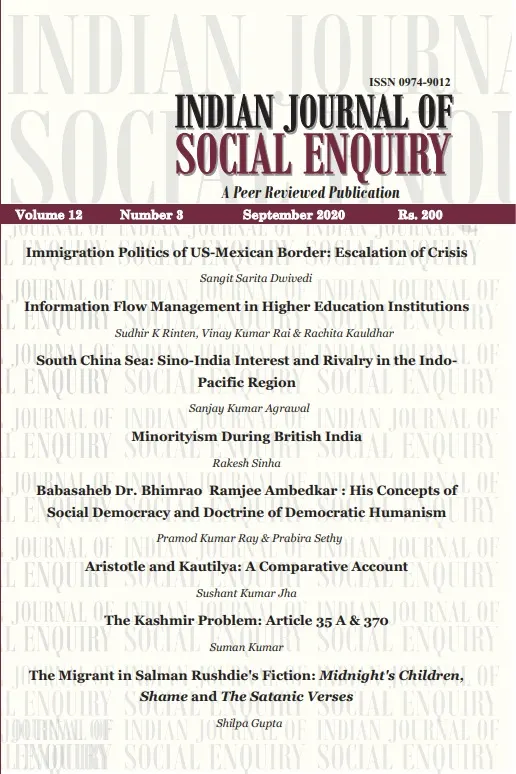
The Kashmir Problem: Article 35 A & 370
Published in Sept. 2020 (Vol. 12, Issue 3, 2020)
Abstract
The state of Jammu and Kashmir, ruled by Maharaja Hari Singh at the time of
independence of India, finally acceded to India when the area was attacked by
Pakistani rangers. The Hindu ruler of the state wanted to remain independent
but under the contemporary situation the state had to merge with India.
However, the two opposite political poles were having different aims. One was
of the then ruler Maharaja Hari Singh and another was of Sheikh Abdullah. The
fate of the state was to be decided by these two streams. Finally, agreements
were concluded, Article 370 and Article 35 A were added in the Constitution of
India. In fact, these two were added without approval of the Parliament but
through Presidential orders. The Delhi Agreement was also an important
milestone in this journey. The powers of the Government of India and the
supremacy of the Constitution of India cannot have the same force in the state
because it framed its own Constitution. The accession will be complete only
after the repealing these two provisions of the Constitution of India.
Authors (1)
Suman Kumar
Department of Political Scienc...Department of Political Science, Rajdhani College...Department of Political Science, Rajdhani College, University of Delh...Department of Political Science, Rajdhani College, University of Delhi
View all publications →Download Article
Article Information
Published in:
Sept. 2020 (Vol. 12, Issue 3, 2020)Article Impact
Views:21
Downloads:19
How to Cite
Kumar, S. (2020). The Kashmir Problem: Article 35 A & 370. Indian Journal of Social Enquiry, 12(3), 79-90. https://macijse.org/articles/IJSE3120007
Article Actions
More from this Issue
More by These Authors
Theorizing indigeneity & Indigenous Feminism Reflected in the Narratives of Easterine Kire
2025 • Vol. 17, Issue 1
Read more →The Printed Word, Polemics and Debate in Northern India up to 1860s
2021 • Vol. 13, Issue 1
Read more →