

editor_ijse@mac.du.ac.in
9818679187
e-ISSN: applied
Indian Journal of Social Enquiry

Indian Journal of Social Enquiry

Volume 12, Issue 3 - 2020 (Sept. 2020)

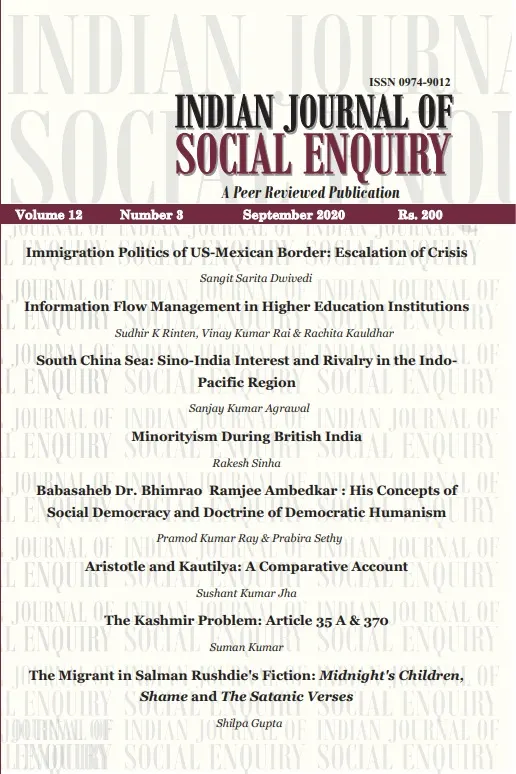
Volume 12 Issue 3 Cover

Issue Details:

Volume 12 Issue 3
Published:Sep 2, 2026

Editorial: Sept. 2020

Welcome to the 2020 issue of Indian Journal of Social Enquiry. This issue showcases the remarkable breadth and depth of contemporary research across multiple disciplines. From cutting-edge applications of machine learning in climate science to the revolutionary potential of quantum computing in drug discovery, our featured articles demonstrate the power of interdisciplinary collaboration in addressing global challenges.

We are particularly excited to present research that bridges traditional academic boundaries, reflecting our journal's commitment to fostering innovation through cross-disciplinary dialogue. The integration of artificial intelligence with environmental science, the application of blockchain technology to supply chain management, and the convergence of urban planning with smart city technologies exemplify the transformative potential of collaborative research.

As we continue to navigate an era of rapid technological advancement and global challenges, the research presented in this issue offers both insights and solutions that will shape our future. We thank our authors, reviewers, and editorial board members for their continued dedication to advancing knowledge and promoting scientific excellence.

Prof Gitanjali Chawla
Editor in Chief
Indian Journal of Social Enquiry

Articles in This Issue

Showing 8 of 8 articles
Research PaperID: IJSE3120001Pages 7-21Open AccessOpen Access

Immigration Politics of US-Mexican Border: Escalation of Crisis

Sangit Sarita Dwivedi

This paper seeks to evaluate contemporary trends of international migration using Mexico-US migration as a case study. It intends to capture the true diversity of migrants from Mexico and their evolving migration patterns over time. After evaluating it conceptually, the paper will analyze whether a country should have more open or more closed borders. Both US and Mexico understand the need for control and so the discussion will be on how much control. It will also focus on why people participated in protests against migration laws and what are the effects of these events. Thus, the empirical study will analyze the emergence and obstacles of social movement in order to better understand the immigrant rights movement highlighting the importance of protest intensity in influencing political attitudes as well as the relationship between protests and public opinion on immigration policy in the current scenario.

MigrationMigration LawsImmigrant RightsImmigration PolicyUSAMexico
2 views
1 downloads

Contributors:

 Sangit Sarita Dwivedi
Research PaperID: IJSE3120002Pages 22-33Open AccessOpen Access

Information Flow Management in Higher Education Institutions

Sudhir K Rinten

In this information age, information literacy and its management has gained importance with the rapidly changing technological environment and proliferation of information resources. Information literacy and its management became significant for students, academicians, and professionals involved in Higher Education especially in terms of need, access and preservation. Information in the higher education system is available through libraries, community resources, and internet along with various other resources in a much unfiltered form. This research paper provides an insight of 'Probability', 'Expertise', 'Efficiency' and 'Accountability' of information management in Higher Education Institutions in order to 'Identify', 'Classify' & 'Rectify' the information. Further this paper examines the flow of information at different levels and the importance of information literacy for information management in Higher Education Institutions (HEIs).

Information ManagementInformation LiteracyHigher Education InstitutesTechnology
2 views
1 downloads

Contributors:

 Sudhir K Rinten
Research PaperID: IJSE3120003Pages 34-47Open AccessOpen Access

South China Sea: Sino-India Interest and Rivalry in the Indo-Pacific Region

Sanjay Kumar Agrawal

The South China Sea region caters as a political and economic life preserver for the coastal region. It also has important strategic implications and base ground for coastal states to project their specific legitimate claims over oceanic resources. The narrative established by the post-cold war is of a unipolar world leaning highly towards hegemonic American interests, which turned out in rising of various geopolitical powers, those of India, China, and South-East Asian countries like, Laos, Thailand and Cambodia. The rise of stakes of these countries in international relations is not just a by-product of American policies but also the product of their individual sovereign endeavours e.g. the rise of Asian tigers is a testimony to this fact. After the liberalisation policies of China and India in 1970s and 1990s respectively, the growth of South-East Asian Nations accelerated in world trade and geopolitics making the Malacca strait and South China Sea (SCS) as strategic rallying point for the powerful contenders of the region. This paper highlights how due to growing energy demands globally and its economic exploitation leads to the rise of the chances of strife among the surrounding coastal nations. The surrounding region is the main navigation route of heavily transported and largely populated area of South Asia and South East Asia. All these factors accumulated in the hegemonic interest of China were overtly protected by its cheque book diplomacy (financing Hambantota port-Sri Lanka, Gwadar port-Pakistan, One Belt, One Road strategy) to protect its economic and strategic national interests. Presence of America in Japan and South Korea is seen as a counter balancing force for China, however post 2008 subprime crises that gave economic shocks to America created economic gap in aiding these countries to tackle China. Hence it became the pivot to America's Asia Strategy to tackle China by combining efforts of contending nations of Indo-Pacific region (Japan, India, Australia, New Zealand)-the Quad to offer a united front against China. Further various issues pertaining to South China Sea dispute and challenges in the Indian Ocean region is dealt with. It also pertains to Chinese assertion on Indian Ocean under the garb of protecting it from piracy and oil spill disaster is frequently creating its rivalry with India; its military base in Djibouti is another reason for IndoChinese rivalry, which has its roots in India's interest in South China Sea, which is the main topic of discussion here. The paper also covers South China Sea in India's 'Act East Policy' as how India's long-standing Look East Policy is transformed into more assertive Act East Policy in the region.

South China seaChina-Pakistan Economic CorridorIndoPacificThe 1982 United Nations Convention on the Law of the Sea (UNCLOS)One Belt-One RoadString of Pearl Strategy+3 more
2 views
1 downloads

Contributors:

 Sanjay Kumar Agrawal
Research PaperID: IJSE3120004Pages 48-57Open AccessOpen Access

Minorityism During British India

Rakesh Sinha

The politics of minorityism in India was an outcome of the British design especially thought for saving the reign of British empire. Lord Mayo, a Viceroy and W.W. Hunter, an ICS in India, were prime contributors in this deliberate and nefarious policy. The Wahabi movement among Muslims was also seen by Mayo as a threat to the Empire. The movement advocated and practiced radicalisation of Muslims and was considered an immediate danger to the political stability and civil society. Therefore, the apologists of the Empire wanted to pacify Muslims on the one hand and divert the anger of Muslims from the Empire. This was laborious and was done by inventing the majorityminority dictum and by inventing a new definition of secularism. This colonial imposed theoretical conceptualisation of secularism was perpetuated not only during the colonial period but also in the post-colonial India. This paper looks into the reasons why secularism in India faces both conceptual and empirical crisis.

MinorityismBritish IndiaMuslimsColonial Rule
2 views
1 downloads

Contributors:

 Rakesh Sinha
Research PaperID: IJSE3120005Pages 58-70Open AccessOpen Access

Babasaheb Dr. Bhimrao Ramjee Ambedkar : His Concepts of Social Democracy and Doctrine of Democratic Humanism

Pramod Kumar Ray

Babasaheb Dr. Bhimrao Ramjee Ambedkar is one of the greatest political thinkers and social revolutionaries that modern India has ever produced. He was the foremost exponent and expounder of social democracy based on basic human values and freedom, liberty, equality and human dignity. He considered the institution of caste system as the greatest social evil and a major stumbling block in the path of a cohesive national psyche obstructing an inclusive and emancipated society which can only be possible by complete annihilation of caste. He waged a relentless struggle against the then prevailing dehumanised social orderin India where a vast multitude of people belonging to the depressed communities were treated less than humans and sub humans for which he wanted to abolish the worthless birth graded status and its functions. Being the chief architect of the democratic Constitution of independent India, he inculcated in it the basic values such as the sovereign equality of every individual, self-respect, human dignity and reclamation of human personality. Keeping this in mind, this papermakes an honest and earnest endeavour to foreground his concept of democratic humanism as the guiding principle in achieving the goal of social democracy as a necessary precondition to political democracy.

Democratic humanismSocial democracyAutochtonAboriginalsBrahminical social orderSocial exclusion+4 more
2 views
1 downloads

Contributors:

 Pramod Kumar Ray
Research PaperID: IJSE3120006Pages 71-78Open AccessOpen Access

Aristotle and Kautilya A Comparative Account

Sushant Kumar Jha

The study of politics in a systematized way sprawls in the historic treatises of both Kautilya and Aristotle. The universal appeal in the ideas presented by both, labels them as political marvels, keeping the significance of contextual truths of society. Aristotle and Kautilya teach us the values of self-fulfilment and self-achievement. This paper is a humble attempt to widen the canvas of comparative study of both astutepolitical philosophers, teachers and mentors. The present zest of political inquiry to the comparative study between both would have far-reaching implications to the body of knowledge. Both, Politics of Aristotle and Arthashastra of Kautilya are the seminal contributions to the study of politics.

GreekSlaverySaptanga TheoryRajamandalaMatsya NyayaIdeal State+4 more
2 views
1 downloads

Contributors:

 Sushant Kumar Jha
Research PaperID: IJSE3120007Pages 79-90Open AccessOpen Access

The Kashmir Problem: Article 35 A & 370

Suman Kumar

The state of Jammu and Kashmir, ruled by Maharaja Hari Singh at the time of independence of India, finally acceded to India when the area was attacked by Pakistani rangers. The Hindu ruler of the state wanted to remain independent but under the contemporary situation the state had to merge with India. However, the two opposite political poles were having different aims. One was of the then ruler Maharaja Hari Singh and another was of Sheikh Abdullah. The fate of the state was to be decided by these two streams. Finally, agreements were concluded, Article 370 and Article 35 A were added in the Constitution of India. In fact, these two were added without approval of the Parliament but through Presidential orders. The Delhi Agreement was also an important milestone in this journey. The powers of the Government of India and the supremacy of the Constitution of India cannot have the same force in the state because it framed its own Constitution. The accession will be complete only after the repealing these two provisions of the Constitution of India.

DograsConstitutionDelhi AgreementArticle 370Article 35 AAccession+1 more
2 views
1 downloads

Contributors:

 Suman Kumar
Research PaperID: IJSE3120008Pages 91-111Open AccessOpen Access

The Migrant in Salman Rushdie's Fiction Midnight's Children, Shame and The Satanic Verses

Shilpa Gupta

Salman Rushdie has always been concerned with giving a voice to the voiceless, by giving the power of description to the disenfranchised, the migrant, i.e. a personage who is often central in his narratives. This paper looks at three of Rushdie's most important works, Midnight's Children, Shame and The Satanic Verses, (which draw heavily on the theme of migration) not only by examining his life, but also through a critical analysis of his deliberate attempt to write in a particular yet distinct kind of manner and language; the themes of "double identity", "divided selves" and the "shadow figures" in the three novels by him.

MigrantsIdentityDisplacementHybridityLanguage
2 views
1 downloads

Contributors:

 Shilpa Gupta
Whatsapp