
Published
Editorial v10 n3
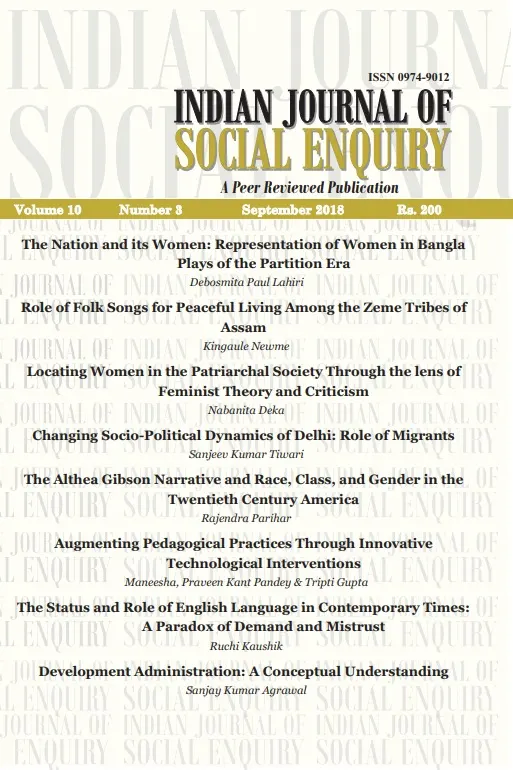
Published in Sept. 2018 (Vol. 10, Issue 3, 2018)
Keywords
Abstract
Indigenous literature and cultural practices have emerged as important areas of contemporary research, offering valuable insights into identity, community, history, knowledge systems, and human behaviour. This article examines the significance of indigenous storytelling as an oral and dynamic cultural practice through which beliefs, memories, values, and social experiences are transmitted across generations. It highlights how indigenous narratives function as sociological and cultural archives that connect individuals, communities, and broader social structures while maintaining links between the past, present, and future. The transition from oral traditions to written documentation, particularly during the colonial period in India, also raises concerns regarding cultural misrepresentation, appropriation, marginalisation, and the loss of indigenous agency. Although early folklorists produced valuable records, their interpretations were often influenced by limited understanding of indigenous languages and cultures. Later scholarship contributed to restoring greater recognition of indigenous voices and narratives. The article argues for a methodological shift in the study of indigenous cultures, moving beyond rigid external theoretical frameworks toward interdisciplinary and transdisciplinary approaches that recognize cultural diversity, oral memory, ritual, religion, and community knowledge. Meaningful engagement with indigenous communities is essential for developing nuanced interpretations and safeguarding cultural heritage. Strengthening institutional support, research initiatives, and dedicated programmes in folklore and indigenous studies can further promote the preservation and scholarly understanding of indigenous literatures and cultural practices.
Authors (1)
Gitanjali Chawla
List of ContributorsList of ContributorsList of ContributorsList of Contributors
View all publications →Download Article
Article Information
Published in:
Sept. 2018 (Vol. 10, Issue 3, 2018)Article Impact
Views:34
Downloads:24
How to Cite
Chawla, G. (2026). Editorial v10 n3. Indian Journal of Social Enquiry, 10(3), 1-3. https://macijse.org/articles/IJSE3100092