
Published
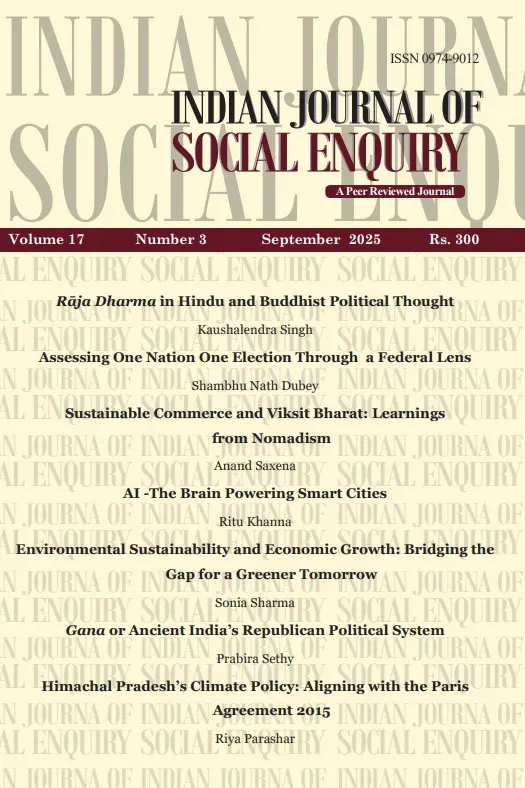
Editorial v17 n3
,
Published in September 2025 (Vol. 17, Issue 3, 2025)
Keywords
Sustainable DevelopmentSustainabilityIndian Knowledge SystemsTraditional KnowledgeEnvironmental EthicsVasudhaiva KutumbakamEnvironmental AwarenessSustainable LivingNational Education Policy 2020Value Based EducationEnvironmental ConservationSocial JusticeIntergenerational EquityIndian CultureEducation for Sustainable Development
Abstract
Sustainable development has emerged as a central concern in global policy, emphasizing the need to balance economic growth, environmental protection, social justice, and intergenerational equity. This article examines sustainability from the perspective of Indian cultural traditions and knowledge systems, highlighting the principles of Dharma, Karma, Satya, Seva, and Vasudhaiva Kutumbakam as ethical foundations for responsible and inclusive living. Traditional Indian practices reflected an awareness of the interconnectedness between human beings, society, and nature through nature worship, resource conservation, recycling, Ayurveda, Yoga, and environmentally responsive practices. However, rapid economic development, resource depletion, pollution, and changing lifestyles have increasingly weakened these traditional approaches to environmental responsibility. The article discusses contemporary governmental initiatives aimed at addressing environmental challenges and emphasizes that policy interventions alone cannot achieve sustainable development without corresponding changes in public attitudes and everyday practices. Education and awareness are identified as important mechanisms for reviving traditional values and integrating sustainability into contemporary life. Particular attention is given to the National Education Policy 2020, which promotes environmental awareness and sustainable development through curriculum, experiential learning, field activities, and value based education. The article argues that integrating traditional ecological wisdom with modern educational approaches can encourage responsible citizenship, environmental sensitivity, social inclusion, and sustainable lifestyles. Embedding these principles from early education through higher education can contribute to developing individuals capable of balancing development with environmental and social wellbeing.
Authors (2)
Gitanjali Chawla
List of ContributorsList of ContributorsList of ContributorsList of Contributors
View all publications →Deepa Sharma
List of ContributorsList of ContributorsList of ContributorsList of Contributors
View all publications →Download Article
Article Information
Published in:
September 2025 (Vol. 17, Issue 3, 2025)Article Impact
Views:16
Downloads:16
How to Cite
Chawla, G., & Sharma, D. (2025). Editorial v17 n3. Indian Journal of Social Enquiry, 17(3), 1-4. https://macijse.org/articles/IJSE3170097