

editor_ijse@mac.du.ac.in
9818679187
e-ISSN: applied
Indian Journal of Social Enquiry

Indian Journal of Social Enquiry

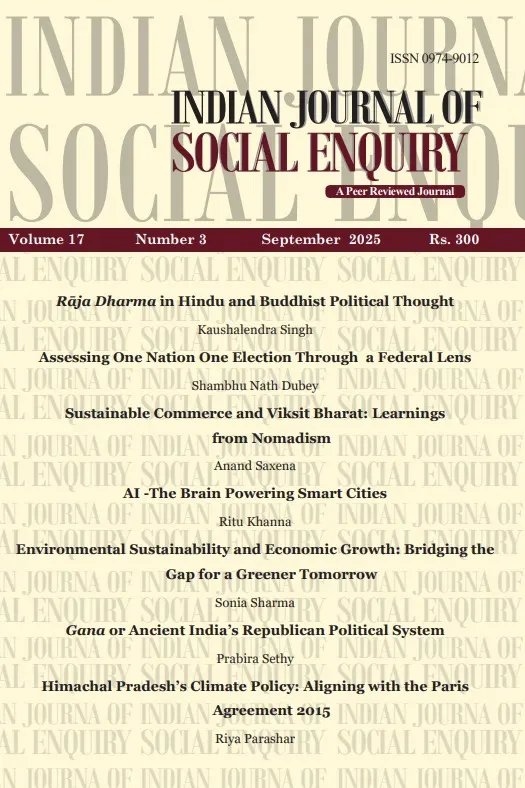
Volume 17, Issue 3 - 2025 (September 2025)

Volume 17 Issue 3 Cover

Issue Details:

Volume 17 Issue 3
Published:Sep 3, 2026

Editorial: September 2025

Welcome to the 2025 issue of Indian Journal of Social Enquiry. This issue showcases the remarkable breadth and depth of contemporary research across multiple disciplines. From cutting-edge applications of machine learning in climate science to the revolutionary potential of quantum computing in drug discovery, our featured articles demonstrate the power of interdisciplinary collaboration in addressing global challenges.

We are particularly excited to present research that bridges traditional academic boundaries, reflecting our journal's commitment to fostering innovation through cross-disciplinary dialogue. The integration of artificial intelligence with environmental science, the application of blockchain technology to supply chain management, and the convergence of urban planning with smart city technologies exemplify the transformative potential of collaborative research.

As we continue to navigate an era of rapid technological advancement and global challenges, the research presented in this issue offers both insights and solutions that will shape our future. We thank our authors, reviewers, and editorial board members for their continued dedication to advancing knowledge and promoting scientific excellence.

Prof Gitanjali Chawla
Editor in Chief
Indian Journal of Social Enquiry

Articles in This Issue

Showing 7 of 7 articles
Research PaperID: IJSE3170001Pages 7-20Open AccessOpen Access

Rāja Dharma in Hindu and Buddhist Political Thought

Kaushalendra Singh

This paper examines the foundational principles of governance in Hindu and Buddhist traditions, as exemplified by Rāja Dharma and the doctrine of ethical kingship, which converge on shared ideals of righteousness, compassion, and service to society. In Hindu political philosophy, Rāja Dharma delineates the sovereign’s sacred obligation to uphold justice, safeguard moral and cosmic order, and ensure the material and spiritual welfare of the populace. It envisions the ruler as both a protector and a moral exemplar, harmonising political authority with dharmic responsibility. The paper also foregrounds Buddhist political thought which conversely advances a vision of leadership grounded in selflessness, non-violence, and ethical restraint. The Dasa Rāja-Dhamma prescribes ten royal virtues that guide rulers in fostering harmony, equity, and collective well-being without succumbing to ego or tyranny. Both traditions advocate pluralism, tolerance, and the respectful coexistence of diverse religious and cultural identities. Though emerging from distinct metaphysical frameworks, Hindu and Buddhist models of governance offer a unified ethical paradigm that remains relevant for contemporary discourses on leadership and justice. These systems demonstrate that moral legitimacy, rather than coercive power, constitutes the true foundation of enduring and inclusive governance.

Rāja DharmaDasa Rāja-DhammaEthical governanceHindu political thoughtBuddhist political philosophyPluralism
2 views
1 downloads

Contributors:

 Kaushalendra Singh
Research PaperID: IJSE3170002Pages 21-36Open AccessOpen Access

Assessing One Nation One Election Through a Federal Lens

Shambhu Nath Dubey

The recent endorsement by the Government of India of the High-Level Committee’s recommendations, chaired by former President Shri Ram Nath Kovind, to implement synchronised elections has reignited scholarly and political discourse around the feasibility and implications of the One Nation, One Election (ONOE) model. This article undertakes a critical examination of the ONOE proposition by contextualising it within India’s constitutional framework and electoral history. It explores both domestic precedents and global analogues of synchronised elections while analysing insights from various expert committees. The inquiry further delves into the practical, administrative, and normative dimensions of ONOE, interrogating whether such a model strengthens democratic efficiency or threatens the federal equilibrium that underpins India’s pluralist polity. Additionally, it investigates whether ONOE can meaningfully engage with the socio-political cleavages that characterise Indian electoral behaviour—marked by regional diversity, caste affiliations, linguistic identities, and the multiplicity of party systems. In doing so, the article questions whether ONOE signifies a transformative leap toward the government’s envisioned ‘Amrit Kaal’, or whether it portends centralisation at the cost of democratic decentralism.

Simultaneous ElectionsReformsONOEFederal Democracy
2 views
1 downloads

Contributors:

 Shambhu Nath Dubey
Research PaperID: IJSE3170003Pages 37-53Open AccessOpen Access

Sustainable Commerce and Viksit Bharat: Learnings from Nomadism

Anand Saxena

The research question the paper addresses is: could a rear view into India’s nomadic economy of the past have implications for the articulation and realisation of the vision of India’s future, Vision Viksit Bharat (VVB) via sustainable commerce? The research question assumes inevitability as reference to, if not reliance upon, ancient wisdom and traditional knowledge (AWTK) as integral to addressing contemporary issues. In this context, even its flip version, would there be a place for nomadic communities - of pastoralists, hunter-gatherers and peripatetic groups - in Viksit Bharat is an equally pertinent question. The paper delves into the learnings from the nomadic commerce and economics of the past to understand potential connections with our common future. In a broader context, the paper explores the resurgence of interest in the social, environmental, and economic aspects of nomadism, as evident in initiatives such as the World Initiative for Sustainable Pastoralism (WISP). The paper vehemently makes a case for active protection of nomadism wherever it exists and also focuses on discerning and extending the economic and environmental contributions of nomadism of the past for an economy, polity and society of the future. In the process, the paper identifies several linkages and pathways to leveraging nomadic wisdom of the past for India’s future as reflected in the Vision Viksit Bharat.

NomadismSustainable CommerceSustainable DevelopmentVision Viksit Bharat
2 views
1 downloads

Contributors:

 Anand Saxena
Research PaperID: IJSE3170004Pages 54-70Open AccessOpen Access

AI: The Brain-Powering Smart Cities

Ritu Khanna

Artificial Intelligence (AI) describes systems that can replicate human thought processes, including learning, reasoning, and making decisions. These abilities are driven by sophisticated algorithms, data analysis, and the recognition of patterns. The development of AI has been sometimes compared to the invention of electricity since it has as diverse applications as the usage of electricity. It can be used across multiple sectors of the economy including agriculture, healthcare, manufacturing, urban transport, disaster management, education, policy making, cyber-security, governance, energy solutions, and supply chain management. Artificial intelligence enhances predictive analytics, enabling improved planning and immediate interaction with citizens, contributing to more inclusive governance. It can also boost the operational efficiency of managing large systems. In India, the AI-enabled digital public-infrastructure platforms like Aadhaar, Digiyatra, UPI, and DigiLocker have revolutionised governance. This paper explores the various initiatives adopted by the state governments in India to use AI technology to develop and transform Indian cities into smart cities. The paper also seeks to examine the opportunities that AI offers as well as the challenges that the governments must address for successful integration of AI into the designing of these cities. The government needs to play the balancing act between innovation and ethical concerns.

Artificial intelligenceSmart cities indexSmart cities missionTechnologyData securityEthics
2 views
1 downloads

Contributors:

 Ritu Khanna
Research PaperID: IJSE3170005Pages 71-85Open AccessOpen Access

Environmental Sustainability and Economic Growth: Bridging the Gap for a Greener Tomorrow

Sonia Sharma

This study explores the connection between economic growth and corporate social responsibility towards the environment, focusing on how leading Indian companies are integrating sustainability into their business model. Environmental sustainability and economic growth are considered as contradicting and hard to achieve together. But with the rise of green corporate strategies and environmental sustainability policies these goals are increasingly attainable. This paper seeks to examine sustainable business practices which focus both on financial success as well as ecological well-being and to evaluate the role of government policies as well as the contribution of companies and the society in sustainable economic growth. By examining real world examples, this paper highlights the importance of corporate leadership in achieving economic growth which is more in sync with a sustainable environment. The findings suggest that the growth of an economy should not be achieved at the cost of the environment, rather, innovative corporate strategies and policies can bridge the gap between financial success and sustainability, paving the way for a greener and more robust and vital future.

Environmental sustainabilityEconomic growthCorporate Social ResponsibilityFinancial successGovernment policies
2 views
1 downloads

Contributors:

 Sonia Sharma
Research PaperID: IJSE3170006Pages 86-101Open AccessOpen Access

Gana or Ancient India’s Republican Political System

Prabira Sethy

The present paper is an attempt to analyze the republicanism prevalent in ancient India which was one of the foundational stones of the ancient Indian state and how it has disproved the occidental views about ancient Indian political system which mainly rested on the notion of ‘oriental despotism’. Secondly, it explores how the Jain works, Greek authors’ works, Panini, literature on Buddhism, coins, literary evidence, etc. bear an important testimony to the existence of republics in ancient India. Thirdly, the paper has given a glimpse about different ancient republics which were recorded in the Buddhist literature and in epics like Mahabharata. Fourth, it has also highlighted the key characteristics of ancient Indian Ganas or republics which were ingrained in Hindu politics. Finally, the paper has made assessments and delineated the causes of the decline of ancient Indian republics from Hindu India.

GanaSanghaAcharangasutraNyaya VyavasthaShanti ParvaVargya+1 more
2 views
1 downloads

Contributors:

 Prabira Sethy
Research PaperID: IJSE3170007Pages 102-118Open AccessOpen Access

Himachal Pradesh’s Climate Policy: Aligning with the Paris Agreement 2015

Riya Parashar

The combined impact of over-population, misuse of natural resources and unsustainable farming practices has made the Himalayan ecosystem fragile. Climate change has led to increase in temperature affecting the weather-cycle with abrupt rainfall patterns, the delayed winter and the harsher summer. The variations brought upon by climate change in Himachal Pradesh is of particular significance as the economy of the state relies heavily on agriculture, horticulture and forestry. All these sectors are facing the consequences of climate change, putting the economy and people of the state in a flux. Himachal Pradesh has frequently experienced natural disasters such as floods, droughts and cloud bursts which has led to biodiversity loss and lower harvest resulting into poverty and deprivation. Nearly 63% of the workforce in the state relies on agriculture or horticulture for their livelihoods, making rural communities especially vulnerable to extreme weather events. The article delves into key initiatives, schemes, and policies undertaken by the Himachal Pradesh government, particularly since 2010, to address climate change and promote sustainable living. It also critically examines and evaluates the extent to which these policies align with the objectives of the Paris Agreement within the broader framework of the Sustainable Development Goals.

Climate ChangeGlobal WarmingEnvironmentParis Agreement and Kyoto Protocol
2 views
1 downloads

Contributors:

 Riya Parashar
Whatsapp