
Published
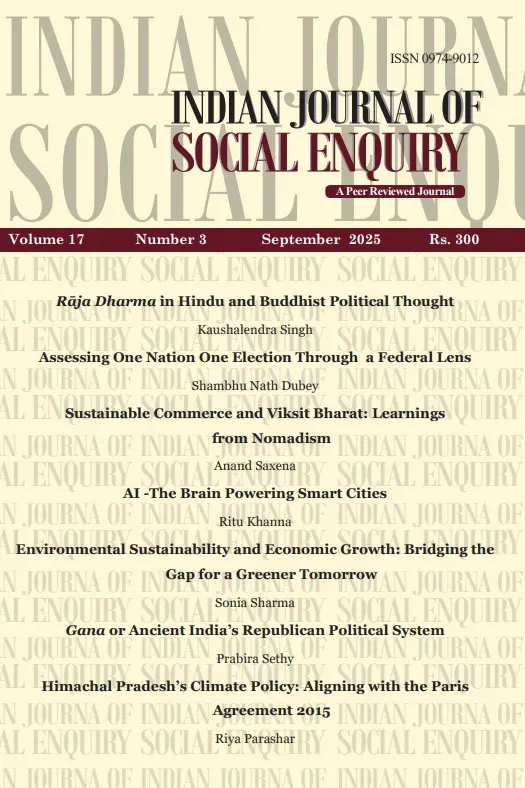
Assessing One Nation One Election Through a Federal Lens
Published in September 2025 (Vol. 17, Issue 3, 2025)
Abstract
The recent endorsement by the Government of India of the High-Level
Committee’s recommendations, chaired by former President Shri Ram Nath
Kovind, to implement synchronised elections has reignited scholarly and
political discourse around the feasibility and implications of the One Nation,
One Election (ONOE) model. This article undertakes a critical examination
of the ONOE proposition by contextualising it within India’s constitutional
framework and electoral history. It explores both domestic precedents and
global analogues of synchronised elections while analysing insights from
various expert committees. The inquiry further delves into the practical,
administrative, and normative dimensions of ONOE, interrogating whether
such a model strengthens democratic efficiency or threatens the federal
equilibrium that underpins India’s pluralist polity. Additionally, it investigates
whether ONOE can meaningfully engage with the socio-political cleavages that
characterise Indian electoral behaviour—marked by regional diversity, caste
affiliations, linguistic identities, and the multiplicity of party systems. In doing
so, the article questions whether ONOE signifies a transformative leap toward
the government’s envisioned ‘Amrit Kaal’, or whether it portends centralisation
at the cost of democratic decentralism.
Authors (1)
Shambhu Nath Dubey
Department of Political Scien...Department of Political Science, ARSD College, Un...Department of Political Science, ARSD College, University of DelhiDepartment of Political Science, ARSD College, University of Delhi
View all publications →Download Article
Article Information
Published in:
September 2025 (Vol. 17, Issue 3, 2025)Article Impact
Views:23
Downloads:30
How to Cite
Nath Dubey, S. (2025). Assessing One Nation One Election Through a Federal Lens. Indian Journal of Social Enquiry, 17(3), 21-36. https://macijse.org/articles/IJSE3170002