
Artificial Intelligence and Indian Society: New Research Questions for Social Scientists, Policymakers and Institutions
Artificial intelligence is rapidly becoming part of India’s social and institutional environment. It is being used to generate text and images, translate languages, recommend content, evaluate information, automate administrative work and support decisions in education, finance, employment, healthcare and public administration.
This growth creates important opportunities. AI can help expand access to information, support regional-language communication, improve public-service delivery, strengthen research capacity and increase productivity. It may also support teachers, small enterprises, public officials, farmers, healthcare workers and citizens who need faster access to knowledge.
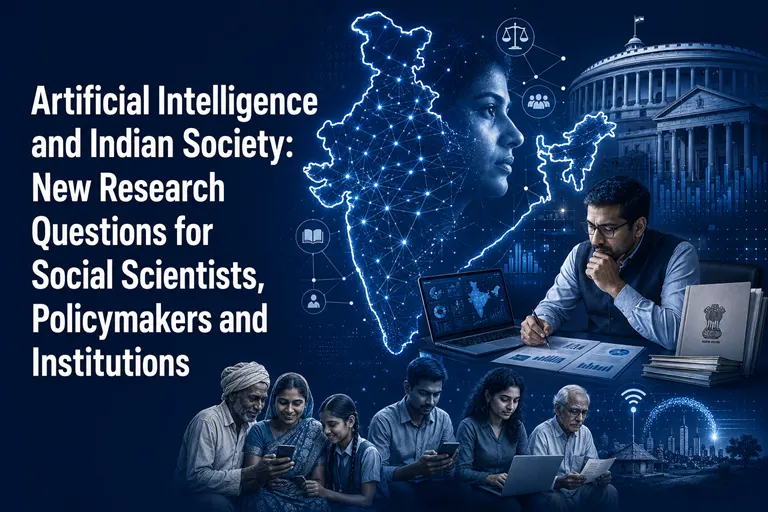
At the same time, artificial intelligence raises questions that cannot be answered through engineering or computer science alone. Researchers must examine who benefits from AI, whose knowledge is represented in its datasets, how automated decisions affect different communities and what forms of accountability are needed when AI contributes to an unfair or harmful outcome.
India’s social diversity makes these questions especially significant. Caste, class, gender, language, education, disability, region and digital access influence whether individuals can use AI effectively and how they experience its consequences. A system that performs well for an English-speaking urban professional may not work equally well for a rural user communicating in a regional language or dialect.
The Indian Journal of Social Enquiry encourages social scientists, policy researchers and institutions to investigate these emerging issues through empirical, theoretical and interdisciplinary research. AI should be studied not only as a technical tool but also as a social institution capable of redistributing knowledge, power, opportunity and risk.
Why Artificial Intelligence Has Become a Social Science Question
AI systems are designed and deployed within existing social structures. Their goals, datasets, classifications and performance standards are shaped by human choices.
An automated recruitment system may appear neutral while relying on employment histories influenced by unequal educational opportunity. A language model may answer questions confidently but perform unevenly across Indian languages. An educational AI tool may benefit students with personal devices and reliable internet access while offering limited value to learners dependent on shared smartphones.
Social scientists can investigate these relationships by asking:
- Who decides what problem an AI system should solve?
- Which groups are represented in its training data?
- What values are embedded in its design?
- Who can understand or challenge its decisions?
- Which institutions remain responsible for its consequences?
- Does AI reduce administrative burden or transfer it to citizens?
- Does automation improve work or intensify monitoring?
- How does AI affect trust in experts and institutions?
- What happens when technological efficiency conflicts with fairness?
These questions connect artificial intelligence with sociology, economics, political science, psychology, education, media studies, cultural studies, gender studies, law and public administration.
India’s Expanding AI Ecosystem
The IndiaAI Mission seeks to develop an inclusive national AI ecosystem through computing capacity, datasets, indigenous models, future skills, startup financing, socially relevant applications and safe and trusted AI.
India is also developing a governance approach intended to support innovation while addressing safety, accountability and social risk. The IndiaAI Safe and Trusted AI initiative emphasises responsible, secure, inclusive and trustworthy development.
The national conversation has consequently moved beyond whether India should adopt AI. The more important question is how AI should be designed, governed and evaluated within India’s social context.
The scale of this transformation creates a significant research agenda. National missions and institutional programmes can establish infrastructure, but social research is needed to determine whether AI applications are accessible, effective and fair in practice.
Research Priority 1: AI, Employment and the Future of Work
Employment is one of the most visible areas of AI-related concern. Public discussion often presents two competing predictions: AI will eliminate large numbers of jobs, or AI will create unprecedented productivity and new occupations.
The actual effects are likely to vary across sectors, tasks and worker groups. AI may automate some activities, assist workers with others and introduce additional monitoring or verification duties elsewhere.
Research at the task level
Researchers should investigate how individual tasks change within occupations rather than categorising entire professions as simply automated or unaffected.
Key research questions include:
- Which tasks are being automated?
- Which workers receive AI tools and training?
- How are productivity gains distributed?
- Does AI reduce routine work or increase work intensity?
- How are entry-level positions changing?
- What new forms of supervision are being introduced?
- Are workers responsible for errors produced by AI?
- How does AI affect professional identity and expertise?
- Which occupations are gaining or losing bargaining power?
These questions are relevant to teaching, administration, software development, financial services, customer support, journalism, design, law, translation and other professional activities.
AI and informal employment
Research must also extend beyond formal offices. India’s informal and platform workers form a major part of its labour environment.
AI may be used for route optimisation, worker ratings, task allocation, fraud detection, credit assessment or demand prediction. Workers may have little knowledge of how these systems operate even when algorithmic decisions affect their income.
Social researchers should examine whether AI applications support informal workers or create new dependencies on platforms and data systems.
Research Priority 2: Algorithmic Management and Platform Labour
Digital platforms already influence employment through ratings, incentives, location tracking and automated task assignment. AI can make these systems more predictive and personalised, but potentially less transparent.
Important areas of enquiry include:
- How tasks and incentives are allocated
- Whether workers understand rating systems
- How accounts are suspended or restored
- Whether workers can appeal automated decisions
- Effects of customer ratings
- Changes in income predictability
- Occupational surveillance
- Worker safety and fatigue
- Use of personal data
- Collective action and worker representation
Researchers should include workers’ interpretations and strategies rather than treating them only as labour-market statistics.
Ethnographic research, interviews, worker diaries, interface analysis and mixed-methods studies can reveal aspects of algorithmic work that are not visible in company data.
Research Priority 3: AI and Social Inequality
AI is sometimes presented as a tool capable of expanding access and overcoming human bias. It may support inclusion when designed carefully, but it can also reproduce inequality contained in historical data or institutional practices.
Indirect reproduction of disadvantage
An AI system does not need to use caste, gender or class labels directly to produce unequal outcomes. Variables such as postal code, educational history, language, employment gaps, device behaviour or purchasing patterns may correlate with social position.
Researchers should investigate:
- Differences in AI access across income groups
- Performance across languages and regions
- Bias in recruitment and lending
- Accessibility for persons with disabilities
- AI-related differences in education
- Representation in datasets
- Gender differences in AI skills
- Unequal access to paid AI services
- Effects on historically marginalised communities
- Regional concentration of AI employment and infrastructure
An intersectional approach is essential. The digital experience of a low-income rural woman may differ from that of an urban professional, even when both are technically classified as AI users.
Research Priority 4: AI in Education and Academic Life
Generative AI is changing how students search for information, prepare assignments, translate material, write code and receive explanations. Teachers and institutions are using AI for lesson preparation, assessment, administration and student support.
The central educational question is not simply whether AI should be permitted. Institutions must determine which uses improve learning and which undermine independent reasoning, fairness or academic integrity.
New research questions for education
- Does AI improve conceptual understanding?
- Which students benefit most?
- Does AI reduce or widen educational inequality?
- How reliable is AI-generated information?
- How does it perform in regional languages?
- What happens to writing and critical-reasoning skills?
- How should AI-assisted work be disclosed?
- Can conventional assignments still measure learning?
- How does AI affect teacher autonomy?
- What privacy risks accompany AI-based educational tools?
- How should universities evaluate AI-generated references?
- What support do educators need to develop AI literacy?
AI detectors should also be studied critically. Institutions should not assume that automated detection produces certain or unbiased findings.
Redesigning academic assessment
Universities may need to place greater value on:
- Oral explanation
- Research process
- Reflective commentary
- Source verification
- Local data collection
- Draft development
- Methodological reasoning
- Transparent disclosure
- Evidence-based argument
The objective should be to preserve genuine learning while preparing students for responsible AI use.
Research Priority 5: Language, Culture and Representation
India’s linguistic diversity creates one of the most important testing environments for inclusive AI.
Translation, speech recognition and language-generation systems could expand access to education, markets, public services and information. However, languages and dialects with limited digital representation may receive less accurate or culturally appropriate results.
Language is more than technical data
Language carries:
- Cultural memory
- Social identity
- Regional context
- Humour
- Metaphor
- Hierarchy
- Historical meaning
- Community knowledge
A system may generate grammatically correct text while misinterpreting the cultural context in which a phrase is used.
Research priorities include:
- Comparative performance across Indian languages
- Representation of dialects
- Ownership of language datasets
- Community participation in dataset creation
- Automated translation and loss of meaning
- Cultural stereotypes in generated content
- Digital preservation of oral traditions
- Effects on regional publishing
- Visibility of local knowledge
- Linguistic accessibility of public services
Researchers should ask who determines whether an AI-generated translation is accurate and which communities have authority over culturally specific data.
Research Priority 6: AI, Media and Misinformation
Generative AI can produce convincing text, images, audio and video. These tools can support creativity, accessibility and communication, but they can also lower the cost of producing misleading or manipulative content.
India’s large and multilingual media environment makes AI-generated information an urgent area of research.
Potential topics include:
- Public recognition of synthetic media
- Political misinformation
- Regional-language disinformation
- AI-generated impersonation
- Circulation through private messaging groups
- Effects on journalism
- Verification practices
- Content labelling
- Platform responsibility
- Online harassment
- Public trust in media
- Digital literacy interventions
Research should examine why people believe and share content. Trust is shaped by family, community, ideology, language, religious identity, political affiliation and prior experience with institutions.
Misinformation research should therefore connect technology with social relationships and cultural context.
Research Priority 7: Data, Privacy and Consent
AI depends on data. The collection and use of data raise questions about privacy, consent, surveillance and power.
The scale of data collection may be difficult for ordinary users to understand. Consent is especially complicated when access to an essential service depends on accepting terms that cannot be negotiated.
Research should examine:
- Public understanding of data collection
- Accessibility of privacy notices
- Consent across literacy levels and languages
- Data relating to children
- Workplace surveillance
- Biometric information
- Behavioural profiling
- Institutional data sharing
- Grievance mechanisms
- Community attitudes towards privacy
- Risks associated with sensitive social data
Privacy should not be studied only as an individual preference. Household relationships, gender norms, employment power and institutional dependence affect whether a person can refuse data collection.
Research Priority 8: AI in Public Administration
Public institutions may use AI to analyse data, identify needs, improve service delivery or support administrative decisions. These applications can increase efficiency, but public-sector use requires especially strong accountability.
NITI Aayog’s DPI@2047 roadmap considers how digital infrastructure may support inclusive economic participation, education, health and livelihoods. AI can extend these capabilities, but social research is necessary to evaluate citizen experience and institutional responsibility.
Questions include:
- How are automated public decisions explained?
- Can citizens request human review?
- What happens when records are incorrect?
- Who is responsible for correcting errors?
- Are regional languages supported?
- Are persons with disabilities included?
- How are high-risk systems evaluated?
- Does automation improve grievance redressal?
- Are marginalised communities represented in design?
- How is public trust affected?
Public authorities remain responsible for decisions made or supported by technology. Outsourcing system development should not mean outsourcing accountability.
Research Priority 9: AI in Finance, Credit and Economic Opportunity
AI is increasingly used to assess creditworthiness, detect fraud, personalise financial products and automate customer service.
These systems may expand access for people without conventional credit histories, but alternative data can create new forms of profiling.
Research questions include:
- Which data influence credit decisions?
- Can applicants understand a rejection?
- Are errors corrected quickly?
- Does alternative-data scoring benefit informal workers?
- Can digital behaviour become a proxy for social class?
- How are vulnerable consumers protected?
- What language support is available?
- Are automated recommendations suitable for different users?
- How does AI affect financial fraud?
- What forms of human assistance remain available?
Financial inclusion should be evaluated through fairness, affordability and user control, not only account creation.
Research Priority 10: AI, Healthcare and Social Trust
AI may support diagnosis, triage, documentation, translation and public-health analysis. Although technical and clinical validation are essential, social research is also required.
Researchers can examine:
- Patient trust in AI-supported decisions
- Responsibility for errors
- Informed consent
- Regional and social differences in access
- Health-data privacy
- Effects on professional roles
- Communication between clinicians and patients
- Use of AI-generated health advice
- Risks of misinformation
- Differences across languages
- Use by rural and underserved communities
AI should support rather than replace meaningful communication and professional accountability.
Research Priority 11: Gender and Artificial Intelligence
Gender inequality may affect access to AI education, employment, entrepreneurship and leadership. It may also shape how AI systems represent women and gender-diverse people.
Research priorities include:
- Gender gaps in AI skills
- Women’s participation in AI research
- Representation in leadership
- Access to devices and paid tools
- AI-supported employment
- Technology-facilitated harassment
- Gender stereotypes in generated content
- Automated recruitment
- Safety technologies
- Effects on unpaid care work
- AI and women’s entrepreneurship
- Representation of transgender people in datasets
Gender should be studied together with class, caste, region, disability and language.
Research Priority 12: AI and Institutional Accountability
AI does not make decisions independently of institutions. Organisations choose the data, tools, thresholds and contexts in which systems are used.
Research should therefore examine organisational responsibility.
Key questions include:
- Who approves the use of AI?
- Is a risk assessment conducted?
- What documentation is maintained?
- Can users appeal decisions?
- Are systems independently audited?
- Is human oversight meaningful?
- How are errors reported?
- Who compensates affected individuals?
- Are third-party vendors accountable?
- How are systems retired when they become unsafe?
The term “human in the loop” is not sufficient if the human reviewer lacks time, authority or information to question the system.
Research Priority 13: Environmental Costs of AI
AI requires computing infrastructure, data centres, energy and water. Its social value must therefore be considered alongside its environmental costs.
Possible research areas include:
- Location of data infrastructure
- Energy demand
- Water use
- Electronic waste
- Environmental effects on nearby communities
- Green-computing policies
- Sustainable procurement
- Public reporting
- Relationship between AI growth and climate commitments
A socially responsible AI agenda should consider both technological benefit and environmental sustainability.
Research Priority 14: AI and the Production of Knowledge
AI is changing how researchers search literature, analyse text, translate interviews, write summaries and develop code.
These applications can save time but may also introduce fabricated references, hidden errors, methodological opacity and confidentiality risks.
Social scientists should investigate:
- AI-assisted literature reviews
- Bias in research discovery
- Translation of qualitative interviews
- Automated coding
- Synthetic research data
- Reproducibility
- Disclosure standards
- Confidentiality
- Authorship responsibility
- Effects on peer review
- Inequality between well-resourced and under-resourced institutions
Researchers remain responsible for verifying every factual statement, reference and interpretation produced with AI assistance.
Methodological Approaches for Studying AI and Society
AI-related social research requires methodological diversity.
Qualitative methods
Interviews, focus groups, ethnography and case studies can reveal how workers, students, citizens and professionals understand AI.
Quantitative methods
Surveys, experiments, administrative-data analysis and statistical modelling can identify patterns across populations.
Algorithmic and platform audits
Researchers can test whether systems perform differently across languages, identities or user profiles.
Participatory research
Affected communities can help define research questions, identify risks and interpret findings.
Comparative studies
Comparisons across states, sectors, institutions and social groups can show how local conditions influence AI outcomes.
Longitudinal research
Studies conducted over time can distinguish temporary adoption effects from lasting institutional change.
The chosen method should match the research question. Researchers should avoid making national claims from narrow or unrepresentative samples.
Ethical Requirements for AI and Society Research
Research involving artificial intelligence may include personal data, online behaviour or automated profiling. Researchers should consider:
- Informed consent
- Privacy
- Data security
- Participant anonymity
- Community risk
- Platform terms
- Researcher accountability
- Bias in analytical tools
- Transparency about AI assistance
- Secure handling of confidential data
Publicly available online information should not automatically be treated as unrestricted research material. Ethical use depends on context, sensitivity and users’ reasonable expectations.
An Interdisciplinary Research Agenda for IJSE
The Indian Journal of Social Enquiry encourages contributions connecting AI with:
- Sociology
- Economics
- Political science
- Public administration
- Education
- Psychology
- Gender studies
- Cultural studies
- Media and communication
- Development studies
- Law and society
- Labour research
- Digital humanities
- Environmental studies
The most valuable contributions will connect technological change with evidence about people, institutions and public outcomes.
Preparing an AI and Society Manuscript for IJSE
Before submission, authors should ensure that:
- The research question is socially significant
- AI is studied in a clear institutional context
- Relevant social-science literature is engaged
- Methods are described transparently
- The sample is appropriate
- Ethical approval and consent are addressed
- Data limitations are acknowledged
- Claims remain proportional to the evidence
- AI-generated content has been verified
- Conflicts and funding are disclosed
- Participant privacy is protected
- Policy recommendations follow from the findings
Authors should review the journal’s author guidelines and use the online submission portal.
Frequently Asked Questions
Why is artificial intelligence a social science subject?
AI affects work, education, media, finance, governance, culture and social relationships. Its consequences depend on institutions, inequality, human behaviour and public policy.
What AI topics can social scientists research?
Researchers can study employment, algorithmic bias, digital inequality, AI in education, misinformation, privacy, language, public services, gender, cultural representation and institutional accountability.
Does AI always reduce human bias?
No. AI may reduce some forms of inconsistent decision-making, but it can also reproduce inequality contained in historical data, design assumptions or institutional practices.
How can AI affect social inequality?
Benefits may be concentrated among people with better devices, connectivity, education, English proficiency and institutional support. Automated systems may also perform differently across social groups.
Why are Indian languages important in AI research?
Language determines access to information and services. Systems that work poorly in regional languages or dialects may exclude large populations or misrepresent cultural meaning.
Can research on generative AI in education be submitted to IJSE?
Yes. Research examining learning, assessment, academic integrity, student inequality, teacher practice or education policy may align with IJSE’s social-science scope.
What is responsible AI?
Responsible AI generally refers to systems designed and used with fairness, safety, transparency, privacy, accountability, inclusion and meaningful human oversight.
How can researchers evaluate algorithmic bias?
Researchers may compare system outcomes across languages, demographic groups, locations or user profiles while considering legal, ethical and methodological requirements.
Can qualitative AI research be valuable?
Yes. Interviews, ethnography and case studies can reveal how people understand AI, adapt to it and experience its effects.
How can authors submit AI and society research to IJSE?
Authors should review the IJSE author guidelines and submit through the manuscript-submission system.
Conclusion
Artificial intelligence is not entering an equal or uniform society. It is entering a country characterised by significant linguistic, cultural, regional and socioeconomic diversity. These conditions will shape how AI is used and who benefits from it.
India’s AI future will depend not only on computing capacity, technical models or startup growth. It will also depend on whether institutions protect rights, explain decisions, address inequality and remain accountable for technological outcomes.
Social scientists have an essential role in this process. They can study how AI changes work, education, governance, culture and social relationships. They can identify groups overlooked by aggregated adoption statistics. They can evaluate whether responsible-AI principles are reflected in actual institutional practice.
The Indian Journal of Social Enquiry welcomes rigorous research that examines these transformations through credible evidence, transparent methods and interdisciplinary analysis.
Submit your research to IJSE:
For institutions planning to launch or modernise a social science journal, ScholarJMS supports journal websites, online submissions and editorial workflows. OJSCloud provides OJS hosting, migration, journal-launch support and ISSN-readiness consulting. GetDOI supports Crossref DOI workflows, while Scholar9 supports transparent peer review and research trust. Contact inquiry@ojscloud.com or WhatsApp +91 82003 85143.