
IJSE Invites Social Science Research on India’s Changing Society, Digital Transformation and Public Policy
The Indian Journal of Social Enquiry invites researchers, academicians, doctoral scholars, policy analysts and practitioners to submit original scholarly work examining the transformation of Indian society.
India is experiencing significant social, economic, technological and institutional change. Digital public infrastructure is reshaping access to financial services and public administration. Artificial intelligence is entering education, employment, media, business and governance. Platform-based work is changing the relationship between workers, consumers and organisations. Migration, urbanisation, environmental pressure and evolving cultural identities are creating new questions for social research.
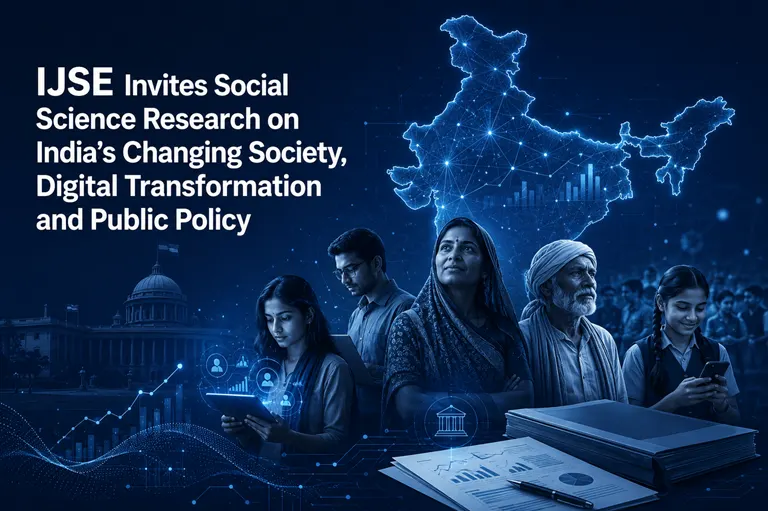
These developments cannot be understood through technological or economic indicators alone. They require careful enquiry into how individuals, households, communities and institutions experience change. They also require attention to who benefits, who remains excluded and how public policy can respond fairly to social diversity.
The Indian Journal of Social Enquiry welcomes theoretically informed and empirically grounded research that advances understanding of these transformations. Submissions may draw on sociology, economics, political science, psychology, education, public administration, gender studies, cultural studies, media studies, development studies or interdisciplinary social science.
About the Indian Journal of Social Enquiry
The Indian Journal of Social Enquiry is a peer-reviewed academic journal published by Maharaja Agrasen College, Delhi. The journal provides a platform for original research, review articles, case studies, short communications and interdisciplinary contributions addressing significant social questions.
Its scholarly positioning supports research that:
- Develops or evaluates social theory
- Produces credible empirical evidence
- Examines contemporary social institutions
- Connects research with practical or policy questions
- Introduces innovative qualitative, quantitative or mixed methodologies
- Compares regions, communities or social groups
- Encourages interdisciplinary dialogue
- Supports ethical and socially responsible scholarship
The journal is particularly interested in research that moves beyond description to explain why social patterns emerge, how they are reproduced and what their consequences are for individuals and institutions.
Why Research on India’s Changing Society Matters
India’s transformation is multidimensional. Economic growth, technological development and expanding infrastructure coexist with inequality, informal employment, unequal educational opportunity, social exclusion and regional disparity.
National progress can be substantial while particular communities continue to experience institutional barriers. Increased internet connectivity can expand access while leaving differences in device ownership, digital literacy and online safety unresolved. Educational enrolment can improve while learning conditions and employment transitions remain unequal. New employment platforms can generate income while raising questions about worker security and algorithmic control.
Social enquiry helps explain these apparent contradictions.
A strong research agenda should ask:
- How is social change experienced across caste, class, gender and region?
- How are technologies modifying established institutions?
- Which groups can convert formal access into meaningful opportunity?
- How do households and communities adapt to economic transition?
- What creates trust or mistrust in public institutions?
- How can policy implementation respond to local realities?
- What new forms of identity, participation and collective action are emerging?
IJSE encourages research that addresses these questions through transparent methods and context-sensitive analysis.
Priority Research Area 1: Digital Society and Everyday Life
Digital technologies now shape communication, consumption, education, finance, employment and access to government services. The distinction between online and offline life has become increasingly difficult to maintain because digital systems influence activities carried out in homes, schools, workplaces and public institutions.
Research on digital society may investigate:
- Household access to smartphones and computers
- Gendered control of digital devices
- Digital literacy and online safety
- Social media and interpersonal relationships
- Digital finance and economic participation
- Online public services
- Regional-language technology
- Digital consumption and cultural change
- Technology use among children and older people
- Digital exclusion among marginalised communities
Researchers should move beyond measuring whether people are connected. Meaningful digital inclusion depends on affordability, reliability, language, skills, accessibility, social permission and the ability to use digital services independently.
Studies comparing rural and urban experiences, different income groups or regional contexts can make a particularly valuable contribution.
Priority Research Area 2: Artificial Intelligence and Society
Artificial intelligence has become an important subject for social science because AI systems influence information, work, education, media and decision-making.
The IndiaAI Mission seeks to strengthen computing capacity, datasets, indigenous models, future skills, socially relevant applications and safe and trusted AI. This development creates opportunities for social scientists to examine how AI is designed, governed and experienced.
Relevant research questions include:
- How is AI changing employment and occupational skills?
- Who has access to useful AI tools?
- Do AI systems perform equally across Indian languages?
- How does generative AI affect education and academic integrity?
- Can automated decisions be understood and challenged?
- How might historical inequality enter training data?
- What are the consequences of AI-generated misinformation?
- How do citizens understand privacy and algorithmic decision-making?
- What forms of human oversight are required?
- How should institutions define accountability for AI-assisted decisions?
India’s current AI-governance approach emphasises fairness, accountability, safety, inclusion and human oversight. Social research can help translate these principles into evidence about actual institutions, communities and outcomes.
Priority Research Area 3: Digital Public Infrastructure and Governance
India’s digital public infrastructure has transformed identity systems, payments, document access and public-service delivery. NITI Aayog’s DPI@2047 roadmap considers how digital infrastructure can support livelihoods, productivity, education, health and market access.
Social research is necessary to evaluate this transformation from the citizen’s perspective.
A public service may be technically available online while remaining difficult to access because of language, authentication, connectivity, documentation or digital-literacy barriers. When systems fail, citizens may need to visit service centres, depend on intermediaries or navigate complex grievance procedures.
IJSE welcomes research on:
- Citizen experiences of digital public services
- Digital identity and institutional access
- Financial inclusion
- Authentication failures
- Grievance redressal
- Public trust in data-driven administration
- Rural and regional access
- Accessibility for persons with disabilities
- Digital-service intermediaries
- Privacy and data governance
- Role of local government
- Accountability in automated public decisions
Evaluating digital governance requires attention to efficiency, inclusion, procedural fairness and access to human assistance.
Priority Research Area 4: Inequality and Social Inclusion
Caste, class, gender, education, disability, language and geography continue to influence access to resources and institutions. These dimensions often interact rather than operate separately.
The journal encourages intersectional research examining how different systems of advantage and disadvantage shape:
- Education
- Employment
- Income and assets
- Housing
- Healthcare
- Digital access
- Political participation
- Institutional treatment
- Safety and mobility
- Social recognition
Researchers should distinguish between formal access and substantive inclusion. Admission to an educational institution does not necessarily guarantee equal learning conditions or a sense of belonging. Internet access does not necessarily provide independent control of a device. Financial inclusion does not automatically create control over household income.
High-quality inequality research should use respectful language, recognise differences within social groups and include the agency and knowledge of affected communities.
Priority Research Area 5: Platform Labour and the Future of Employment
Technology platforms have reorganised transport, delivery, logistics, domestic services, retail, freelancing and creative work. They have created employment opportunities while raising questions about income stability, employment status, algorithmic management and social protection.
Potential research topics include:
- Earnings after work-related costs
- Working and waiting time
- Algorithmic task allocation
- Worker ratings
- Incentive systems
- Account suspension and appeals
- Occupational safety
- Access to insurance
- Gender and caste within platform work
- Migrant-worker experiences
- Worker associations and collective organisation
- Effects of automation on employment
- AI-related changes in professional work
Platform workers should not be studied only as passive recipients of technological change. Research should also examine how workers interpret algorithms, organise support networks and develop strategies for managing uncertainty.
Priority Research Area 6: Education, Skills and Social Mobility
Education remains a central pathway through which individuals and families pursue mobility. However, educational opportunity is influenced by school quality, language, household resources, digital access, private tutoring, social networks and institutional support.
The journal welcomes research examining:
- School access and learning outcomes
- Higher education participation
- Social-group differences in educational experience
- Digital education
- Regional-language instruction
- AI-assisted learning
- Teacher preparation
- Vocational and professional skills
- Examination pressure
- Student mental health
- Academic integrity
- Transition from education to employment
- First-generation learners
- Institutional belonging and discrimination
- Disability inclusion
Educational research should move beyond enrolment figures to examine participation, learning, completion and the ability to convert qualifications into meaningful employment or further study.
Priority Research Area 7: Public Policy and Evidence-Based Governance
Public policy becomes socially effective through implementation. A well-designed policy may still produce uneven results because of administrative capacity, local institutions, documentation barriers or weak communication.
IJSE encourages policy research examining:
- Policy design and implementation
- Welfare delivery
- Education and health programmes
- Local governance
- Rural and urban development
- Social-protection systems
- Public finance and social outcomes
- Citizen participation
- Grievance mechanisms
- Institutional accountability
- Programme evaluation
- Centre-state coordination
- Community organisations
- Administrative burden
The strongest policy studies explain not only whether an intervention produced an outcome, but also for whom it worked, under which conditions and through what mechanisms.
Priority Research Area 8: Urbanisation, Migration and Regional Change
India’s urban transition is reshaping employment, housing, mobility, family relationships and access to public services. Migration also connects villages, small towns and metropolitan regions through flows of labour, money, knowledge and culture.
Relevant areas include:
- Affordable housing
- Informal settlements
- Migrant access to services
- Circular and seasonal migration
- Urban employment
- Transport inequality
- Gender and public space
- Growth of smaller cities
- Peri-urban development
- Digital systems in urban governance
- Environmental risk
- Social relationships in changing neighbourhoods
Researchers should also examine rural transformation beyond agriculture. Rural communities are increasingly connected to non-farm employment, online education, digital finance, e-commerce, migration and new forms of entrepreneurship.
Priority Research Area 9: Gender, Family and Care
Gender research continues to expand into questions of employment, technology, time use, household decision-making, care responsibilities, safety and mobility.
Potential submissions may address:
- Women’s labour-force participation
- Gender wage differences
- Unpaid care work
- Remote and platform employment
- Women’s control of income
- Digital access
- Online harassment
- Education and occupational choice
- Women’s entrepreneurship
- Non-traditional livelihoods
- Family change
- Marriage and intergenerational relationships
- Masculinity and social expectations
- Experiences of gender-diverse people
Research should avoid presenting women or households as uniform categories. Gender relations differ across caste, class, religion, region, disability and age.
Priority Research Area 10: Culture, Media and Democratic Communication
Digital platforms have changed how cultural identities are expressed and how political information circulates. Regional-language media, streaming platforms, online creators and generative AI are modifying cultural production and public communication.
IJSE welcomes research on:
- Digital and popular culture
- Regional-language media
- Cultural identity
- Online communities
- Influencer economies
- Political communication
- Misinformation
- AI-generated media
- Online harassment
- Media trust
- Fact-checking
- Community media
- Citizen journalism
- Cultural preservation
- Changes in film, music and literary consumption
Research should examine how audiences interpret media rather than assuming that they receive content passively.
Priority Research Area 11: Climate Change and Social Vulnerability
Climate change has consequences for livelihoods, migration, health, housing, food security and public infrastructure. Its effects are shaped by existing inequality.
Research priorities include:
- Extreme heat and informal labour
- Climate-related migration
- Rural livelihoods
- Water insecurity
- Urban environmental risk
- Gendered adaptation burdens
- Community resilience
- Environmental justice
- Renewable-energy transitions
- Indigenous and local knowledge
- Public participation in environmental policy
- Just-transition employment
Climate research in the social sciences should identify who bears the costs of environmental change and who has the resources to adapt.
Priority Research Area 12: Youth, Mental Health and Changing Aspirations
Young people are navigating expanding educational participation, competitive labour markets, digital culture and changing expectations regarding careers, relationships and social mobility.
The journal encourages studies on:
- Education-to-employment transitions
- Youth unemployment and insecure work
- Examination and career pressure
- Student mental health
- Social media and self-image
- Digital entrepreneurship
- Creator work
- Civic and political participation
- Migration for education
- Family expectations
- Changing attitudes towards marriage
- Youth engagement with climate and social movements
Research should treat young people as active social actors rather than only as future workers or policy beneficiaries.
Methodologies Welcomed by IJSE
The journal welcomes a range of rigorous social science methodologies.
Qualitative approaches
- In-depth interviews
- Focus groups
- Ethnography
- Participant observation
- Oral history
- Case-study research
- Discourse analysis
- Narrative analysis
- Archival research
Quantitative approaches
- Surveys
- Secondary-data analysis
- Statistical modelling
- Policy evaluation
- Longitudinal analysis
- Experimental and quasi-experimental designs
- Social-network analysis
Mixed and emerging methods
- Mixed-methods research
- Digital ethnography
- Platform analysis
- Computational social science
- Geospatial analysis
- Participatory research
- Comparative regional research
- Interdisciplinary methodological designs
Authors should explain their sampling, analytical decisions, limitations and ethical safeguards clearly.
Research Ethics and Responsible Scholarship
IJSE encourages research that protects participants and preserves academic integrity.
Authors should address, where applicable:
- Institutional ethics approval
- Informed consent
- Participant confidentiality
- Protection of vulnerable communities
- Data security
- Conflict of interest
- Funding
- Data availability
- Authorship contributions
- Use of generative AI
- Limitations and potential harm
Publicly visible digital information should not automatically be treated as ethically unrestricted. Researchers should consider whether users reasonably expected their content to become part of an academic study.
AI tools may support transcription, translation, literature organisation or language improvement, but authors remain responsible for the accuracy, originality and integrity of their manuscripts.
Who Should Submit?
IJSE welcomes submissions from:
- University and college faculty members
- Social science researchers
- Doctoral and postdoctoral scholars
- Policy researchers
- Independent scholars
- Research institutions
- Civil-society researchers
- Development professionals
- Interdisciplinary research teams
- Early-career academics with methodologically sound work
Collaborative research across institutions, disciplines and regions is encouraged.
Authors should consult the journal’s author guidelines before submission and use the online manuscript-submission system to submit their work.
Preparing a Manuscript for IJSE
Before submission, authors should ensure that:
- The manuscript aligns with the journal’s scope
- The research question is clearly defined
- Relevant literature is critically discussed
- Methodology is transparent
- Findings are supported by evidence
- Ethical requirements are addressed
- References are complete and accurate
- Tables and figures are readable
- All authors approve the submission
- Conflicts and funding are disclosed
- The work is not under consideration elsewhere
- Significant use of AI tools is disclosed appropriately
- Identifying information is removed where anonymous review requires it
A well-prepared manuscript allows editors and reviewers to focus on its scholarly contribution.
Online Submission and Peer Review
IJSE’s online publishing structure supports organised manuscript submission, editorial processing and peer review.
The general workflow includes:
- Manuscript preparation
- Online submission
- Administrative and scope screening
- Editorial assignment
- Independent peer review
- Author revision where required
- Editorial decision
- Copyediting and production
- Publication in an issue or approved publication sequence
Peer review is intended to strengthen research quality. Reviewers assess the manuscript’s relevance, originality, theoretical contribution, methods, evidence, interpretation and presentation. The final publication decision remains an editorial responsibility.
Authors can also use the journal’s paper-tracking facility to follow the status of their submission.
Building a Stronger Social Science Research Community
A journal is more than a publication platform. It is a community connecting authors, editors, reviewers, institutions and readers.
IJSE seeks to strengthen this community by encouraging:
- Constructive peer review
- Interdisciplinary dialogue
- Regional and comparative research
- Participation by emerging scholars
- Ethical research
- Methodological transparency
- Public relevance
- Collaboration across institutions
Editors and experienced researchers can support this objective by reviewing manuscripts, contributing thematic proposals and encouraging early-career scholars to develop rigorous research.
Frequently Asked Questions
What subjects does IJSE cover?
IJSE covers social sciences and interdisciplinary social enquiry, including sociology, economics, political science, education, psychology, culture, media, gender, inequality, governance, public policy and development studies.
Can research on artificial intelligence be submitted to a social science journal?
Yes, when the study examines the social, economic, educational, cultural, ethical, labour or governance implications of AI rather than focusing only on technical development.
Does IJSE accept interdisciplinary research?
Yes. Research connecting two or more social science disciplines, or linking social sciences with technology, education, environment or public policy, may be suitable when it aligns with the journal’s scope.
Can doctoral scholars submit manuscripts?
Yes. Doctoral and early-career researchers may submit original and methodologically sound research that meets the journal’s requirements.
What article types may be considered?
Depending on the journal’s current guidelines, submissions may include original research articles, review articles, case studies, theoretical papers, policy analyses, research notes and short communications.
Does IJSE use peer review?
The journal identifies itself as peer reviewed and uses an editorial evaluation process involving subject experts. Authors should consult the current peer-review and submission information for details.
Can qualitative research be submitted?
Yes. Interview studies, ethnographies, case studies, oral histories, discourse analyses and other qualitative approaches may be appropriate when methods and analytical procedures are explained clearly.
Does the journal consider studies focused on a single state or community?
Yes. Regionally focused research can make a strong scholarly contribution when it is theoretically informed, methodologically rigorous and situated within a wider body of literature.
Must social science research include ethics approval?
Requirements depend on the research design and applicable institutional standards. Research involving human participants, sensitive information or vulnerable groups should explain ethics approval, consent and confidentiality.
How can authors submit their research?
Authors should review the IJSE author guidelines and submit through the online submission portal.
Conclusion
India’s social transformation requires research that is empirically strong, theoretically meaningful and attentive to the diversity of lived experience.
Digital infrastructure, artificial intelligence, platform employment and data-driven governance are creating new opportunities. They are also raising questions about inequality, privacy, accountability, labour security and institutional trust. At the same time, longstanding concerns involving caste, class, gender, education, migration, culture and regional development continue to evolve.
The Indian Journal of Social Enquiry invites scholars to investigate these transformations through rigorous and ethical social research. By connecting disciplinary knowledge with contemporary questions, researchers can strengthen academic understanding and contribute evidence relevant to public policy, institutions and communities.
Researchers interested in contributing should review the journal’s scope and submission requirements, prepare their manuscripts carefully and submit through the online system.
Submit your research to IJSE:
For colleges, universities and scholarly institutions planning to launch or modernise a social science journal, ScholarJMS provides journal websites, online submission and editorial workflows. OJSCloud supports OJS hosting, migration, journal launches and ISSN readiness. GetDOI provides Crossref DOI workflow guidance, while Scholar9 supports transparent peer review and research trust. For publishing-support enquiries, contact inquiry@ojscloud.com or WhatsApp +91 82003 85143.
8. Recommended Internal Links for This Journal Website
- Home: Link the first mention of IJSE to https://ijse.scholarjms.org/
- About the Journal: Link the journal-description section to https://ijse.scholarjms.org/about
- Editorial Board: Link references to editorial expertise to https://ijse.scholarjms.org/editorialboard
- Author Guidelines: Link manuscript-preparation references to https://ijse.scholarjms.org/author-guidelines
- Submit Manuscript: Link every direct submission invitation to https://ijse.scholarjms.org/submit-paper
- Track Paper: Link manuscript-status references to https://ijse.scholarjms.org/track-paper
- Call for Papers: Link the primary news CTA to https://ijse.scholarjms.org/call-for-papers
- Current Issue: Invite readers to explore current scholarship at https://ijse.scholarjms.org/current-issue
- Journal Archive: Link references to published social science research to https://ijse.scholarjms.org/archive
- Related blog: “Emerging Social Science Research Trends in India in 2026: Society, Technology, Policy and Cultural Change”
- Related blog: “Digital Society and Social Change in India: Research Priorities for the Platform and AI Era”
- Related blog: “Researching Inequality in Contemporary India: Caste, Class, Gender, Education and Digital Access”
- Contact: Link editorial enquiries to https://ijse.scholarjms.org/contact