
Researching Social Inequality in Contemporary India: Caste, Gender, Class, Education and Digital Exclusion
India’s social and economic transformation has expanded educational opportunities, strengthened physical and digital infrastructure, reduced several forms of deprivation and connected millions of people to public services. Yet the experience of development remains uneven. Opportunities are still shaped by caste location, gender, household resources, educational background, geography, language, disability and access to technology.
For social scientists, this creates an important research challenge. Inequality in contemporary India cannot be understood adequately through a single category or indicator. Income alone does not explain unequal social power. Educational enrolment does not necessarily establish equal learning. Internet connectivity does not always mean meaningful digital participation. Formal legal equality does not automatically remove discrimination from institutions, workplaces or everyday life.
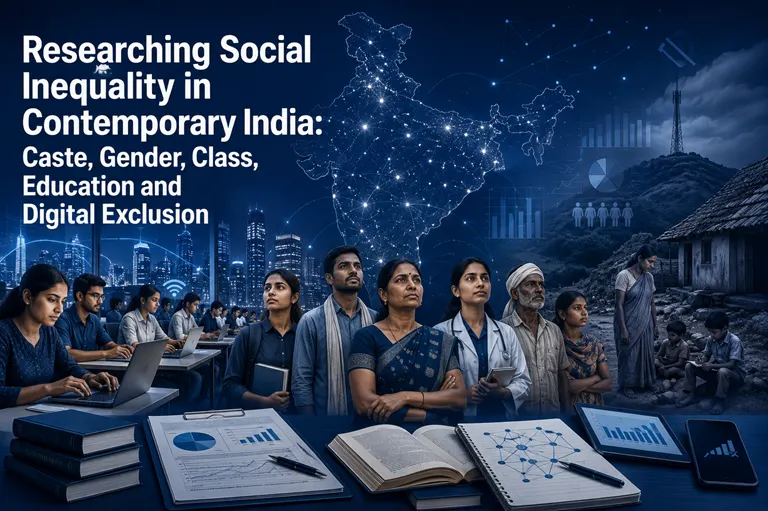
Research must therefore examine not only who has access to a resource, but also who can use it effectively, who controls it, who benefits from it and whose experiences remain absent from official or institutional records.
The Indian Journal of Social Enquiry (IJSE) encourages rigorous, interdisciplinary and contextually grounded research on these questions. As a peer-reviewed social science journal published by Maharaja Agrasen College, Delhi, IJSE provides a scholarly space for examining India’s changing institutions, communities, identities and public policies.
This News & Event feature identifies significant research priorities for scholars studying caste, gender, class, education and digital exclusion in contemporary India.
Social inequality is multidimensional
Public discussion often presents inequality as a difference in income or consumption. These measures are indispensable, but they capture only part of the social reality. Inequality may also concern land, housing, education, healthcare, employment security, political representation, social recognition, mobility, information and the ability to participate in institutions without discrimination.
India’s National Multidimensional Poverty Index illustrates the importance of moving beyond a single economic measure. It evaluates deprivation across health, education and standards of living through indicators such as schooling, nutrition, housing, sanitation, assets and access to a bank account. According to India’s 2025 Voluntary National Review, multidimensional poverty declined substantially during the preceding decade. At the same time, its district-level and rural-urban findings show why national averages should not be treated as complete descriptions of social experience. NITI Aayog’s National MPI and the India Voluntary National Review 2025 provide important official reference points.
Progress in aggregate indicators can coexist with persistent disadvantages among particular communities. A household may have electricity but lack reliable internet access. A student may be enrolled in school but face linguistic exclusion, discrimination or inadequate learning support. A woman may possess a bank account but have limited control over its use. A person may own a mobile phone but lack the privacy, literacy or confidence needed to access digital services.
Researchers must therefore distinguish among:
- Formal access and effective use
- Household ownership and individual control
- Enrolment and meaningful educational participation
- Legal protection and lived equality
- Connectivity and digital capability
- Economic mobility and social recognition
The central analytical question is not simply whether development has occurred. It is how its gains, costs and risks are distributed.
Caste inequality in changing institutions
Caste remains an essential field of enquiry because it continues to influence social networks, educational experiences, occupational mobility, marriage practices, housing and access to institutional authority. Its contemporary forms, however, may not always resemble older or more visible structures of exclusion.
Urbanisation, higher education, digital communication and occupational change have transformed the settings in which caste operates. They have not necessarily made it irrelevant. In some situations, caste is reproduced through informal networks, institutional cultures, residential patterns, recruitment practices or assumptions about competence and merit.
Research beyond representation
Representation data can identify whether Scheduled Castes, Scheduled Tribes, Other Backward Classes and other social groups are present in an institution. Presence alone, however, does not reveal whether participants experience equal treatment, belonging, mentorship or advancement.
Research on caste in universities and workplaces should examine:
- Access to influential academic and professional networks
- Experiences of explicit and indirect discrimination
- Unequal exposure to financial or linguistic barriers
- Mentorship and progression into leadership positions
- The social composition of disciplinary and decision-making bodies
- Differences between numerical representation and substantive inclusion
- The relationship between caste, locality and type of institution
Such work may combine administrative data with interviews, ethnography, institutional case studies and longitudinal research.
Caste in digital environments
The migration of social interaction to digital platforms has created another research frontier. Caste identities can be challenged, concealed, negotiated or amplified online. Digital spaces may support anti-caste mobilisation and enable marginalised voices to reach wider audiences. The same spaces can also circulate harassment, stereotypes and discriminatory speech.
Researchers may investigate how platform design, language, moderation and algorithmic recommendation affect the visibility of caste-related discourse. The objective should not be to assume that technology automatically weakens or strengthens caste, but to establish the conditions under which either outcome occurs.
Gender inequality as an institutional and relational question
Gender inequality extends beyond comparisons between women and men. It is shaped by household authority, unpaid work, occupational segregation, safety, mobility, property, health, sexuality, disability and social identity.
Gender also interacts with caste and class. An economically secure urban woman and a woman employed in informal rural work may face very different constraints. Research must avoid treating “women” as a uniform analytical group.
Paid work and unpaid care
Labour-force participation is one important measure of gender inequality, but participation figures should be connected to the quality and conditions of work. Researchers need to distinguish between secure employment, informal work, unpaid family labour, self-employment and work undertaken without meaningful control over earnings.
Time-use research is particularly valuable because conventional employment measures can overlook unpaid care, domestic work, fuel and water collection, and community responsibilities. These activities affect women’s educational continuity, occupational choices, health and access to leisure.
Useful research questions include:
- How does unpaid care influence women’s employment decisions?
- Do remote and platform-based work expand autonomy or transfer additional costs to workers?
- How do caste, class and geography shape exposure to insecure employment?
- Who controls income, assets and financial accounts within households?
- How do transport and safety affect access to education and work?
- How are transgender and gender-diverse persons represented in institutional datasets?
Gendered technology use
Digital inclusion is also gendered. Household access to a device does not establish that every member can use it independently. Women and girls may experience restrictions relating to time, privacy, surveillance, affordability and social permission.
Studies should consequently measure individual access, frequency of use, device quality, control over passwords, digital skills and freedom from monitoring. These details can show whether technology expands personal agency or reproduces household inequalities in a new form.
Class inequality beyond income categories
Class is connected to income, but it also concerns wealth, occupation, housing, security, social networks and the capacity to withstand financial shocks. Two households reporting similar current income may have very different levels of debt, property, savings, employment stability and access to influential institutions.
Contemporary research on class should pay closer attention to the distinction between upward mobility and security. A person may enter a new occupation or acquire educational credentials without obtaining stable employment, affordable housing or protection from debt.
Informality and economic insecurity
A significant area for enquiry is the relationship between labour-market informality and social protection. Platform work, contractual employment and other flexible arrangements can create opportunities while shifting costs and risks to workers.
Researchers should examine:
- Income volatility rather than income at a single point in time
- Access to paid leave, insurance and social security
- Working hours and occupational health
- Debt and emergency expenditure
- Housing and commuting costs
- Algorithmic management in platform work
- Workers’ ability to negotiate or appeal decisions
- Differences across gender, caste, migration status and locality
The National Sample Survey Office conducts large-scale surveys across a wide range of socioeconomic subjects. Such datasets are crucial, but they can be strengthened by qualitative research that explains how insecurity is experienced within households and workplaces.
Wealth and intergenerational advantage
Intergenerational inequality deserves further attention. Family wealth affects neighbourhood, school choice, coaching, language exposure, unpaid internships, professional networks and the ability to delay paid employment while pursuing higher qualifications.
Longitudinal studies can help establish how advantage accumulates across generations. Research should also explore whether educational and occupational mobility reduces social distance or merely changes its institutional setting.
Educational inequality: access, learning and progression
India has achieved substantial expansion in educational access. The next research challenge is to study inequalities in retention, learning, transition and educational experience.
A 2026 NITI Aayog analysis notes that students from historically disadvantaged communities may face a combined burden of poverty, low parental education and limited early-learning support. It also identifies continuing differences in learning outcomes and challenges affecting girls’ retention at later stages of schooling. The School Education System in India report offers an important policy reference for researchers.
Enrolment is not the end point
Research on educational equity should extend beyond enrolment ratios. A student may be formally enrolled but unable to participate fully because of irregular attendance, language barriers, disability, inadequate infrastructure or household responsibilities.
Priority questions include:
- Which students progress from elementary to secondary and higher education?
- How do learning outcomes differ across social groups and regions?
- What is the influence of private tuition and coaching on opportunity?
- How do English-language expectations affect academic participation?
- Which students have access to mentoring, libraries and research networks?
- How do fees, transport, housing and digital expenses affect continuation?
- How do students experience discrimination or belonging within institutions?
Data should be disaggregated wherever ethically and methodologically appropriate. National averages can conceal differences between states, districts, rural and urban areas, types of institutions and intersecting social groups.
Inequality within higher education
The expansion of higher education raises new questions about the distribution of institutional quality and academic opportunity. Entry into higher education does not guarantee equal access to prestigious institutions, well-resourced programmes, research supervision or employment networks.
Researchers should examine inequality within the system, including differences among public and private institutions, metropolitan and non-metropolitan campuses, English-medium and regional-language environments, and established and first-generation learners.
Student experience must also form part of the evidence. Belonging, classroom participation, assessment practices, faculty expectations and access to academic support can affect outcomes even where formal rules appear equal.
Digital exclusion as a new layer of inequality
Digital access now affects education, employment, welfare, banking, healthcare, information and public participation. Exclusion from digital systems may therefore intensify several other inequalities at once.
The digital divide should not be reduced to a binary distinction between internet users and non-users. Meaningful digital participation depends on multiple resources:
- A suitable and functional device
- Reliable electricity and connectivity
- Affordable data
- Individual control over the device
- Digital and information literacy
- Language accessibility
- Disability-compatible interfaces
- Privacy and cybersecurity awareness
- The availability of non-digital alternatives
- Confidence in dealing with automated or institutional systems
A household with one shared smartphone may be classified as connected even when children cannot attend online lessons consistently or women have restricted access. A person may complete a digital transaction only with assistance, exposing personal information and reducing autonomy.
Digital public services and unequal capability
The expansion of digital public infrastructure can improve the scale and efficiency of services. Yet researchers should also examine last-mile experiences. Authentication failures, inaccessible interfaces, language limitations, poor connectivity and weak grievance processes may affect groups differently.
Relevant questions include:
- Who needs assistance to use digital public services?
- Who provides that assistance, and under what conditions?
- What happens when digital verification fails?
- Are offline or assisted alternatives genuinely available?
- Do users understand consent and data-sharing practices?
- How do disability, age and literacy affect access?
- Which populations are missing from digitally generated records?
Digitalisation should be assessed through the outcomes it produces for differently situated citizens, not only through transaction numbers or platform reach.
Algorithmic inequality
Automated decision systems can influence credit, recruitment, welfare administration, policing, education and content visibility. Their effects are becoming a significant social science concern.
Models trained on historically unequal data may reproduce existing patterns without explicitly using caste, gender or class labels. Location, language, educational institution, consumption behaviour and network characteristics can operate as indirect proxies.
Research should investigate dataset composition, institutional accountability, explainability, error distribution and mechanisms for appeal. A particularly important question is whether marginalised people bear a disproportionate cost when automated systems make mistakes.
Intersectionality must guide the research design
Caste, gender, class, education and digital access are analytically distinct, but they rarely operate separately in lived experience.
For example, the digital educational experience of a rural first-generation woman student cannot be explained fully by “gender” or “internet access” alone. Device sharing may interact with household income, caste location, domestic responsibilities, language and the quality of the educational institution.
An intersectional design does more than add demographic variables to a statistical model. It asks whether institutions create different experiences for people located at the intersection of several inequalities.
Researchers should therefore avoid:
- Treating one category as the universal explanation
- Assuming uniformity within Scheduled Castes, Scheduled Tribes, women, rural residents or low-income households
- Using small subgroup samples to make expansive claims
- Interpreting household access as equal individual access
- Presenting correlation as proof of discrimination or causation
- Removing local history and institutional context from the analysis
Intersectionality is most useful when it changes the research question, sampling strategy, analysis and interpretation.
Methodological priorities for inequality research
Studying inequality requires methods capable of capturing both distribution and experience. No single method is sufficient for every research problem.
Use mixed methods deliberately
Large datasets can identify patterns across populations, while interviews and ethnography can explain the mechanisms behind those patterns. Mixed-method research should integrate the two forms of evidence rather than presenting unrelated quantitative and qualitative components.
A strong design might use survey data to locate disparities, institutional records to trace outcomes, and interviews to understand how rules and practices produce them.
Study change over time
Cross-sectional research provides a snapshot but may not show whether inequality is increasing, decreasing or changing form. Panel studies, repeated surveys and historical institutional analysis can reveal mobility, cumulative disadvantage and policy effects.
Researchers should also differentiate between temporary disruption and durable structural change.
Compare institutions and locations
India’s regional diversity makes comparative research especially valuable. The same policy may operate differently across states, districts, cities, villages or institutions. Comparative case studies can identify how implementation capacity, political context and local norms influence outcomes.
Comparison should not mean removing context. Researchers must explain why cases were selected and which dimensions are genuinely comparable.
Engage affected communities
Participatory research can improve the relevance and interpretation of inequality studies. Communities should not be treated merely as sources of data. Where appropriate, researchers can involve community organisations in identifying questions, interpreting findings and discussing dissemination.
This is particularly important when research concerns discrimination, violence, identity or access to essential services.
Protect participants and sensitive data
Social inequality research may collect sensitive information about caste, income, discrimination, sexuality, disability or welfare status. Ethical safeguards should cover informed consent, confidentiality, secure data storage and the risk of deductive disclosure.
Researchers should be cautious when publishing small-area data or detailed participant profiles. Even if names are removed, combinations of location, occupation and identity may make individuals identifiable.
From descriptive inequality to institutional explanation
Descriptive studies remain valuable, especially where reliable data are limited. However, the field must also move from documenting gaps to explaining how they are produced and sustained.
If one group has lower educational participation, the analysis should examine possible mechanisms rather than treating group identity as the cause. Relevant mechanisms may include school distance, household work, discrimination, language, fees, digital access, prior learning, safety or differences in institutional support.
Similarly, researchers examining digital exclusion should move beyond ownership statistics to study design choices, administrative requirements, social norms and market structures.
This approach produces more useful policy knowledge because it identifies where intervention may be possible.
Connecting inequality research with public policy
Research achieves wider value when it informs policy without surrendering scholarly independence. Academics can contribute by evaluating not only whether programmes reach intended populations, but also how people encounter them.
Policy-relevant inequality research should ask:
- Who is included in programme records?
- Who remains eligible but unenrolled?
- Which costs are transferred to households?
- Does access improve substantive outcomes?
- Are grievance and appeal mechanisms accessible?
- Do benefits vary among social groups?
- What unintended consequences emerge?
- Are improvements sustained after the intervention ends?
The objective is not simply to classify a programme as successful or unsuccessful. It is to understand its distributional effects and the conditions under which it works.
IJSE invites scholarship on social inequality
The Indian Journal of Social Enquiry welcomes original social science research that advances informed discussion of India’s social transformations. Studies on caste, gender, class, education and digital exclusion are particularly valuable when they combine methodological rigour with attention to institutional and regional context.
Potential contributions may include:
- Original quantitative, qualitative or mixed-method studies
- Comparative state, district or institutional research
- Analyses of social policy and implementation
- Studies of education, labour and digital participation
- Research on identity, representation and institutional experience
- Interdisciplinary work connecting sociology, economics, political science, education, public policy, anthropology, media studies or related fields
- Conceptual contributions grounded in Indian social realities
Prospective authors should review the journal’s Aims and Scope, author guidelines and publication policies before submission. Manuscripts should present a clearly defined research problem, transparent methodology, an ethically responsible approach and a meaningful contribution to social science scholarship.
Publishing support note
Colleges, universities and scholarly societies seeking to establish credible social science journals can obtain support for a professional journal website, online submission, editorial workflow, OJS migration, ISSN readiness and Crossref DOI planning through ScholarJMS, OJSCloud, GetDOI and Scholar9.
WhatsApp: +91 82003 85143
Email: inquiry@ojscloud.com
Frequently Asked Questions
What is social inequality?
Social inequality refers to the uneven distribution of resources, opportunities, authority, recognition and security among individuals and groups. It can arise through economic conditions, social institutions, discrimination, geography and unequal access to education, technology, healthcare or political participation.
Why should caste, gender and class be studied together?
These dimensions frequently interact. The opportunities available to a person may be shaped simultaneously by caste identity, gender, household resources, location and education. Studying only one category may conceal important differences within groups and lead to incomplete conclusions.
Is digital exclusion the same as having no internet connection?
No. Digital exclusion includes unreliable connectivity, unaffordable data, inadequate devices, low digital literacy, inaccessible interfaces, limited privacy, language barriers and lack of individual control over technology. Meaningful access is more demanding than nominal connectivity.
What are the main educational inequality research priorities in India?
Important priorities include learning outcomes, retention, transitions between educational stages, affordability, digital access, language, institutional quality, disability inclusion, discrimination, student belonging and access to academic or professional networks.
Which research methods are suitable for studying inequality?
The appropriate method depends on the question. Household surveys, administrative data, interviews, ethnography, institutional case studies, experiments, longitudinal analysis and participatory methods can all contribute. Mixed-method designs are particularly useful when researchers need to connect statistical patterns with institutional mechanisms and lived experience.
How can researchers avoid oversimplifying caste or gender inequality?
Researchers should disaggregate data responsibly, recognise diversity within social categories, explain local context and examine intersecting identities. They should avoid assuming that group membership itself explains an outcome without investigating institutional and socioeconomic mechanisms.
Why is longitudinal research important?
Inequality is cumulative. A one-time survey may not reveal how early educational disadvantage affects later employment, how debt changes household security or how digital access influences mobility. Longitudinal research can trace these processes over time.
Does declining poverty mean that inequality is no longer a major concern?
No. Poverty reduction is an important achievement, but poverty and inequality are different concepts. Average improvement can coexist with unequal wealth, insecure work, discrimination, regional disparities and uneven access to high-quality institutions.
Can researchers submit interdisciplinary studies to IJSE?
Yes. The journal’s interdisciplinary social science positioning makes it suitable for research connecting sociology, economics, political science, education, public policy, anthropology, gender studies, media studies and related areas, subject to its current author guidelines and editorial assessment.
Conclusion
Researching social inequality in contemporary India requires an approach that is empirical, intersectional and attentive to institutional processes. Caste, gender, class, education and digital exclusion should neither be collapsed into one general measure nor studied as entirely separate domains.
India’s development trajectory contains substantial achievements as well as persistent and changing inequalities. Social research must document both realities. It should examine not only how many people possess a resource or enter an institution, but whether they can exercise meaningful agency, obtain equitable outcomes and seek redress when systems fail.
By encouraging rigorous scholarship on inequality, the Indian Journal of Social Enquiry can contribute to a more precise understanding of India’s changing society and to more inclusive public policy. Researchers working on these questions are encouraged to consult IJSE’s scope, policies and author guidance and consider the journal as a forum for consequential social enquiry.