

editor_ijse@mac.du.ac.in
9818679187
e-ISSN: applied
Indian Journal of Social Enquiry

Indian Journal of Social Enquiry

Volume 18, Issue 1 - 2026 (March 2026)

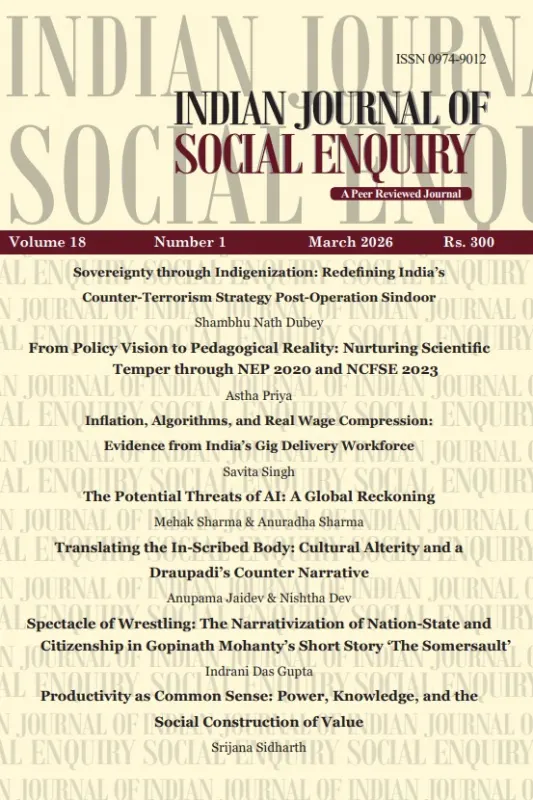
Volume 18 Issue 1 Cover

Issue Details:

Volume 18 Issue 1
Published:Aug 31, 2026

Editorial: March 2026

Welcome to the 2026 issue of Indian Journal of Social Enquiry. This issue showcases the remarkable breadth and depth of contemporary research across multiple disciplines. From cutting-edge applications of machine learning in climate science to the revolutionary potential of quantum computing in drug discovery, our featured articles demonstrate the power of interdisciplinary collaboration in addressing global challenges.

We are particularly excited to present research that bridges traditional academic boundaries, reflecting our journal's commitment to fostering innovation through cross-disciplinary dialogue. The integration of artificial intelligence with environmental science, the application of blockchain technology to supply chain management, and the convergence of urban planning with smart city technologies exemplify the transformative potential of collaborative research.

As we continue to navigate an era of rapid technological advancement and global challenges, the research presented in this issue offers both insights and solutions that will shape our future. We thank our authors, reviewers, and editorial board members for their continued dedication to advancing knowledge and promoting scientific excellence.

Prof Gitanjali Chawla
Editor in Chief
Indian Journal of Social Enquiry

Articles in This Issue

Showing 8 of 8 articles
Research PaperID: IJSE1180001Pages 1-5Open AccessOpen Access

Artificial Intelligence Readiness Among Small and Medium Enterprises: A Survey Based Assessment Framework

Mr. Darshan Patel (ME CE)

Artificial Intelligence (AI) has become an essential technology for improving business efficiency and competitiveness. However, many Small and Medium Enterprises (SMEs) continue to face challenges in adopting AI due to financial limitations, lack of technical expertise, and uncertainty regarding return on investment. This demonstration study proposes an AI Readiness Framework and presents fictional survey data from 150 SMEs to illustrate how such a study may be structured. The findings indicate that while business leaders recognize the strategic importance of AI, implementation readiness remains moderate, emphasizing the need for affordable AI solutions, employee training, and organizational planning.

Artificial IntelligenceSMEsDigital TransformationBusiness StrategyTechnology Adoption
6 views
4 downloads

Contributors:

 Mr. Darshan Patel (ME CE)
Research PaperID: IJSE1180002Pages 8-19Open AccessOpen Access

Sovereignty through Indigenization: Redefining India’s Counter-Terrorism Strategy PostOperation Sindoor

Shambhu Nath Dubey

India has witnessed multiple waves of terrorism since 1945, shaped by both internal and external factors. In recent history, Operation Sindoor, a tactful military response launched in May 2025 following the brutal terrorist attack in Pahalgam points out a figurative shift in India’s counter-terrorism policy. This paper situates the operation within broader terrorism theory, evaluates India’s evolving security strategy, and interrogates the legal, political, and ethical dimensions, multilateral approach, to understand state responses to terrorism. By analyzing the integration of indigenous defense technologies and the synergy between military action and diplomatic engagement, this study interprets Operation Sindoor not merely as a tactical event but as a symbolic and structural transformation in India’s counter-terrorism posture. It argues that India has successfully transitioned toward a “dual-track” strategy that seamlessly blends hard-power deterrence with assertive multilateralism, underpinned by an indigenous ecosystem that ensures strategic autonomy.

Operation SindoorTerrorismCounter – terrorismIndiaJammu and Kashmir
2 views
1 downloads

Contributors:

 Shambhu Nath Dubey
Research PaperID: IJSE1180003Pages 20-33Open AccessOpen Access

From Policy Vision to Pedagogical Reality: Nurturing Scientific Temper through NEP 2020 and NCFSE 2023.

Astha Priya

Promotion of Scientific Temper has always been at the heart of the democratic and intellectual evolution of India. This article explores the alignment between NEP 2020 and NCFSE 2023 in developing Scientific Temper among learners. The study also discusses Piaget’s constructivism, Vygotsky’s social scaffolding, Dewey’s inquiry-based pragmatism, and Kolb’s experiential learning, in understanding the development of Scientific Temper among learners. The analysis highlights that NSCFSE 2023 translates the philosophical mandates provided by NEP 2020 within real classrooms. At the same time, the article also discusses the challenges in the execution process and the potential of emerging technologies to bridge these gaps. The study concludes that the development of Scientific Temper among learners not only requires policy support but also a transformative shift at the classroom level. Changes at the grassroots level are an important step towards this direction.

Scientific TemperNEP 2020NCFSE 2023Transformative Shift
3 views
2 downloads

Contributors:

 Astha Priya
Research PaperID: IJSE1180004Pages 34-53Open AccessOpen Access

Inflation, Algorithms, and Real Wage Compression: Evidence from India’s Gig Delivery Workforce

Savita Singh

The Indian gig economy has seen exponential growth, with trajectory-based estimates putting the number of active gig workers above 12 million around the 2025-2026 fiscal year. However, this structural reorientation towards informalized, algorithmically controlled labor conceals an escalating crisis of real wage erosion. The impact of retail inflation and its resultant increase of living costs on the effective earnings of Indian location-based short, quickcommerce, and delivery type gig workers. The cumulative increase in the costs of essential commodities, primarily fuel, food, and rent in urban localities, has significantly impaired the purchasing power of the workers, against the backdrop of India’s higher macroeconomic stability and inflation headline moderation following the post-pandemic inflation peak. Using a combined macro-micro framework, this paper argues that policy must shift from nominal earnings discourse to a transparent real-wage architecture. It assesses cumulative CPIindexed minimum per-task earnings, mobility compensation indexed to fuel, paid waiting-time rules, and social-security contributions that are portable. The central conclusion is that, without inflation-indexed wage floors and algorithmic accountability, India’s gig economy will continue to generate employment volume while producing income insecurity and urban precarity.

Gig economyReal wagesRetail inflationAlgorithmic wagesettingIndian labor marketPlatform workers+1 more
2 views
1 downloads

Contributors:

 Savita Singh
Research PaperID: IJSE1180005Pages 54-77Open AccessOpen Access

The Potential Threats of AI: A Global Reckoning

Mehak Sharma, Anuradha Sharma

This article presents the potential threats which are usually faced while using artificial intelligence. The study looks at data from government organizations and prominent academic institutions such as Yoshua Bengio’s 2025 study, The International AI Safety study (2025), World Economic Forum assessments, McKinsey Global Institute projections, OECD monitoring frameworks, MIT Technology Review, and research from the International Labor Organization amongst others to investigate the complex risk environment associated with the development and use of AI. It also portrays that instead of processing any inherent moral attributes, AI reflects the objectives, values and errors of creators. Moreover, it focuses on the fact that at this critical juncture, the issue is mostly sociological rather than technical. It is finally concluded that AI Governance is a must, and not a choice.

Artificial intelligencePotential threatsSocial disintegrationData poisoningPredictive policing
2 views
1 downloads

Contributors:

 Mehak Sharma
,
 Anuradha Sharma
Research PaperID: IJSE1180006Pages 78-87Open AccessOpen Access

Translating the In-Scribed Body: Cultural Alterity and a Draupadi’s Counter Narrative

Anupama Jaidev, Nishtha Dev

The subject of this paper is the translation of a short story by late Mahasweta Devi titled “Draupadi” by Gayatri Chakravarti Spivak. The paper seeks to explore the journey of the narrative from the contextual subset of 20th century Bengali literature, to the pan-national and indeed the international literary field as a representative text of subaltern consciousness in the subcontinent. The paper seeks to explore the textual inscription of the (un)making of a tribal ‘Draupadi’ from the moment of her accidental christening, through complex cultural parallels, to the inevitable moment of her disrobing and after. The figure of Mahasweta’s Draupadi strides across from beyond the pale of the mainstream cultural imaginary and forces a realignment of customary readings of the narrative of the legendary Draupadi and her infamous humiliation.

DraupadiMainstream cultural imaginaryPostcolonialAlterityTribal namesake
3 views
2 downloads

Contributors:

 Anupama Jaidev
,
 Nishtha Dev
Research PaperID: IJSE1180007Pages 88-104Open AccessOpen Access

Spectacle of Wrestling: The Narrativization of Nation-State and Citizenship in Gopinath Mohanty’s Short Story ‘The Somersault’

Indrani Das Gupta

This article examines Gopinath Mohanty’s short story, ‘The Somersault’, within the framework of Bhartiya Kushti’s cross-pollination with the postcolonial Indian nation-state’s politics of inequality and disparity. Mohanty’s narrative is analysed in relation to the politics of spectacle and the notion of the public sphere, highlighting the plight of poor citizens within the democratic practices of the nation-state. What this essay showcase is the divide between wrestling (Bhartiya Kushti) as an ethico-somatic framework articulated through Mohanty’s protagonist, Jaga Palei, and wrestling’s encapsulation as a commodified spectacle—drawing attention to issues of political governance and challenges created by a hypermedia-dominated public arena.

WrestlingDangalSpectaclePublic sphereDemocratic practices
2 views
1 downloads

Contributors:

 Indrani Das Gupta
Research PaperID: IJSE1180008Pages 105-113Open AccessOpen Access

Productivity as Common Sense: Power, Knowledge, and the Social Construction of Value

Srijana Sidharth

This paper challenges the assumption that common sense is neutral, selfevident, or devoid of power by situating it within relations of ideology and hegemony. Drawing on a ‘Sociology of Knowledge’ perspective, and building on insights from Antonio Gramsci and Satish Deshpande, it argues that common sense derives its power precisely from its ability to obscure its own conditions of production. Rather than being natural or universal, common sense is historically constructed and shaped by dominant social groups. The paper develops this argument through an analysis of productivity as a contemporary form of ideological common sense. It examines how media and digital discourses associated with hustle culture, circulate and normalize specific valuations of time, labour, and selfhood. In doing so, productivity emerges not merely as a descriptive category but as a normative framework that naturalizes and legitimizes hierarchies of labour. By foregrounding the discursive construction of productivity, the paper demonstrates how common sense operates as a site of power that structures both perception and practice in contemporary neoliberal contexts.

Common SenseProductivityIdeologyHegemonyHustle CultureNeoliberalism+1 more
2 views
1 downloads

Contributors:

 Srijana Sidharth
Whatsapp