

editor_ijse@mac.du.ac.in
9818679187
e-ISSN: applied
Indian Journal of Social Enquiry

Indian Journal of Social Enquiry

Volume 17, Issue 2 - 2025 (June 2025)

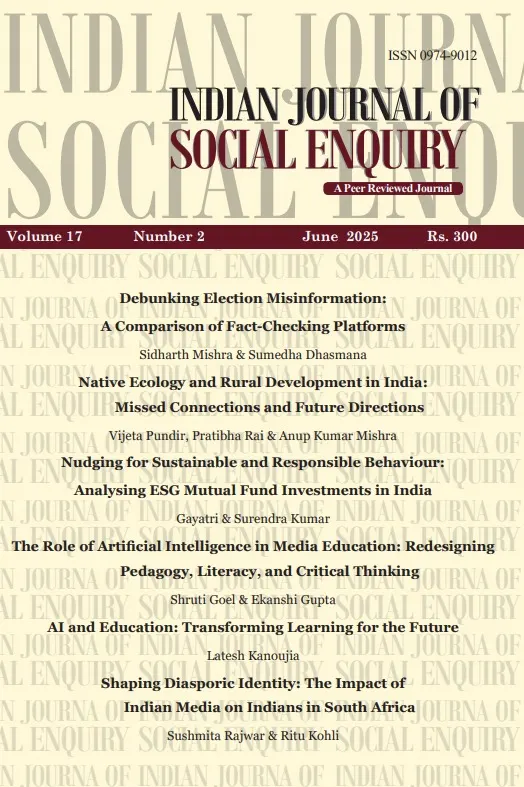
Volume 17 Issue 2 Cover

Issue Details:

Volume 17 Issue 2
Published:Sep 3, 2026

Editorial: June 2025

Welcome to the 2025 issue of Indian Journal of Social Enquiry. This issue showcases the remarkable breadth and depth of contemporary research across multiple disciplines. From cutting-edge applications of machine learning in climate science to the revolutionary potential of quantum computing in drug discovery, our featured articles demonstrate the power of interdisciplinary collaboration in addressing global challenges.

We are particularly excited to present research that bridges traditional academic boundaries, reflecting our journal's commitment to fostering innovation through cross-disciplinary dialogue. The integration of artificial intelligence with environmental science, the application of blockchain technology to supply chain management, and the convergence of urban planning with smart city technologies exemplify the transformative potential of collaborative research.

As we continue to navigate an era of rapid technological advancement and global challenges, the research presented in this issue offers both insights and solutions that will shape our future. We thank our authors, reviewers, and editorial board members for their continued dedication to advancing knowledge and promoting scientific excellence.

Prof Gitanjali Chawla
Editor in Chief
Indian Journal of Social Enquiry

Articles in This Issue

Showing 6 of 6 articles
Research PaperID: IJSE2170001Pages 7-25Open AccessOpen Access

Debunking Election Misinformation: A Comparison of Fact-Checking Platforms

Sidharth Mishra

India is home to the world’s largest democracy. The lynchpin of this vibrant democracy is free and fair elections. The year 2024 witnessed substantial political dynamism with General Elections in April, followed by Legislative Assembly Elections in the consequent months. As the election period gained momentum, the media started to brim with political news stories. Given this evolving landscape, it is crucial to examine how different media platforms circulated election-related news. Researchers emphasize that the election period brought a surge in fake news, misinformation, and disinformation. The Election Commission of India has launched the Myth vs Reality Register to combat this mounting challenge and to uphold electoral integrity. Against this backdrop, this research examines how ECI’s Myth vs Reality Register and other leading Indian independent fact-checking agencies, such as Alt News, Boom, and Vishvas News combat the challenges posed by the fake news circulated by the ever-growing online media. Analysis of content has been performed to understand the manner in which fake news is tackled. It is identified that the news items that are presented on these sites are majorly presented as false news, fake news, and misleading news.

Fact checkFake newsElectionsModel code of conductMyth vs Reality Register
2 views
1 downloads

Contributors:

 Sidharth Mishra
Research PaperID: IJSE2170002Pages 26-50Open AccessOpen Access

Native Ecology and Rural Development in India: Missed Connections and Future Directions

Vijeta Pundir

Rural India is vulnerable to most of the 21st century developmental challenges like the vast and continuing environmental as well as ecological damage, large-scale migration and mobility, international competition, rising income-inequalities, increased instances of natural disasters and technological disruption. In order to navigate these complexities, a long-term guiding framework that emphasises on rural sustainability is essential. India has implemented various Rural Development Programmes (RDP), each with specific objectives, resulting in a fragmented policy framework and disjointed implementation. These initiatives seem to have been conceived from an urban perspective, ignoring the unique needs of diverse rural and peri-urban regions. Even though 44.72% of the world’s population resides in rural areas, mainstream development policies often underestimate their potential. Rural areas can play an important role in sustainable development by harnessing indigenous resources, promoting local industries and tourism, and contributing to renewable energy production. This paper explores the effectiveness of integrated rural development initiatives in India, evaluating their impact on livelihoods, basic infrastructure, and community empowerment. Drawing from programme documentation and stakeholder perspectives, the paper seeks to identify key bottlenecks and policygaps. The findings underscore the need for context-specific interventions, stronger community-participation, and convergence across schemes for holistic development.

Rural developmentSustainable developmentIntegrated rural developmentSocial innovationSmart villages
2 views
1 downloads

Contributors:

 Vijeta Pundir
Research PaperID: IJSE2170003Pages 51-78Open AccessOpen Access

Nudging for Sustainable and Responsible Behaviour: Analysing ESG Mutual Fund Investments in India

Gayatri ayatri

‘Prithvi shanti’, meaning ‘let the forces of nature be in balance’, is an ancient Indian wisdom, coming from the Upanishads. Ever since the Rio de Janeiro conference took place in 1992 in Brazil, the world has improved compared to what it would have been without this conference. This nudging for sustainable and responsible behaviour has continued since then, but the question remains as to how effective it has been. The effectiveness of nudging to perform sustainable behaviour can be assessed in several ways, including global investment in environmental sustainability, improvements in environmental, social, and governance (ESG) metrics, and a reduction in environmental degradation. Presently, it has evolved into a full-fledged ESG sector, encompassing compliance and investment This paper attempts to trace the evolution of the ESG framework in India. Further, it seeks to analyse the performance of the Nifty 100 Index with the Nifty 100 ESG Index and ranks the ESG mutual funds in India based on their last 3 years’ performance. The tendency to invest in sustainable and responsible investments is rising, albeit slowly. A comparison of the broad market index, Nifty 100, with the Nifty 100 ESG shows that the latter has outperformed.

EnvironmentalSocialand Governance (ESG)IndicesESG Mutual FundsInvestments+1 more
2 views
1 downloads

Contributors:

 Gayatri ayatri
Research PaperID: IJSE2170004Pages 79-94Open AccessOpen Access

The Role of Artificial Intelligence in Media Education: Redesigning Pedagogy, Literacy, and Critical Thinking

Shruti Goel

The integration of Artificial Intelligence (AI) in media education is transforming pedagogical methods, media literacy, and the definition of critical thinking as it is perceived today. The employment of AI technologies facilitates learning through the provision of personalised content, the automation of the assessment process, and the development of analytical capabilities. This research delves into the implications of AI in education practice, its impact on media literacy and on developing critical thinking. The paper also briefly discusses ethical implications and data privacy concerns associated with AI. This research posits that AI technologies will be the most essential tools to equip students in order to navigate a digital world.

Artificial intelligenceMedia educationPedagogyMedia literacyCritical thinking
2 views
1 downloads

Contributors:

 Shruti Goel
Research PaperID: IJSE2170005Pages 95-106Open AccessOpen Access

AI and Education: Transforming Learning for the Future

Latesh Kanoujia

Artificial Intelligence (AI) is revolutionising classrooms by making learning efficient, accessible, and personalised. AI-enabled tools such as intelligent tutoring systems and adaptive learning software, monitor students’ performance and provide customised study plans, allowing students to study at their own pace. Virtual assistants and chatbots offer instant feedback and guidance in communication, and computer grading lightens the administrative load for faculty members, permitting them to devote their time to teaching and advising. Outside the classroom, AI is transforming access to learning. Speech-to-text and text-to-speech functionality facilitate learning for disabled students, and textto-language programs aid in breaking down multilingual classroom barriers. Such technologies promote accessibility and inclusion of foreign students in education. However, integrating AI with education may also be fraught with danger. Issues such as privacy of information, digital disparities, and reduction of the human element in education need to be addressed. AI technologies are not equally accessible to all, which may cause them to widen educational disparities instead of reducing them. It is emphasised that ethical AI innovation, wise policymaking, and digital infrastructure investments be used to ensure that AI is accessible to all students on an equal basis, irrespective of their backgrounds. This study examines the potential of AI to revolutionise learning into possibilities and opportunities intertwined. It is hoped that AI improves future learning and customised education as well as becomes inclusive, if policymakers, educators, and technologists join hands in a collective effort.

Artificial IntelligencePersonalised learningEducation technologyDigital accessibilityAdaptive learning
2 views
1 downloads

Contributors:

 Latesh Kanoujia
Research PaperID: IJSE2170006Pages 107-125Open AccessOpen Access

Shaping Diasporic Identity: The Impact of Indian Media on Indians in South Africa

Sushmita Rajwar

Various researchers have discussed at length the story of Indians migrating to South Africa. There is quite a body of literature tracing the journey of Indians migrating to South Africa through different means. Through the different studies the question of ‘identity’ especially for Indians in South Africa, has been addressed time and again. South African Indian identity is the product of many different factors. Among the various factors that have led to the formation of this South Africa identity, perhaps the most significant is the media. Indians have been influenced with the Indian media, since the beginning of migration as indentured labour. This essay purports to analyze three types of Indian media that have been paramount in shaping Indian diasporic identity in South Africa: print media, especially newspapers; cinema, Bollywood; and social media, including Facebook, Instagram, and YouTube.

MigrationIndiansSouth AfricaMediaIdentity
2 views
1 downloads

Contributors:

 Sushmita Rajwar
Whatsapp