

editor_ijse@mac.du.ac.in
9818679187
e-ISSN: applied
Indian Journal of Social Enquiry

Indian Journal of Social Enquiry

Volume 9, Issue 1 - 2017 (March 2017)

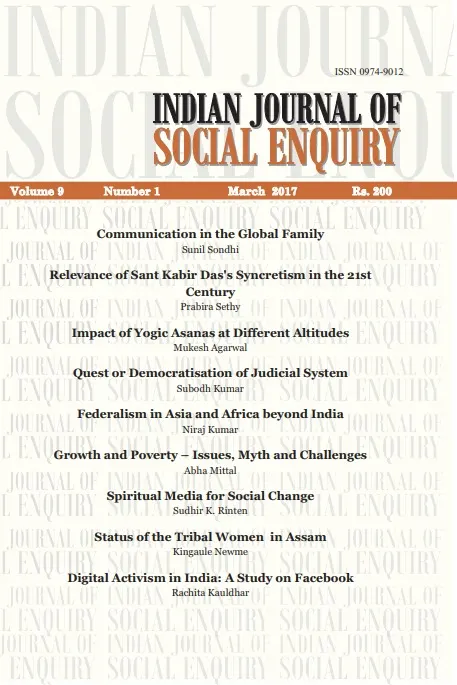
Volume 9 Issue 1 Cover

Issue Details:

Volume 9 Issue 1
Published:Sep 2, 2026

Editorial: March 2017

Welcome to the 2017 issue of Indian Journal of Social Enquiry. This issue showcases the remarkable breadth and depth of contemporary research across multiple disciplines. From cutting-edge applications of machine learning in climate science to the revolutionary potential of quantum computing in drug discovery, our featured articles demonstrate the power of interdisciplinary collaboration in addressing global challenges.

We are particularly excited to present research that bridges traditional academic boundaries, reflecting our journal's commitment to fostering innovation through cross-disciplinary dialogue. The integration of artificial intelligence with environmental science, the application of blockchain technology to supply chain management, and the convergence of urban planning with smart city technologies exemplify the transformative potential of collaborative research.

As we continue to navigate an era of rapid technological advancement and global challenges, the research presented in this issue offers both insights and solutions that will shape our future. We thank our authors, reviewers, and editorial board members for their continued dedication to advancing knowledge and promoting scientific excellence.

Prof Gitanjali Chawla
Editor in Chief
Indian Journal of Social Enquiry

Articles in This Issue

Showing 9 of 9 articles
Research PaperID: IJSE190002Pages 9-35Open AccessOpen Access

Communication in the Global Family

Sunil Sondhi

Global development has broken through the boundaries of space, time, cultural assumptions, and the scope, structure, and function of human society. It not only demands new ways of thinking and organization, but also opens up new imperatives for investigating linkages between thought and action, knowledge and being, structure and process. These new imperatives of global development demand a new way of communication in order to achieve skill in the process of intercultural interaction. It is the purpose of this paper to examine the principles and practice of intercultural communication skill in the context of the Indian concepts of Advaita, Sahridayata, and Samdarsana

Intercultural CommunicationGlobal DevelopmentIntercultural InteractionAdvaitaSahridayataSamdarsana+8 more
4 views
5 downloads

Contributors:

 Sunil Sondhi
Research PaperID: IJSE190003Pages 36-52Open AccessOpen Access

Relevance of Sant Kabir Das's Syncretism in the 21st Century

Prabira Sethy

The article begins with an attempt to reconstruct Kabir's biography by analysing where Kabir was born, who were his parents and when he was born which has been shrouded in the mists of mystery. Then, the article goes on to exhibit Kabir's philosophy about syncretism by bridging the gap in between rich and poor, higher and lower castes, and the Hindus and the Muslims people by his message to maintain equality, love affection and cooperation to one and another in place of enmity, jealousy, egotism, disparity and has shown the way to the human beings to love for one another.

KabirKabir's PhilosophySyncretismSocial EqualityHindu Muslim RelationsCaste System+7 more
2 views
1 downloads

Contributors:

 Prabira Sethy
Research PaperID: IJSE190004Pages 53-61Open AccessOpen Access

Impact of Yogic Asanas at Different Altitudes

Mukesh Agarwal

This study examines the impact of yogic asanas on the physiological functioning of youth living at different altitudes. A total of 399 subjects were selected from three regions representing different altitudinal conditions, Shimla, Delhi and Mumbai. The participants underwent three months of yogic asanas training, followed by physiological assessment. The study evaluated Body Mass Index, body fat percentage, Basal Metabolic Rate, Waist Hip Ratio, pulse rate, systolic and diastolic blood pressure, and Total Leukocyte Count. The collected data were analyzed using the independent t test and Kruskal Wallis nonparametric test. The findings indicate significant differences among the three altitude groups in several physiological parameters, particularly Body Mass Index, Basal Metabolic Rate, Waist Hip Ratio and Total Leukocyte Count, both before and after yogic asanas training. In contrast, body fat percentage and pulse rate did not show significant differences among the groups. The findings suggest that altitude related environmental conditions may be associated with variations in physiological parameters among youth undergoing yogic asanas training.

Yogic asanasyoga trainingaltitudephysiological parametersyouthBody Mass Index+4 more
2 views
1 downloads

Contributors:

 Mukesh Agarwal
Research PaperID: IJSE190005Pages 62-67Open AccessOpen Access

Quest for Democratisation of Judicial System

Subodh Kumar

The suppression of power was done to check the arbitrariness of the executive legislative and judiciary. The democratization of democracy can only be possible when there is no interference in these processes. Today, there has been a remarkable achievement of equality, liberty, and fraternity through constitutionalism. This was possible only when Judiciary is independent. To enhance the belief in institutions of judiciary, more pragmatic and decentralized approach is needed. This will enhance the faith and trust in judicial institutions. Through democratization of judiciary, constitutional democracy and republic will achieve the aims and objectives of our constitution. Montesquieu's Spirit of Laws advocates separation of powers were political authority of the state is divided into legislative, executive and judicial powers. The separation was done to preserve liberty and, as the institutional requirement of a representative democracy. Hence, Judiciary checks arbitrariness of the Executive and Legislature and is the custodian of the constitution. To ensure its independence elaborate provisions have been made in the constitution under Article 124, 217, 233, 234 and 235. Moreover, the democratisation in actual sence can only be possible when there is no interference in the processes of judiciary, i.e., from appointments of judges to pronouncement of the verdicts. Today there has been a remarkable achievement of liberty, equality and fraternity through constitutionalism. This is possible only when our judiciary is independent.

ConstitutionalismJudicial IndependenceDemocratization of JudiciarySeparation of PowersConstitutional DemocracyJudiciary+8 more
2 views
1 downloads

Contributors:

 Subodh Kumar
Research PaperID: IJSE190006Pages 68-73Open AccessOpen Access

Federalism in Asia and Africa beyond India

Niraj Kumar

Federalism, first born in North America in pioneering presidential-federal and parliamentary-federal forms in the USA and Canada respectively, is not particularly popular in Asia and Africa. Only five of Asia`s 48sovereign states have adopted some kinds of federal or quasi-federal forms of government. In Africa it is even more unpopular. Of 54 African states, only three can be counted as some kind of federal or hybrid federal formations. I offer some speculative but empirically and theoretically relevant explanations why it might be so.

Presidential-federal governmentParliamentary-federal governmentFederal structureFederal division of powersQuasi-federalfederal second chamber+1 more
2 views
1 downloads

Contributors:

 Niraj Kumar
Research PaperID: IJSE190007Pages 74-85Open AccessOpen Access

Growth and Poverty –Issues, Myth and Challenges

Abha Mittal

In more than half century since its Independence, India has accomplished many notable social and economic achievements. Among these are the eradication of widespread famine, a reduction in population growth, some lowering of caste barriers to economic opportunity and the creation of a large pool of technical and scientific talent. While it has also managed to reduce poverty in that period, only since 1975, when growth accelerated, has the decline been fairly steady. India's progress in fighting poverty has been modest when compared with some of its Asian neighbours. Between 1970 and 1993, for example, the proportion of Indonesia's population living in poverty dropped from 58 to 8 percent, an annual decline of nearly 10 percent. India's poverty continues to be predominantly rural although rural poverty declined faster than urban poverty. Moreover, the decline in national poverty seems to have been driven mostly by the decline in rural poverty. The real issue in establishing a development strategy is whether growth and distribution are independent of each other or, strongly inter-related. Is it the case for instance that faster growth tends to reduce inequality or on the contrary, to increase it? Could too much inequality in a given country act to slow down or, to accelerate growth? All these questions have concerned economists in the last decades and probably will keep doing so for the years to come. Therefore, while preparing a development strategy for our nation, the main issue before the economists is whether to focus on increasing growth or by reducing poverty or by removing inequality or removing unemployment.

PovertyEconomic GrowthIncome InequalityRural PovertyUrban PovertyUnemployment+6 more
2 views
1 downloads

Contributors:

 Abha Mittal
Research PaperID: IJSE190008Pages 86-92Open AccessOpen Access

Spiritual Media for Social Change

Sudhir K. Rinten

Indian Media coverage is dealt in materialistic perspective due to various reasons. Content, coverage style, presentation and portrayal all are affected by contemporary 'peg' of pulling audience in to the content. Media ignores humanitarian approach in different walk of media activities. They gather and present information without keeping in mind the ethico-legal and sociocultural aspects of affected parties. 'Journalistic sense' and 'news value' are examined on the basis of materialistic approach of media management. Requisite of the content is superseded by wow factor of the content. In such an environment spiritual media and professionals with spiritual understanding may provide a solution to the problem. This paper suggests the spiritual media as only alternative.

MediaSpiritualEthicsKarmyoga
2 views
1 downloads

Contributors:

 Sudhir K. Rinten
Research PaperID: IJSE190009Pages 93-102Open AccessOpen Access

Status of the Tribal Women in Assam

Kingaule Newme

In the tribal society, customary laws and practices have acted as the biggest stumbling block for empowering women. Zeme Naga women in Assam do not enjoy equal political and social status with men. Women perform diverse roles in the society. Traditionally, women had four fold role to play such as a daughter, wife, housewife and a mother. From the childhood women are taught to believe that they are inferior to men in every sphere of life. Traditions and religion have a strong influence on women in guiding their lives from birth to death. The Zeme follow the Patriarchal system of family, who holds the absolute power as well the full responsibilities for protection and looking after the welfare of all dependents and the maintenance of his family. The descendant is always traced down from the male members only and the supremacy of male had been the unquestioned norm of social governance since the ancient times. After the death of the father, the head of the family is taken over by the eldest son of the family. Therefore after the first child, the birth of a son is preferred and the family with more sons are respected by the people whereas the family with many daughters are regarded to be the end of the generation of that family. This paper tries brings out the different position of a women in the Zeme Naga society.

Women positionZeme NagaAssam
2 views
1 downloads

Contributors:

 Kingaule Newme
Research PaperID: IJSE190010Pages 103-114Open AccessOpen Access

Digital Activism in India: A Study on Facebook

Rachita Kauldhar

Ever since the internet has penetrated in our society, people have been using it in many ways. One of such use of the Internet, that has grown rapidly within the last decade, is the use of internet for mass mobilization or activism. A Digital Activism campaign is "an organised public effort, making collective claims on a target authority, in which civic initiators, or supporters use digital media to accomplish their cause". Internet can be used in a variety of ways to create activism, such as by e-mailing petitions perusing people to join the campaigns, making social groups, creating awareness about the issue or the cause on the internet, use of hashtags and other ways. This study analysis the various types of digital activism on current issues appearing on the Facebook. For this purpose content analysis is being adopted as a research methodology with an objective to analyse the occurrences, types and functions of digital activism in India. Also, the study identified the nature and functions of the posts and comments on digital activism issues on Facebook. The result reveals that 'Slacktivism' is the most popular form of digital activism on Facebook in India.

Digital ActivismFacebookCampaignsSlacktivismHashtags
3 views
1 downloads

Contributors:

 Rachita Kauldhar
Whatsapp