

editor_ijse@mac.du.ac.in
9818679187
e-ISSN: applied
Indian Journal of Social Enquiry

Indian Journal of Social Enquiry

Volume 9, Issue 3 - 2017 (Sept. 2017)

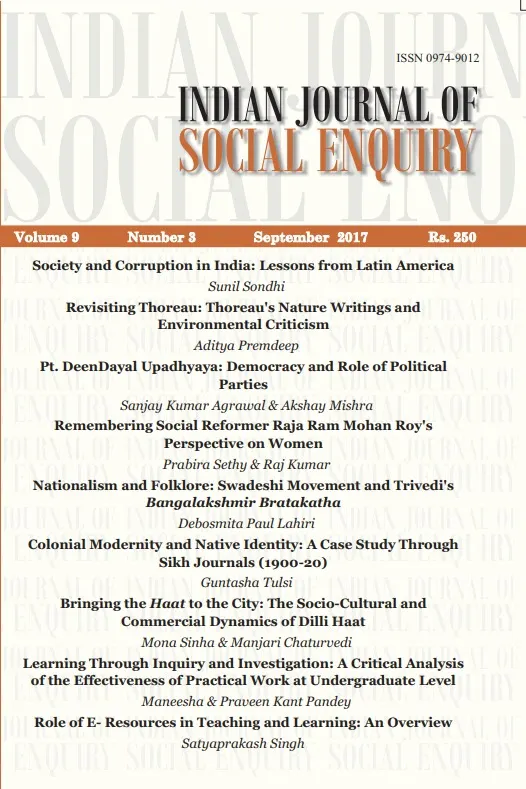
Volume 9 Issue 3 Cover

Issue Details:

Volume 9 Issue 3
Published:Sep 2, 2026

Editorial: Sept. 2017

Welcome to the 2017 issue of Indian Journal of Social Enquiry. This issue showcases the remarkable breadth and depth of contemporary research across multiple disciplines. From cutting-edge applications of machine learning in climate science to the revolutionary potential of quantum computing in drug discovery, our featured articles demonstrate the power of interdisciplinary collaboration in addressing global challenges.

We are particularly excited to present research that bridges traditional academic boundaries, reflecting our journal's commitment to fostering innovation through cross-disciplinary dialogue. The integration of artificial intelligence with environmental science, the application of blockchain technology to supply chain management, and the convergence of urban planning with smart city technologies exemplify the transformative potential of collaborative research.

As we continue to navigate an era of rapid technological advancement and global challenges, the research presented in this issue offers both insights and solutions that will shape our future. We thank our authors, reviewers, and editorial board members for their continued dedication to advancing knowledge and promoting scientific excellence.

Prof Gitanjali Chawla
Editor in Chief
Indian Journal of Social Enquiry

Articles in This Issue

Showing 9 of 9 articles
Research PaperID: IJSE390001Pages 30-38Open AccessOpen Access

Revisiting Thoreau: Nature and Natural in the Literary Imagination

Aditya Premdeep

Thoreau's corpus of writings celebrates nature and the natural. Nature, for Thoreau, is a spiritual vehicle and a living entity. He considers “man as an inhabitant, or a part and parcel of Nature, rather than a member of society” (2000, p. 627). As a foundational text for environmentalism and ecocriticism, Thoreau's Walden (1854) accentuates the importance of nature as an inalienable entity for the human existence. His influential essay “Walking” (1862) demonstrates the significance of nature for the “physical, mental, and spiritual” well-being of human beings. Another essay “Paradise (to be) Regained” (1843) critiques the technological advancement at the cost of nature and manipulation of the natural ecosystem. This paper seeks to locate nature and the natural in the literary imagination of Thoreau's three influential texts Walden, “Walking”, and “Paradise (to be) Regained”.

ThoreauNature-writingEcocriticismWaldenTranscendentalism
2 views
1 downloads

Contributors:

 Aditya Premdeep
Research PaperID: IJSE390002Pages 51-63Open AccessOpen Access

Remembering Social Reformer Raja Ram Mohan Roy's Perspective on Women

Prabira Sethy, Raj Kumar

This paper attempts to develop an explanation for women's unequal position in society keeping in mind Raja Ram Mohan Roy's views on women's right to property. It appears that he saw gender inequalities to be a consequence of the denial of rights to women. Accordingly, it also focuses on how increase in polygamy made the plight of women more dreadful leading them to either commit Sati or otherwise opt for deplorable widowhood. It also deals with other areas of women's concern - such as widow remarriage, female education, female infanticide, respect for women, etc.

Social ReformWomenGender inequalitiesNationalism
2 views
1 downloads

Contributors:

 Prabira Sethy
,
 Raj Kumar
Research PaperID: IJSE390003Pages 39-47Open AccessOpen Access

Pt. DeenDayal Upadhyaya: Democracy and Role of Political Parties

Sanjay Kumar Agrawal, Akshay Mishra

Democracy is a theory of society and not a theory of governance. A democratic government is the product of democratic society and not vice-versa. We may define democracy as the organization of society for liberty and equality, through the spirit of fellowship or fraternity, as well as the right to participate in political decision making. Participation and control of governance by people is the essence of democracy which is a constantly moving dynamic force and which impels us towards a social organisation in which every individual member shall have equal opportunity to develop holistically. Pt. DeenDayalUpadhaya's views on democracy and the role of political party is relevant in contemporary India as it was in past. He wanted to decolonise Indian political thought which was largely as he said, “A western political picture in the Indian background”. He strongly argued against the left-right division as being detrimental to the growth of the constructive, transformative pro-people democracy which is the part of his “Swayambhu philosophy” which contains the celebrated Integral Humanism. He argued that this left-right categorisation does not give a correct idea of politics in India because many programmes of these political parties defy any classification on this orthodox basis. He wanted to wash out this distinction from political parties which hamper the transformation of India into New India in a more democratic fashion. According to him, politics must be controlled by the masses and not by the wealthy. Neo liberalism has challenged democracies to ensure they do not become beholden to corporate interest. DeenDayal cautioned that “if steps are not taken to mend them, powerful lobbies will emerge in the country's legislature and political decision will hardly be taken in an objective manner”. Taking into consideration the welfare of people and promotion of national interest, this paper will focus on the feasibility of practising the concept of Integral Humanism in a democracy, highlighting the importance of it in contemporary issues of policy making and implementation through a more democratic, accountable and participative manner.

DemocracyIntegral HumanismPolicy makingGovernance
2 views
1 downloads

Contributors:

 Sanjay Kumar Agrawal
,
 Akshay Mishra
Research PaperID: IJSE390004Pages 64-71Open AccessOpen Access

Nationalism and Folklore: Swadeshi Movement and Trivedi's Bangalakshmir Bratakatha

Debosmita Paul Lahiri

The Swadeshi Movement of Bengal (1905-1908) came up to protest against the division of the Presidency of Fort William into two separate provinces. Its leaders attempted to popularise its ideologies amongst the masses by including ethno-cultural motifs. Religious festivals like Durga Puja and Kali Puja were celebrated by the Swadeshi leaders with the motive of spreading anti-colonial sentiments amongst the people and forging a nation. Urban writers experimented with the folk forms to propagate Swadeshi ideologies. Ramendrasundar Trivedi (1864-1919) wrote Bangalakshmir Bratakatha (1905) in the bratakatha (ritual tales) form and was an allegory of the nation of the Bengalis as visualised by the Swadeshis. Trivedi's aim was to preach the ideals of the Swadeshi movement among the women, the spiritual core of the nation in the making. However, the principles proposed in the Bratakatha reflect an image of a nation which is against the idea of pan-Indian nationalism propagated by the Swadeshis. Trivedi, rather, propagates sub-nationalist ideology. Based on the above made observations, the proposed paper aims to study the use of folklore to represent the ideology of the urban/political. The paper also attempts to study the formulation of nationalism/ sub-nationalism in Trivedi's work.

Bengal historyBengali literatureFolkloreNationalismNationPartition+1 more
2 views
1 downloads

Contributors:

 Debosmita Paul Lahiri
Research PaperID: IJSE390005Pages 72-88Open AccessOpen Access

Colonial Modernity and Native Identity: A Case Study through Sikh Journals (1900-20)

Guntasha Tulsi

This paper will explore the consolidation of colonial modernisation in the Punjab of the late nineteenth century. This will basically be in regard to projects of a similar nature carried in the entire Indian sub-continent. It will then look at fascinating responses in indigenous identity formation as an outcome of the Singh Sabha Movement of 1873, one of the most significant modernising influences on the colonised Punjab. By looking at the examples of various Sikh journals and their coverage of Sikh education and identity related issues during the years between 1900 to 1920, this paper will conclude to observe as to how there was a simultaneous process of influence and subversion on the part of members of native communities to modernising measures introduced by the colonial administration. From a post-colonial viewpoint and that of social enquiry, this is fascinating, as it is not a routine exercise to consult such lesser known sources, while exploring the colonial-native encounter in one of the most significant periods of Indian history.

Colonial ModernityNative IdentitySikh communitySubversionSikh Newspapers
2 views
1 downloads

Contributors:

 Guntasha Tulsi
Research PaperID: IJSE390006Pages 89-100Open AccessOpen Access

Bringing the Haat to the City: The Socio-Cultural and Commercial Dynamics of Dilli Haat

Mona Sinha, Manjari Chaturvedi

In the midst of the metropolis and urban center of the capital city Delhi stands Dilli Haat, serving varied purposes for the visitors who throng it, and the artisans, craftspeople, and shopkeepers who sell their products. Envisioned as a glimpse into the richness of rural India for the urban dwellers and a market for display and selling of indigenous crafts sans middle-men, Dilli Haat has transformed and metamorphosed with time in a complex grid of market forces, market players, consumers, and the accompanying constant role change. The paper takes a wholesome look at the haat, its changing dynamics, and purported influence over the cityscape and citizens through a research study to understand the nuanced questions of urban-rural divide, confluence, and the role played by created-and-designed spaces like Dilli Haat.

Dilli HaatUrban-rural divideDastakarMuseumification Dilli Haat
2 views
1 downloads

Contributors:

 Mona Sinha
,
 Manjari Chaturvedi
Research PaperID: IJSE390007Pages 101-112Open AccessOpen Access

Learning Through Inquiry and Investigation: A Critical Analysis of the Effectiveness of Practical Work at Undergraduate Level

Maneesha, Praveen Kant Pandey

Laboratories are a core requirement, in particular in science education for skill training and better understanding of concepts. The importance of good quality practical work is widely accepted for improvement of scientific skills and promoting the scientific culture amongst students, thereby leading to improved learning. Through this study, an effort was made to reflect and explore these often-raised concerns by assessing and mapping the current situation with inputs from stakeholders in developing students' knowledge and skills at the undergraduate level. A survey was conducted to identify and understand students' requirements, expectations, experiences and opinions regarding the practical work being done in undergraduate science laboratories in University of Delhi. The students' expectations in identifying the significant characteristics and requirements that demonstrate effective lab work were derived from this data.

Efficacy of practical workInquiryExperimental work
2 views
1 downloads

Contributors:

 Maneesha
,
 Praveen Kant Pandey
Research PaperID: IJSE390008Pages 113-123Open AccessOpen Access

Role of E- Resources in Teaching and Learning: An Overview

Satyaprakash Singh

The main purpose of this paper is to discuss the need and advantages of elearning and electronic resources. Nowadays e-resourcesare becoming more popular, since they are not only easy to use but are also reliable. Searching relevant information in a time frame is significant for both researchers and information professionals. E-resources are gaining popularity due to easy and fast accessibility. This paper focuses on the uses of various forms of electronic resources in academics and research. The new and current trend of library services has an economic and user-oriented tendency to access library collections electronically. Library professionals feel that electronic information has a vital role in providing updated information and timely delivery to the users.

LibraryInformationE ResourcesTechnologyResearch
2 views
1 downloads

Contributors:

 Satyaprakash Singh
Research PaperID: IJSE390011Pages 7-29Open AccessOpen Access

Society and Corruption in India: Lessons from Latin America

Sunil Sondhi

Fighting corruption has emerged as a key development issue in India in recent years. More and more policymakers, businesses, and civil society organizations have begun to confront the issue openly. Corruption in India is today recognized as a complex phenomenon, as the consequence of more deep-seated problems of policy distortion, institutional incentives and governance. Viewed in this perspective, anti-corruption policies are not simply policies that can be planned in advance and isolation, but often a set of subtler insights that can be developed only in conjunction with citizen participation. The Economic Development Institute at the World Bank, in collaboration with the Transparency International and local NGOs, has developed a methodological approach integrating within one empirical framework the various components identified so far for understanding and combating corruption. In this research paper, the World Bank framework is used to understand and explain the role of state and society in combating corruption in India and consider recent initiatives for an effective action plan in this regard.

CorruptionPolicySocietyDevelopmentPublic AdministrationDemocracy
2 views
1 downloads

Contributors:

 Sunil Sondhi
Whatsapp