

editor_ijse@mac.du.ac.in
9818679187
e-ISSN: applied
Indian Journal of Social Enquiry

Indian Journal of Social Enquiry

Volume 17, Issue 1 - 2025 (March 2025)

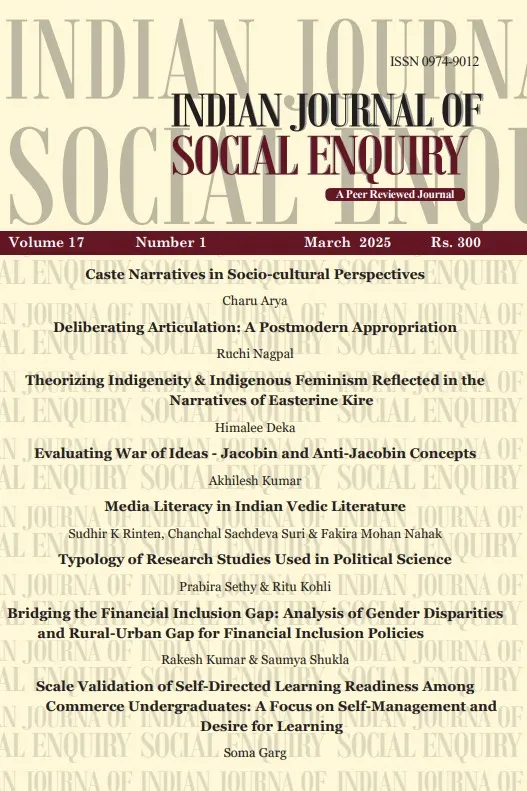
Volume 17 Issue 1 Cover

Issue Details:

Volume 17 Issue 1
Published:Sep 2, 2026

Editorial: March 2025

Welcome to the 2025 issue of Indian Journal of Social Enquiry. This issue showcases the remarkable breadth and depth of contemporary research across multiple disciplines. From cutting-edge applications of machine learning in climate science to the revolutionary potential of quantum computing in drug discovery, our featured articles demonstrate the power of interdisciplinary collaboration in addressing global challenges.

We are particularly excited to present research that bridges traditional academic boundaries, reflecting our journal's commitment to fostering innovation through cross-disciplinary dialogue. The integration of artificial intelligence with environmental science, the application of blockchain technology to supply chain management, and the convergence of urban planning with smart city technologies exemplify the transformative potential of collaborative research.

As we continue to navigate an era of rapid technological advancement and global challenges, the research presented in this issue offers both insights and solutions that will shape our future. We thank our authors, reviewers, and editorial board members for their continued dedication to advancing knowledge and promoting scientific excellence.

Prof Gitanjali Chawla
Editor in Chief
Indian Journal of Social Enquiry

Articles in This Issue

Showing 8 of 8 articles
Research PaperID: IJSE1170001Pages 7-19Open AccessOpen Access

Caste Narratives in Socio-cultural Perspectives

Charu Arya

Understanding Caste in the historical perspective can be broadly analysed as division of people on the basis of their ethnic and economic skill-based divisions. This leads us to develop a deeper understanding of the need for creating caste divisions, that could not sustain their original roots and gradually developed to make these divisions as permanent categorisation based on the birth of an individual into a particular caste. This research will analyse various perspectives that allowed an understanding of various discourses born out of narratives that open this discourse further and create an opportunity to build neo-dalit perspectives towards Dalit identities. Dalit narratives are strong arguments that emphasise the need for bringing these narratives in to mainstream literary canon. Reading Ambedkar to Yagati Chinna Rao to Bama in detail, this paper will build a discussion around Dalit identities from a critical perspective.

CasteDalit narrativesDiscourseNeo-dalitDalit intellectuals
3 views
1 downloads

Contributors:

 Charu Arya
Research PaperID: IJSE1170002Pages 20-29Open AccessOpen Access

Deliberating Articulation: A Postmodern Appropriation

Ruchi Nagpal

Articulation theory is a recent phenomenon which has gained currency in the recent times for the reasons which can fairly be attributed to the zeitgeist. Articulation, which might simply mean “to express” and which, in sociological terms would mean appropriation of certain forms and practices gets extended and convoluted as it enters the postmodern domain. Articulation as a concept walks a tight rope as within its broad rubric it subsumes all expressions and manifestations. The current paper tries to deliberate upon the conception of articulation by conceptualising the distinction between deliberate articulations and unconscious articulations. As it does, the paper delves into the Freudian theory of Unconscious which holds the fundamental problems for such a dyad by explicating unconscious articulations like ‘bundle actions’ and ‘Freudian slips’ which are more expressive than conscious attempts. The paper, thus, eventually looks at the postmodern appropriation of the concept of articulation which transcends words as well as linguistic and paralinguistic mediums. It couches the discourse of articulation within the embryo of sublime, the most powerful postmodern force, which defines postmodernism more prominently as opposed to words and artifacts. The paper, as it brings the argument home keeps the debate open for all essential deliberations vis-à-vis articulation and tries to necessitate the dialogue further.

ArticulationPostmodernismUnconsciousFreudSublime
2 views
1 downloads

Contributors:

 Ruchi Nagpal
Research PaperID: IJSE1170003Pages 30-38Open AccessOpen Access

Theorizing indigeneity & Indigenous Feminism Reflected in the Narratives of Easterine Kire

Himalee Deka

The paper intends to explore the various aspects of indigeneity that are ingrained in the sociocultural dynamics of the Angami-Naga community. While situated among close-knit indigenous communities such as the Angami Nagas, the ideological idea of indigeneity has played a decisive role in influencing the broader discourse of feminism. Situating the ideological notion of indigeneity in the context of Northeast India has been a tough task and plagued with contestations. Yet the very idea of it has been a vital notion to theorise feminism in the context of communities native to the region. The paper will analyse the novels – A Terrible Matriarchy & The Respectable Woman written by the prolific Naga writer Easterine Kire in the above-mentioned context.

IndigeneityIndigenous feminismAngami NagaSociocultural dynamics
3 views
2 downloads

Contributors:

 Himalee Deka
Research PaperID: IJSE1170004Pages 39-47Open AccessOpen Access

Evaluating War of Ideas - Jacobin and AntiJacobin Concepts

Akhilesh Kumar

The war of ideas in the late eighteenth century was an important watershed moment in British history. It signified the pouring over of radical ideas inspired by the French Revolution. This tumultuous period in history affected the discourses on politics, gender, literature and culture. Debates on gender, human rights and reflections on the political scenario shaped further discussions on law and women’s rights. This paper will explore the clash of ideals through select works of Jane West, Thomas Paine, Edmund Burke, Rousseau, Mary Wollstonecraft and Hannah More. An attempt has also been made to trace the different modes of thought about radicalism circulating during this time.

Eighteenth centuryRadicalismJacobinRevolutionGender
2 views
1 downloads

Contributors:

 Akhilesh Kumar
Research PaperID: IJSE1170005Pages 48-63Open AccessOpen Access

Media Literacy in Indian Vedic Literature

Sudhir K Rinten, Chanchal Sachdeva Suri, Fakira Mohan Nahak

Media Literacy is a required literacy for understanding communication and the text in a given environment. Communication has co-existed with society and humanity. From the very beginning of communication in pictographic form, a common understanding and experiences were required for the interpretation of the message. In the contemporary world, when communication is deliberate and sustained with greater impacts on human life with the help of technology, the literacy of the media and its uses are very much required. Different schools of thought have analysed and dissected varying methods to give media literacy to their citizenry to combat the challenges. The aim of this paper is to delve into ethical and legal considerations of different communication models. The fundamental purpose of Vedic Education System in ancient India was to develop morality and ethics. This paper is a commentary on the Media Literacy components of Vedic Literature.

Media LiteracyCommunicationVedic LiteratureMoralityEthics
2 views
1 downloads

Contributors:

 Sudhir K Rinten
,
 Chanchal Sachdeva Suri
,
 Fakira Mohan Nahak
Research PaperID: IJSE1170006Pages 64-76Open AccessOpen Access

Typology of Research Studies Used in Political Science

Prabira Sethy, Ritu Kohli

The present paper is an endeavour to define research as a scientific and systematic search for pertinent information for advancing knowledge in any branch of study and find answers to questions and solutions to problems and in the process determine the economic, social and political development of a nation. Secondly, it examines the main objectives of research to find out the truth, which is hidden, and which has not yet discovered. Thirdly, research being a fact-finding inquiry, the paper underscores certain characteristics of its own. Fourth, the paper categorizes research into natural and human sciences. And finally, the study deliberates in its presentation the typology of research studies used in the discipline of Political Science based on their intended aims and anticipated results.

ObservationPredictionExplanationQualitativeQuantitative Research
2 views
1 downloads

Contributors:

 Prabira Sethy
,
 Ritu Kohli
Research PaperID: IJSE1170007Pages 77-91Open AccessOpen Access

Bridging the Financial Inclusion Gap: Analysis of Gender Disparities and Rural-Urban Gap for Financial Inclusion Policies

Rakesh Kumar

This paper explores the evolving role of finance in economic development, emphasizing financial inclusion in India. Using World Bank Global Findex data from 2011-2021. The study analyses trends in financial access and the usage of financial inclusion indicators such as the percentage of formal financial accounts, account usage, credit and debit card holdings, inactive accounts, reasons for account inactivity, and reasons for not having a financial account with a formal financial institution. The primary focus of the paper is on descriptive analyses and major policy initiatives in India for financial inclusion

Financial inclusionWorld Bank Global Findex SurveyGenderRuralUrbanFinancial Accounts
2 views
1 downloads

Contributors:

 Rakesh Kumar
Research PaperID: IJSE1170008Pages 92-99Open AccessOpen Access

Scale Validation of Self-Directed Learning Readiness Among Commerce Undergraduates: A Focus on Self-Management and Desire for Learning

Soma Garg

The Self-Directed Learning Readiness Scale was developed to assess students’ readiness for self-directed learning (SDL) and help educators modify teaching strategies accordingly. This study aims to validate ‘Self-management’ and ‘Desire for learning’ scales for commerce students in Indian universities. An online questionnaire was administered to 81 Commerce Undergraduate students, consisting of 19 items across two subscales: Self-management (10 items) and Desire for learning (9 items). Confirmatory factor analysis was performed using AMOS (version 17) on two one-factor models due to the small sample size. Eight items were retained for the Self-management construct, with factor loadings ranging from 0.255 to 0.767. All nine items were retained for the ‘Desire for learning’ construct, with factor loadings ranging from 0.248 to 0.794. Model fit indices indicated good fit for both constructs: Self-management (RMSEA = 0.069, CMIN/DF = 1.385, p-value = 0.122) and Desire for learning (RMSEA = 0.042, CMIN/DF = 1.139, p-value = 0.282). The findings support the validity of these two constructs for commerce students in India. The validated scale can help instructors design and modify their pedagogy accordingly This scale can be a useful tool for academicians Indian universities in diagnosing students’ learning needs and adapting teaching strategies accordingly, particularly in light of the introduction of skill-based courses and elective papers in the National Education Policy 2020.

Self-directed learning readinessSelf-managementDesire for learningScale validationAMOSCFA
2 views
1 downloads

Contributors:

 Soma Garg
Whatsapp