
How Colleges and Universities Can Launch a Professional Online Social Science Journal
Colleges and universities generate a substantial body of social science knowledge through faculty research, doctoral work, institutional projects, conferences, policy studies and community engagement. Much of this scholarship addresses questions of immediate public significance, including education, inequality, governance, gender, culture, economic change, digital transformation and regional development.
Launching an academic journal can help an institution organise this research activity into a credible and sustainable scholarly programme. A well-managed journal provides a platform for original research, strengthens the institution’s academic identity, creates editorial opportunities for faculty members and connects local scholarship with wider national and international debates.
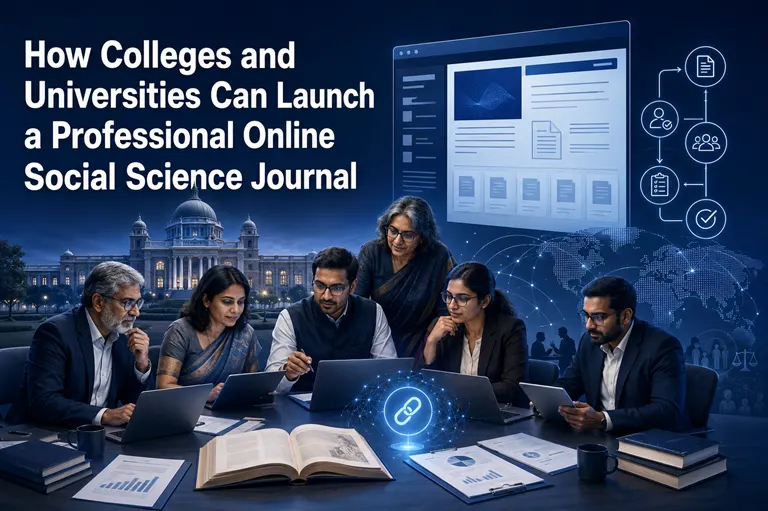
A professional online journal, however, is more than a website containing PDF files. It requires a defined scholarly purpose, responsible institutional ownership, an independent editorial structure, transparent policies, rigorous peer review, reliable technology, accurate metadata and a realistic publication plan.
The Indian Journal of Social Enquiry, published by Maharaja Agrasen College, Delhi, represents the value of institutionally supported social science publishing. Its interdisciplinary orientation creates space for research into India’s changing society, institutions, public policy, culture and emerging social questions.
Drawing on this wider academic publishing context, this guide explains how colleges, universities, research centres and scholarly societies can build a credible online social science journal from the ground up.
Why should an institution launch a social science journal?
An institutional journal can advance several academic objectives when its purpose is clearly defined.
It can provide a sustained forum for research that may not fit within narrowly specialised publications. Social problems rarely remain within disciplinary boundaries. A study of digital welfare delivery, for example, may require insights from sociology, public administration, economics, political science, law, technology studies and development studies.
A professionally managed journal can also:
- Strengthen the institution’s research culture
- Encourage faculty members to participate in scholarly communication
- Create opportunities for collaboration with external researchers
- Support interdisciplinary and regionally grounded research
- Develop editorial and peer-review capabilities
- Disseminate conference and research-project outcomes
- Improve the visibility of institutional scholarship
- Connect evidence with public policy and community concerns
- Provide a credible platform for early-career and established researchers
These benefits do not arise merely from registering a domain or publishing an inaugural issue. They depend on maintaining editorial independence, publication quality and continuity over time.
An institution should therefore begin with a long-term scholarly commitment rather than treating the journal as a short-term administrative project.
Step 1: Define the journal’s scholarly purpose
Every credible journal begins with a clear reason for existing. Before selecting software, forming an editorial board or inviting manuscripts, the institution must decide what intellectual contribution the journal will make.
A social science journal may be:
- Discipline-specific, such as sociology, economics or political science
- Interdisciplinary across several social science fields
- Focused on a theme such as education, gender, governance or development
- Regionally oriented towards a state, community or geographical area
- Institutionally broad but governed by defined scholarly criteria
- Designed to connect academic research with policy or professional practice
The purpose should be specific enough to create a recognisable identity but broad enough to sustain a regular flow of suitable manuscripts.
Prepare a clear aims and scope statement
The aims and scope statement should explain:
- The journal’s principal subject area
- The research questions it seeks to address
- The disciplines or interdisciplinary areas covered
- The types of manuscripts accepted
- The geographical or thematic focus, if applicable
- The intended author and reader communities
- The journal’s expected contribution to scholarship
Generic phrases such as “all fields of social science” provide little editorial direction. A stronger scope might identify social institutions, public policy, inequality, culture, education, digital society and development as connected areas of enquiry.
The scope must also guide editorial decisions. A journal should not accept an unrelated paper simply to fill an issue.
Step 2: Establish responsible institutional ownership
The publisher must be identified clearly. For a college or university journal, the publisher may be the institution, a department, a research centre or a formally constituted scholarly body.
Ownership should not remain ambiguous because the publisher is responsible for the journal’s continuity, website, records, finances, policies and published content.
The institution should formally document:
- The journal owner and publishing body
- The responsible department or research centre
- The approving institutional authority
- The Editor-in-Chief’s appointment
- The editorial board’s responsibilities
- Administrative and technical support
- The publication budget
- The process for leadership succession
- Responsibility for preserving published content
The journal should not depend entirely on one faculty member’s personal email address, hosting account or informal records. Institutional continuity becomes especially important when editors retire, transfer or complete their terms.
Protect editorial independence
Institutional ownership does not mean that administrators should influence individual editorial decisions. Manuscripts must be evaluated on scholarly merit, relevance, originality and ethical compliance.
The journal should publish a statement explaining editorial independence and the management of conflicts of interest. Articles written by members of the publishing institution should undergo the same peer-review and editorial procedures as external submissions.
This separation protects both the journal and the institution.
Step 3: Choose a distinctive and sustainable journal title
The proposed title should reflect the journal’s academic positioning and remain suitable as its research community grows.
Before finalising the name, search:
- The ISSN Portal or national ISSN records
- Library catalogues
- Scholarly search engines
- Journal directories
- Domain-name records
- General web-search results
A title that is identical or confusingly similar to an existing publication can create problems involving identity, discoverability and ISSN processing.
Avoid names that make unsubstantiated claims about prestige, international status or indexing. The journal should earn authority through its editorial work rather than through promotional words in its title.
After deciding on the name, use it consistently across the journal website, policies, article PDFs, metadata, official communication and ISSN application.
Step 4: Design the editorial governance structure
A professional journal needs an editorial structure with clearly allocated responsibilities.
Editor-in-Chief
The Editor-in-Chief provides academic leadership and is ultimately responsible for editorial standards. This role includes scope decisions, reviewer oversight, ethical cases, editorial-board coordination and final publication approval.
Managing or Executive Editor
The Managing Editor supervises daily operations, communicates with authors and reviewers, tracks manuscripts and coordinates production.
Associate or Section Editors
Section editors may handle submissions within particular areas such as sociology, political science, economics, education, public administration or cultural studies.
Editorial Board
The editorial board should include credible scholars whose expertise matches the journal’s stated scope. Members should contribute to peer review, policy development, special issues, outreach or strategic guidance.
Board membership should be based on genuine involvement. Individuals should agree before their names and affiliations are published.
Editorial office
An institutional journal also needs operational support. Responsibilities may include:
- Initial submission checks
- Reviewer communication
- Copyediting and proofreading
- Metadata preparation
- DOI registration
- Website publication
- Records and correspondence
- Policy updates
- Issue scheduling
Names, affiliations and editorial roles should be displayed transparently on the journal website.
Step 5: Prepare the journal’s editorial policies before accepting papers
Publishing policies should be completed before the call for papers is circulated. Policies written only after a dispute arises are unlikely to produce consistent decisions.
The Principles of Transparency and Best Practice in Scholarly Publishing identify essential areas such as journal identity, website information, ownership, peer review, copyright, licensing, publication ethics and access.
A new social science journal should prepare policies covering:
- Aims and scope
- Types of manuscripts accepted
- Author guidelines
- Peer-review process
- Authorship and contributor responsibilities
- Conflicts of interest
- Research ethics and informed consent
- Plagiarism and text recycling
- Complaints and appeals
- Corrections, retractions and expressions of concern
- Data availability, where applicable
- Copyright and licensing
- Open-access terms
- Publication charges or a clear no-fee statement
- Use of generative AI and automated tools
- Preprints and prior dissemination
- Archiving and digital preservation
- Special issues
- Editorial-board conduct
- Misconduct investigation
Policies should describe what the journal actually does. Copying extensive policy text from another publisher without having the necessary procedures is neither useful nor credible.
Social science research requires context-sensitive ethics
Social science journals may receive studies involving interviews, surveys, observation, vulnerable populations, political behaviour, community identity and sensitive personal information.
The author guidelines should explain when institutional ethics approval or another form of ethical review is expected. Authors should also describe informed consent, confidentiality, participant protection and responsible data handling.
The journal must recognise that ethical safeguards appropriate to ethnography or oral-history research may differ from those used in experimental studies. Policies should be rigorous without imposing one methodological model on every discipline.
Planning a new institutional journal?
We can support colleges, universities and research institutions with:
- ScholarJMS journal website and workflow setup
- New journal launch planning
- OJSCloud hosting, OJS support and migration
- Journal policy and ISSN-readiness consulting
- GetDOI Crossref DOI workflow support
- Editorial submission and peer-review configuration
- Scholar9 transparent peer-review options
WhatsApp: +91 82003 85143
Email: inquiry@ojscloud.com
Step 6: Build a professional journal website
The journal website is its public scholarly record. Authors, reviewers, readers, libraries and evaluation bodies use it to assess the publication’s credibility.
A professional journal website should provide clear access to:
- Journal title and institutional publisher
- Print and electronic ISSN, when assigned
- Aims and scope
- Editorial board
- Author guidelines
- Peer-review process
- Publication ethics and other policies
- Copyright and licensing
- Open-access statement
- Publication frequency
- Current and archived issues
- Call for papers
- Submission and manuscript-tracking facilities
- Journal contact information
- Article landing pages
- Full-text files
- Search and navigation
The design should be responsive on mobile devices, accessible, secure and easy to navigate. Academic content should not be obscured by excessive animations, advertisements or promotional banners.
The website must support article-level publishing
Each published paper needs its own stable landing page rather than being available only inside a combined issue PDF.
The page should display:
- Article title
- Author names and affiliations
- Abstract
- Keywords
- Publication date
- Volume, issue and page or article number
- Citation format
- DOI, after registration
- Full-text access
- Copyright and licence information
- References, where supported
Article-level pages improve citation, linking, indexing readiness and search-engine visibility.
Why ScholarJMS is suitable for institutional journals
ScholarJMS combines a journal website with manuscript submission, editorial handling, peer-review coordination and structured article publishing.
For colleges and universities, this can reduce the fragmentation created when submissions arrive through personal email accounts, reviews are stored in separate folders and published content is maintained manually.
A configured ScholarJMS installation can support:
- Branded journal pages
- Online author submission
- Manuscript status tracking
- Role-based editorial access
- Reviewer assignment
- Editorial correspondence
- Decision recording
- Issue and archive management
- Article metadata
- Policy and author-information pages
Technology cannot replace editorial judgement, but it can make the process more consistent and auditable.
Step 7: Configure online submission and peer review
Email-only submission may appear convenient during the first issue, but it becomes difficult to manage as manuscript volume grows. Files can be misplaced, decisions may not be documented and editors may struggle to determine which manuscript version is current.
An online submission system should collect structured information such as:
- Manuscript title
- Abstract and keywords
- Author names and affiliations
- Corresponding-author information
- ORCID identifiers, where available
- Manuscript type
- Subject classification
- Conflict-of-interest declaration
- Funding information
- Ethics statement
- Cover letter
- Main manuscript and supplementary files
Build a defined editorial workflow
A reliable workflow may include:
- Submission and acknowledgement
- Administrative completeness check
- Scope and editorial screening
- Similarity or originality assessment
- Reviewer selection
- Peer review
- Editorial decision
- Author revision
- Final acceptance
- Copyediting and proofreading
- Metadata and DOI preparation
- Online publication and archiving
Every stage should have an assigned responsible person and a documented outcome.
Use double-blind peer review consistently
Double-blind peer review can be suitable for many social science journals because author and reviewer identities are concealed during the review process.
For the model to work properly:
- Authors need clear anonymisation instructions
- Identifying details should be removed from the review file
- Reviewer identities must be protected
- Conflicts of interest must be declared
- Reviews should use defined scholarly criteria
- Editors should record the basis of their decisions
Reviewers should assess originality, methodological suitability, argument, evidence, ethical compliance, relevance and clarity. They should not be expected to make publishing decisions; that responsibility remains with the editor.
Step 8: Prepare the journal for an ISSN application
An ISSN is an identifier for a continuing publication. A separate ISSN may be assigned to different formats, such as print and online versions.
In India, applications are made through the National ISSN Centre. The official centre states that ISSN assignment is free, it does not appoint agents or brokers, and assignment does not constitute approval of the journal or its contents. Institutions should rely on the current instructions published by the National ISSN Centre, India.
Before applying for an online journal’s ISSN, the institution should ensure that its website presents a coherent and active serial publication identity. Relevant information generally includes:
- Confirmed journal title
- Identified publisher
- Place of publication
- Editorial responsibility
- Subject coverage
- Publication frequency
- Online journal homepage
- Issue or publication information required under current guidelines
- Institutional contact details
- Consistency across the website and application
Because requirements can change, applicants should read the latest official guidance at the time of submission.
What ISSN consulting should and should not mean
Legitimate ISSN consulting involves helping an institution prepare its journal identity, website, documentation and application information correctly. It must never be represented as selling an ISSN, acting as an authorised ISSN agent or guaranteeing approval.
OJSCloud can assist institutions with ISSN-readiness review and application preparation while the formal application and assignment remain under the authority of the National ISSN Centre.
Step 9: Plan Crossref DOI registration correctly
A DOI provides a persistent identifier for scholarly content. For journals, Crossref DOI registration also connects each article with structured metadata used across scholarly discovery and citation systems.
DOI planning should begin during website development, not after several issues have been published.
Crossref requires each registered item to have a unique, active landing page. Publishers must deposit accurate metadata and maintain DOI records and resolution URLs over time. Its current membership guidance explains these obligations clearly. Crossref membership requirements and its record-registration documentation should be consulted before implementation.
A journal DOI workflow should include
- A DOI prefix obtained through membership or an appropriate sponsorship route
- A consistent DOI-suffix structure
- One unique landing page for every article
- Accurate title, author, affiliation and publication metadata
- Reference information where available
- DOI display on the article page and PDF
- Registration at the time of online publication
- Deposit-status checking
- Correction of failed or incomplete deposits
- URL updates when the website changes
A DOI string displayed on a PDF is not necessarily a registered DOI. It becomes operational only after the record has been deposited successfully and resolves to the correct article page.
GetDOI support for new journals
GetDOI can support institutions with Crossref DOI setup, sponsorship pathways where applicable, metadata preparation, deposit workflows and DOI troubleshooting.
The objective is not merely to generate identifiers. It is to establish a sustainable DOI and metadata process for every article published by the journal.
Step 10: Develop a realistic publication plan
New journals sometimes announce an ambitious monthly or quarterly schedule before assessing manuscript supply and editorial capacity. Missed schedules weaken confidence and create unnecessary pressure to accept unsuitable submissions.
A new institutional social science journal may begin with one or two issues annually and increase frequency only after developing:
- A stable submission pipeline
- Sufficient external reviewers
- Reliable editorial staffing
- Copyediting and production capacity
- A sustainable budget
- Demonstrated publication continuity
The stated frequency must be consistent across the website, ISSN information, calls for papers and published issues.
Build the first issue carefully
The inaugural issue establishes the journal’s scholarly identity. Institutions should prioritise quality over the number of papers.
A responsible launch sequence may involve:
- Inviting submissions through an open call
- Circulating the call beyond the home institution
- Screening every manuscript against the scope
- Using independent external reviewers
- Managing institutional conflicts of interest
- Completing copyediting and author proof approval
- Preparing accurate article metadata
- Publishing complete policies and issue information
The first issue should not consist entirely of papers written by members of the publishing institution. External authorship and reviewers help demonstrate that the journal serves a wider scholarly community.
Step 11: Prepare for discoverability without promising indexing
Indexing is a consequence of consistent scholarly publishing, not a feature that can credibly be guaranteed at launch.
A journal should first establish:
- Regular publication
- Transparent peer review
- Credible editorial governance
- Accurate metadata
- Stable article landing pages
- Clear licensing
- Ethical procedures
- External authorship
- Website continuity
- Citation and reference quality
For an open-access journal, the Directory of Open Access Journals may become a relevant future objective. DOAJ requires journals to be actively publishing scholarly research and to meet transparency and open-access criteria. New journals must also demonstrate an appropriate publication history before applying. Institutions should consult the current DOAJ Guide to Applying rather than relying on outdated checklists or third-party guarantees.
Statements such as “under evaluation,” “expected to be indexed” or “indexing applied” should be used cautiously. A journal should list only services in which its inclusion can be verified.
Step 12: Build transparent and trustworthy peer review
The credibility of a journal depends heavily on the quality of its editorial decisions. Institutions should develop reviewer databases that extend beyond their own faculty.
Reviewers may be identified through:
- Recent publications in the manuscript’s subject area
- Academic departments and research centres
- Conference networks
- Editorial-board recommendations
- Author-suggested reviewers subjected to verification
- Researcher identifiers and scholarly profiles
Editors must check expertise, identity and conflicts of interest before assignment.
Transparent peer review as an emerging option
Conventional anonymous review remains appropriate for many submissions, but journals may also explore more transparent models where their policies, disciplines and participant consent permit.
Scholar9 supports a research-trust ecosystem built around greater transparency in peer review. Such approaches can help document scholarly contribution and strengthen accountability, provided confidentiality, consent and disciplinary expectations are respected.
A journal should never change its review model informally. The selected model must be explained publicly and applied consistently.
Need help launching or upgrading an institutional journal?
Our journal-publishing support stack includes:
- ScholarJMS website, manuscript submission and editorial workflow
- OJSCloud hosting, OJS support and OJS-to-ScholarJMS migration
- New journal launch consulting
- ISSN-readiness and application guidance
- GetDOI Crossref DOI and metadata workflow support
- Scholar9 transparent peer-review infrastructure
- Editorial-policy and publication-workflow configuration
WhatsApp: +91 82003 85143
Email: inquiry@ojscloud.com
Step 13: Budget for continuity rather than only launch
The real cost of a journal is not limited to website development. Institutions should budget for recurring work such as:
- Domain and platform operation
- Technical maintenance and security
- Editorial administration
- Copyediting and proofreading
- Layout and article production
- DOI registration
- Digital preservation
- Similarity checking
- Communication and outreach
- Staff training
- Policy and metadata maintenance
The journal should disclose all author-facing charges clearly. If there are no submission or publication charges, that should also be stated.
Hidden charges introduced after acceptance are unethical and can seriously damage institutional reputation.
Step 14: Create an accountable launch timeline
A professional launch can be organised into four broad phases.
Phase 1: Academic planning
During this phase, the institution approves the journal concept, title, scope, ownership, budget and publication frequency. It also appoints the Editor-in-Chief and core editorial team.
Phase 2: Policy and infrastructure development
The team prepares editorial policies, author guidelines, website content, submission forms, email identities, workflow stages and document templates.
Phase 3: Testing and editorial preparation
Editors should test the complete process using sample submissions. This includes acknowledgement, screening, reviewer assignment, revision, decision, copyediting and publication.
Technical testing should cover:
- Author registration
- File upload
- Editorial permissions
- Email notifications
- Reviewer access
- Mobile usability
- Article pages
- Metadata fields
- Backups
- DOI-readiness
Phase 4: Call for papers and first issue
After testing, the journal may announce its call for papers. The first issue should be published only after completing the promised peer-review and production procedures.
Depending on institutional readiness, editorial availability and policy approval, development may take several weeks or months. A rushed launch often creates technical and ethical problems that take much longer to correct.
Common mistakes institutions should avoid
Launching with an unclear scope
An excessively broad scope prevents the journal from developing a recognisable scholarly community.
Using only personal email accounts
Institutional journal email addresses improve continuity and accountability.
Copying policies without implementation
A policy has value only if editors understand and follow it.
Publishing before testing the workflow
Untested permissions, notifications and file handling can disrupt live submissions.
Creating unregistered DOI strings
Every DOI must be registered through the appropriate Crossref workflow and resolve correctly.
Treating ISSN as journal approval
An ISSN identifies a serial. It does not certify research quality or confer indexing.
Guaranteeing indexing
No website developer or consultant can ethically guarantee acceptance by an independent indexing service.
Filling issues with weak manuscripts
Maintaining a schedule never justifies bypassing peer review or lowering editorial standards.
Depending on one person
The journal needs documented procedures, institutional access and succession planning.
Ignoring metadata
Inconsistent author names, dates, titles and citations reduce discoverability and create problems in DOI records.
Frequently Asked Questions
Can a college start its own academic journal?
Yes. A college, university, department, research centre or scholarly society can publish an academic journal if it has responsible ownership, appropriate editorial expertise, a sustainable workflow and a commitment to publication ethics.
How much time is required to launch an online social science journal?
The timeline depends on institutional approvals, editorial appointments, policy preparation, website configuration and workflow testing. A professional launch should not be rushed merely to announce a publication date.
Does a new journal need an ISSN before launching its website?
The website and journal identity generally need to be sufficiently prepared to support an online ISSN application under the current national guidelines. Institutions should consult the National ISSN Centre’s latest requirements before applying.
Is an ISSN proof that a journal is approved or indexed?
No. The National ISSN Centre, India, expressly states that ISSN assignment does not amount to approval of the journal or its contents. It is an identification function.
Can OJSCloud guarantee an ISSN?
No legitimate consultant can guarantee assignment. OJSCloud can assist with journal website readiness, documentation review and application guidance. The decision remains with the National ISSN Centre.
Does every article need a separate DOI?
If a journal decides to register Crossref DOIs for its research articles, each article should normally receive its own DOI linked to a unique article landing page. The metadata and URL must be maintained over time.
What is the difference between an ISSN and a DOI?
An ISSN identifies a continuing publication such as a journal. A DOI identifies a specific digital research object, such as an individual article. They serve different but complementary purposes.
Is email submission sufficient for a new journal?
Email can technically receive manuscripts, but it becomes difficult to track versions, reviews, deadlines and decisions. A structured submission and editorial system is more professional and sustainable.
What peer-review model is suitable for a social science journal?
Double-blind peer review is commonly used because author and reviewer identities are concealed. Other models may be appropriate if they are explained transparently and implemented consistently.
Can a journal use both OJS and ScholarJMS?
An institution would normally select one primary submission and publishing environment to avoid duplicated records. OJSCloud can support an existing OJS journal, while ScholarJMS offers an integrated modern journal website and editorial workflow. A migration can be planned if the journal wishes to change platforms.
When should a new journal apply for indexing?
The journal should first establish a genuine publication history, regular issues, peer review, ethical policies, accurate metadata and stable online access. It should apply only after meeting the current criteria of the relevant index.
Should an institutional journal accept papers from its own faculty?
It may do so, provided the papers fall within scope and undergo independent peer review with proper conflict-of-interest management. The journal should also actively seek submissions, reviewers and editorial participation from outside the home institution.
Conclusion
Launching a professional online social science journal is an important academic undertaking. It can strengthen an institution’s research culture, amplify regionally grounded scholarship and create a durable forum for studying society, policy, education, inequality, culture and technological change.
Success depends on more than publishing a website. Colleges and universities need a clear intellectual purpose, accountable ownership, an independent editorial structure, transparent policies, reliable peer review, structured manuscript management, ISSN readiness, accurate Crossref DOI workflows and a realistic publication schedule.
The Indian Journal of Social Enquiry demonstrates the continuing importance of institutionally supported platforms for interdisciplinary social research. Other colleges and universities can build similarly meaningful scholarly programmes when academic purpose and publishing infrastructure are developed together.
Institutions seeking support can access a coordinated service stack covering ScholarJMS implementation, OJSCloud hosting and migration, ISSN-readiness consulting, GetDOI Crossref DOI workflows and Scholar9 transparent peer review.
For new journal setup, OJS migration, ISSN consulting, DOI support or launch guidance:
WhatsApp: +91 82003 85143
Email: inquiry@ojscloud.com