
Building an Online Social Science Journal Website with Manuscript Submission and Double-Blind Peer Review
A professional academic journal website is no longer simply an online noticeboard containing a journal description and downloadable PDF files. It is the journal’s publishing infrastructure, editorial office, scholarly archive and public record.
For a social science journal, the website must support a particularly diverse publishing environment. Submissions may come from sociology, political science, economics, education, public administration, anthropology, gender studies, cultural studies, media research, development studies and related interdisciplinary fields. Manuscripts may use surveys, ethnography, interviews, archival evidence, policy analysis, mixed methods or theoretical approaches.
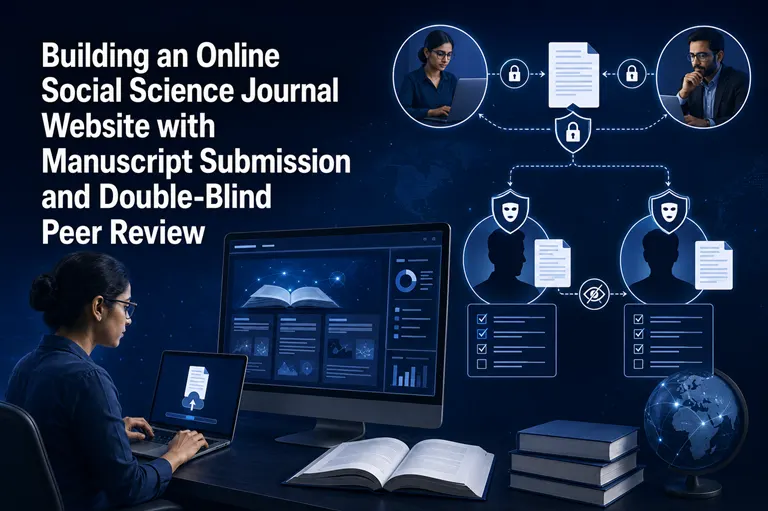
Managing this diversity through personal email accounts, disconnected spreadsheets and manually maintained web pages becomes difficult as the journal grows. It can lead to misplaced files, unclear manuscript status, inconsistent peer review, incomplete metadata and delays in publication.
A modern journal platform should therefore connect four essential functions:
- Public journal information
- Online manuscript submission
- Editorial and peer-review management
- Structured article publication and archiving
The Indian Journal of Social Enquiry, published by Maharaja Agrasen College, Delhi, demonstrates the value of an institutionally supported online platform for interdisciplinary social science scholarship. Its website presents journal information, editorial resources, author guidance, submission facilities, policy pages and publication records within a coordinated environment.
This News & Event guide explains how colleges, universities, scholarly societies and independent academic publishers can build a professional social science journal website with online submission and double-blind peer review.
Why a journal website must be treated as publishing infrastructure
The credibility of a journal is often assessed before a manuscript is submitted. Authors and reviewers examine the website to determine whether the publication has a clear scope, identifiable ownership, credible editors, transparent policies and a professional submission process.
Libraries, indexing services, DOI registration agencies and research-integrity organisations may examine many of the same features.
A journal website must consequently do more than look attractive. It should provide verifiable evidence of how the publication operates.
A credible website helps visitors answer questions such as:
- Who owns and publishes the journal?
- What subjects does it cover?
- Who makes editorial decisions?
- How are manuscripts reviewed?
- What ethical standards apply?
- Are publication charges clearly disclosed?
- Who retains copyright?
- Under which licence are articles published?
- How can corrections or complaints be submitted?
- Where are current and previous issues available?
- Does each article have a permanent landing page?
- How can an author submit and track a manuscript?
The Principles of Transparency and Best Practice in Scholarly Publishing emphasise clear journal identity, website information, ownership, peer review, editorial policies, copyright, licensing and access. These principles should influence the website architecture from the beginning.
Plan the journal before designing its website
Website development should begin only after the journal’s academic identity has been defined. A visually polished platform cannot compensate for an unclear scope or an incomplete editorial structure.
Before development, the publisher should confirm:
- Official journal title
- Publishing institution or organisation
- Aims and scope
- Intended author and reader communities
- Manuscript categories
- Publication frequency
- Access model
- Copyright position
- Peer-review method
- Editorial-board structure
- Submission requirements
- Publication charges, if any
- Long-term operational responsibility
These decisions affect navigation, submission forms, reviewer criteria, article templates and metadata.
Define a useful social science scope
A journal should avoid adopting a scope so broad that it lacks scholarly identity. “All areas of social science” may attract unrelated submissions and make reviewer selection difficult.
A stronger scope identifies the journal’s main fields and intellectual priorities. An interdisciplinary journal may focus on themes such as:
- Social institutions and change
- Governance and public policy
- Education and inequality
- Gender and identity
- Culture and community
- Work, economy and development
- Digital society and artificial intelligence
- Media and political communication
- Urban and rural transformation
- Environment and society
A clear scope improves manuscript relevance, editorial consistency and search visibility.
Essential pages for a professional journal website
A reliable website structure should allow readers to find important information without searching through several unrelated pages.
Home page
The home page should communicate the journal’s identity immediately. It normally includes:
- Full journal title
- Publisher or owning institution
- Subject area
- Print and electronic ISSN, when assigned
- Open-access or subscription status
- Current call for papers
- Current issue
- Submission link
- A concise journal description
- Important announcements
The page should not make unverified claims about impact factors, indexing or international status.
About the journal
The About page should describe the journal’s history, purpose, subject positioning, intended audience and institutional context.
The information should be specific enough to distinguish the journal from unrelated publications.
Aims and scope
This page should state which subjects, research questions and manuscript types are suitable. It should help authors decide whether to submit before they enter the editorial system.
Editorial board
The editorial page should list each editor’s:
- Full name
- Academic role
- Institutional affiliation
- Country
- Editorial responsibility, where relevant
Editorial-board members should agree to serve before their names are published.
Author guidelines
The guidelines should explain:
- Accepted manuscript types
- Article structure
- Word limits
- Citation and reference style
- Tables, figures and supplementary files
- Anonymisation for peer review
- Research-ethics expectations
- Authorship requirements
- Conflict-of-interest declarations
- Data-availability expectations
- File formats
- Submission steps
- Revision requirements
The instructions should match the actual fields and files requested by the online submission system.
Peer-review process
The journal must identify its review model and explain the major stages from submission to decision.
For double-blind peer review, the website should state that author identities are concealed from reviewers and reviewer identities are concealed from authors. It should also explain that complete anonymity cannot always be guaranteed, especially in specialised research communities.
Publication ethics and policies
A consolidated policy hub should cover authorship, plagiarism, duplicate submission, conflicts of interest, complaints, appeals, corrections, retractions, research ethics, data protection and the use of artificial intelligence.
Current issue and archive
Every published issue should be accessible through a stable archive. Readers should be able to browse by year, volume and issue without relying on external file-storage links.
Contact page
The page should display an institutional email address, publishing organisation and appropriate contact information. Personal email addresses should not be the journal’s only permanent communication channel.
Design the website for academic trust
A scholarly website should look professional without becoming visually complicated. Its principal function is to help visitors evaluate the journal and access research.
An effective design usually includes:
- Clear typography
- Consistent institutional branding
- Mobile-responsive pages
- Accessible colour contrast
- Predictable navigation
- Fast-loading images and documents
- Search functionality
- Secure HTTPS access
- Readable article pages
- Visible submission and author-information links
Pop-ups, excessive animations and unrelated advertising can distract from the journal’s academic purpose.
Use institutional branding carefully
A college or university journal may use the institution’s approved logo, colour palette and typography. The journal should nevertheless maintain its own recognisable identity.
The website should distinguish clearly between:
- The journal title
- The publishing institution
- The journal’s editorial office
- Any technical or publishing service provider
Transparent attribution strengthens trust and prevents confusion about editorial responsibility.
Build structured online manuscript submission
A submission system should collect manuscript information in a consistent and searchable form. Uploading a Word file through a general contact form is not equivalent to structured submission.
The author workflow should collect:
- Manuscript title
- Short title, where required
- Abstract
- Keywords
- Article type
- Subject classification
- Author names
- Affiliations
- Corresponding-author details
- Email addresses
- ORCID identifiers, where available
- Funding information
- Conflict-of-interest declaration
- Ethics approval or consent information
- Data-availability statement
- Cover letter
- Anonymised manuscript
- Title page
- Tables, figures and supplementary files
Structured metadata reduces production work and supports article publication, DOI registration and scholarly discovery.
Separate the title page and anonymised manuscript
For double-blind review, the system should request at least two separate files:
- A title page containing author names, affiliations, correspondence details, acknowledgements and declarations
- An anonymised manuscript containing no direct identifying information
Authors should also be instructed to remove names from document properties, tracked changes, file names, acknowledgements and self-identifying statements.
The platform should allow editorial staff to check anonymity before sending the file to reviewers.
Provide an automatic submission acknowledgement
After submission, the system should generate a manuscript identification number and send a confirmation email. The acknowledgement should not be confused with editorial acceptance.
It should tell the author:
- That the files were received
- The manuscript identification number
- How to track progress
- That the paper will undergo preliminary checks
- Whom to contact for technical problems
This small step improves transparency and reduces repetitive status enquiries.
Need a professional journal website with online submission?
We can help colleges, universities, scholarly societies and publishers with:
- ScholarJMS journal website development
- Online manuscript submission
- Editor and reviewer workflow configuration
- Double-blind peer-review setup
- Author dashboards and manuscript tracking
- OJSCloud hosting, support and migration
- ISSN-readiness and journal-launch consulting
- GetDOI Crossref DOI workflow support
WhatsApp: +91 82003 85143
Email: inquiry@ojscloud.com
Design the complete editorial workflow
The submission form is only the first stage. A professional system must guide manuscripts through screening, peer review, revision, production and publication.
A practical workflow can include the following stages.
1. Submission received
The manuscript is recorded in the system and assigned a unique identifier.
2. Administrative screening
Editorial staff check:
- File completeness
- Adherence to author guidelines
- Presence of required declarations
- Manuscript anonymisation
- Readability of tables and figures
- Basic reference formatting
- Submission duplication
- Ethics information, where applicable
Administrative screening should not become a substitute for academic evaluation.
3. Editorial scope assessment
The Editor-in-Chief or section editor evaluates whether the manuscript:
- Fits the journal’s scope
- Presents a recognisable scholarly question
- Meets minimum academic standards
- Appears suitable for external review
- Complies with essential ethical requirements
A manuscript that is clearly outside scope may be declined without external review. This saves reviewer time and gives authors an earlier decision.
4. Similarity and integrity checks
A similarity report may help editors identify copied language or substantial overlap, but the score must not be treated as an automatic verdict.
Editors should interpret:
- The source of the overlap
- Whether quotations are attributed
- Whether methods contain conventional wording
- Whether the manuscript reproduces earlier work
- Whether the overlap affects originality
- Whether references or templates have inflated the score
Research-integrity decisions require editorial judgement.
5. Reviewer selection
The editor selects reviewers with subject and methodological expertise. Reviewer identity, publication history and conflicts of interest should be considered before assignment.
6. Peer review
Reviewers receive the anonymised manuscript, evaluation criteria, confidentiality instructions, conflict-of-interest declaration and response deadline.
7. Editorial decision
The editor considers the reviews and makes a decision such as:
- Accept
- Minor revision
- Major revision
- Reject with an invitation to resubmit
- Reject
The platform should record the decision and the reasoning communicated to the author.
8. Revision and response
Authors should upload:
- Revised manuscript
- Point-by-point response to reviewers
- Marked version, if required
- Updated declarations or supplementary files
The system must retain earlier versions instead of overwriting them.
9. Final acceptance
Acceptance should occur only after the academic and ethical requirements have been satisfied.
10. Production
The accepted manuscript proceeds to copyediting, layout, metadata verification, author proofing and DOI preparation.
11. Publication
The final article is published on a permanent landing page and assigned to an issue or continuous-publishing sequence.
Implement double-blind peer review correctly
Double-blind review is widely used across the social sciences, but concealing names alone does not create a robust review process.
A credible model requires reviewer standards, conflict management, editorial oversight and documented decisions.
Responsibilities of authors
Authors should:
- Submit an anonymised review file
- Avoid self-identifying language
- Disclose conflicts of interest
- Provide accurate authorship information separately
- Identify funding and ethical approvals
- Respond professionally to reviewer comments
- Avoid simultaneous submission to another journal
Responsibilities of reviewers
Reviewers should:
- Accept only assignments within their competence
- Disclose conflicts promptly
- Protect manuscript confidentiality
- Avoid using unpublished ideas or findings
- Provide specific and constructive feedback
- Assess the work without personal or ideological prejudice
- Submit the review within the agreed period
- Avoid attempts to identify or contact authors
Responsibilities of editors
Editors should:
- Select qualified and independent reviewers
- Avoid reviewers with conflicts of interest
- Protect identities under the declared model
- Evaluate the quality of reviewer reports
- Prevent hostile, discriminatory or irrelevant comments from reaching authors
- Make decisions independently
- Maintain records of review and correspondence
- respond appropriately to allegations of misconduct
Recommended reviewer-evaluation criteria
A social science review form may ask reviewers to evaluate:
- Relevance to the journal’s scope
- Originality and significance
- Clarity of the research question
- Engagement with relevant literature
- Suitability of the theoretical framework
- Appropriateness of the methodology
- Adequacy of sampling or source selection
- Ethical treatment of participants and data
- Quality of analysis
- Support for conclusions
- Policy or scholarly contribution
- Organisation and readability
- Required revisions
The form should also provide space for confidential comments to the editor.
Manage conflicts of interest
Conflicts can arise through employment, collaboration, supervision, competition, personal relationships, institutional affiliation, financial interests or intellectual disagreement.
Reviewers should not evaluate manuscripts where such relationships could affect, or reasonably appear to affect, their judgement.
Editors should also recuse themselves when handling manuscripts written by close colleagues, students, collaborators or family members. A separate editor should oversee those submissions.
For institutionally published journals, this safeguard is particularly important when papers are submitted by faculty members of the home college or university.
Configure editorial roles and permissions
Not every user should be able to access every manuscript or administrative setting. Role-based permissions improve confidentiality and reduce accidental changes.
A journal platform may include:
- Publisher administrator
- Editor-in-Chief
- Managing editor
- Section editor
- Editorial assistant
- Reviewer
- Author
- Copyeditor
- Proofreader or production editor
Each role should have only the access necessary for its responsibilities.
Reviewers should not see author identity in a double-blind workflow. Authors should not see confidential reviewer information. Production staff may require access only after acceptance.
Use ScholarJMS for an integrated journal environment
ScholarJMS combines the public journal website with submission, editorial management, peer review and article publication.
This integrated approach helps an institution avoid using separate systems for:
- Website content
- Submission records
- Reviewer communication
- Manuscript tracking
- Issue management
- Published article metadata
A configured ScholarJMS journal may support:
- Institutional branding
- Online author registration
- Structured submission
- Manuscript tracking
- Editorial assignments
- Reviewer invitations
- Double-blind file handling
- Revision management
- Decision records
- Issue creation
- Article landing pages
- Policy and author-information pages
- Searchable journal archives
The workflow must still be configured according to the journal’s actual policies. Technology should enforce and document editorial practice, not invent it.
Compare email submission with a journal management system
| Publishing requirement | Email-based process | Integrated journal platform |
|---|---|---|
| Manuscript identification | Manually assigned | Automatically generated |
| Author metadata | Extracted manually | Collected in structured fields |
| File versions | Easily confused | Preserved by submission stage |
| Reviewer assignments | Tracked in email or sheets | Recorded in the manuscript history |
| Review confidentiality | Dependent on manual handling | Supported through permissions |
| Decision records | Distributed across inboxes | Stored with the manuscript |
| Author tracking | Status enquiries by email | Dashboard or tracking facility |
| Editorial reporting | Manually compiled | Centralised records |
| Article publication | Separate website work | Connected publishing workflow |
| Institutional continuity | Vulnerable to staff changes | Shared role-based access |
Small journals can initially appear manageable through email. The limitations become visible when submission numbers rise or editorial responsibility changes.
Prepare article pages for Crossref DOI registration
DOI readiness begins with the website’s article structure.
Crossref expects a DOI to resolve to a unique, active landing page for the specific content item. The page should display bibliographic information and provide a route to the full text. Crossref members must also maintain metadata and update URLs when content moves. These responsibilities are explained in its membership guidance and record-registration documentation.
Each article page should include:
- Article title
- Author names
- Affiliations
- Abstract
- Keywords
- Volume and issue
- Publication year and date
- Article type
- Citation information
- DOI link
- Full-text access
- Copyright and licence
- References, where technically supported
DOI workflow stages
A responsible DOI process includes:
- Confirming the final article metadata
- Creating a DOI suffix under the publisher’s prefix
- Publishing the permanent article landing page
- Depositing the DOI, URL and metadata with Crossref
- Checking deposit status
- Testing DOI resolution
- Displaying the registered DOI on the article page and PDF
- Correcting metadata when necessary
- Updating the destination URL if the journal moves
GetDOI can assist journals with appropriate Crossref membership or sponsorship routes, DOI setup, metadata preparation, registration workflows and deposit troubleshooting.
A journal should never display invented or reserved-looking DOI strings as if they are active identifiers.
Make the website ready for an electronic ISSN application
An electronic ISSN identifies the online serial as a continuing publication. It does not certify the quality of the journal or confirm inclusion in an indexing database.
The National ISSN Centre, India, states that ISSN assignment is free, applications must follow its official process and it does not appoint agents or brokers. It also expressly clarifies that assigning an ISSN does not amount to approving a journal or its content. Institutions should consult the latest official ISSN guidance when preparing an application.
An ISSN-ready online journal should present a coherent publication identity, including:
- Consistent journal title
- Identified publisher
- Editorial responsibility
- Journal scope
- Publication frequency
- Institutional contact information
- Functional website
- Publication or specimen information required by current guidelines
- Consistent details across the website and application
OJSCloud can provide ISSN-readiness consulting, helping institutions review their website, publication information and application documentation. Formal assignment remains entirely with the National ISSN Centre.
Plan open access, copyright and licensing
A journal should state clearly whether articles are freely accessible and what users may do with them.
Open access is not established merely by allowing free PDF downloads. The website should identify:
- Who holds copyright
- Which licence applies
- Whether authors retain rights
- Whether reuse is allowed
- Whether attribution is required
- Whether publication charges apply
- Whether any embargo exists
The selected licence should appear consistently on the policy page, article landing pages and article PDFs.
Institutions planning eventual application to the Directory of Open Access Journals should consult the current DOAJ Guide to Applying. The directory assesses active publishing, transparency, peer review, open-access terms, licensing and other quality criteria.
Protect research data and platform security
A journal platform processes personal information belonging to authors, reviewers and editors. It may also hold unpublished research and sensitive declarations.
Basic protections should include:
- HTTPS encryption
- Strong administrator passwords
- Role-based permissions
- Controlled reviewer access
- Secure hosting
- Routine backups
- Software updates
- Data-retention procedures
- Responsible handling of exported records
- Restricted access to confidential files
- Recovery planning
Review reports and unpublished manuscripts should not be stored indefinitely in unprotected shared folders.
The journal should also publish an appropriate privacy statement explaining the information collected through registration and submission.
Build a reliable production and publication workflow
Peer review ends with an editorial decision, but publication requires additional quality control.
Copyediting
Copyediting should improve consistency, readability and adherence to journal style without changing an author’s argument improperly.
Checks may include:
- Author names and affiliations
- Abstract and keywords
- Heading structure
- Citations and references
- Tables and figures
- Statistical notation
- Ethical statements
- Funding information
- Acknowledgements
- Language consistency
Author proofing
Authors should receive a final proof and a clear deadline for correcting production errors. Proofing should not become an opportunity to introduce extensive new analysis.
Metadata verification
Metadata should be checked separately from the visible PDF. Errors in structured fields may affect DOI records, website search and citation systems even when the PDF is correct.
Final publication
Before publication, verify:
- Article file opens correctly
- Landing page is complete
- Author order is accurate
- DOI has been registered successfully
- Licence is visible
- Citation information is consistent
- Article appears in the correct issue
- Links and references function as expected
Planning to build, upgrade or migrate a journal platform?
Our integrated publishing support includes:
- ScholarJMS journal website and submission setup
- Double-blind peer-review workflow
- Editorial roles and manuscript tracking
- OJSCloud hosting and technical support
- OJS-to-ScholarJMS migration
- ISSN-readiness and journal-launch consulting
- GetDOI Crossref DOI registration support
- Scholar9 transparent peer-review options
- Article metadata and archive configuration
WhatsApp: +91 82003 85143
Email: inquiry@ojscloud.com
Migrating an existing journal from OJS
Some institutions already operate an OJS journal but face outdated design, unsupported software, technical errors or difficult workflows.
Migration should preserve the journal’s scholarly record. It may involve:
- Journal and issue information
- Article titles and abstracts
- Author names and affiliations
- Keywords
- Publication dates
- Volume and issue assignments
- PDFs and supplementary files
- DOI records
- Article URLs
- Policy pages
- Editorial-board details
- Author accounts where appropriate
- Redirects from older article pages
Before migration, the publisher should create a complete inventory of content and DOI records. After migration, every article and DOI should be tested.
OJSCloud can support OJS hosting, upgrades, technical maintenance and migration planning. Where a publisher wants a different editorial environment, an OJS-to-ScholarJMS migration can be mapped carefully to protect metadata, archives and DOI resolution.
Incorporate transparent peer review where appropriate
Double-blind peer review remains suitable for many social science journals. Some publishers may also wish to explore transparent practices such as publishing review histories or formally recognising reviewer contributions.
Scholar9 supports a transparent peer-review and research-trust ecosystem. Such options should be introduced only with a clear policy and appropriate consent.
A journal might consider:
- Recording verified review activity
- Allowing reviewers to receive appropriate recognition
- Publishing review reports with participant consent
- Linking reviews with article versions
- Documenting editorial decisions more transparently
The journal should not combine confidential and open-review practices without explaining which model applies to each submission.
Test the complete system before launch
Before inviting real submissions, the editorial team should test the platform from every user perspective.
Author testing
Confirm that an author can:
- Register
- Read author instructions
- Enter metadata
- Upload separate files
- Complete declarations
- Submit successfully
- Receive acknowledgement
- View manuscript status
- Upload a revision
Editor testing
Confirm that an editor can:
- View new submissions
- Check files and metadata
- Assign a section editor
- Invite reviewers
- Record decisions
- Request revisions
- Move accepted papers into production
- Access a complete manuscript history
Reviewer testing
Confirm that a reviewer can:
- Accept or decline an invitation
- Declare conflicts
- Access only the anonymised files
- Complete the review form
- Upload a report
- Submit confidential comments
- Avoid seeing author identity
Publication testing
Create a sample issue and article to check:
- Article layout
- Metadata display
- DOI field
- Citation format
- PDF access
- Mobile responsiveness
- Search results
- Archive navigation
The sample content should be removed or clearly marked before the public launch.
Common journal website and workflow mistakes
Building only the public website
A journal may look professional while continuing to manage submissions through scattered email threads. Website development and editorial workflow should be planned together.
Publishing incomplete policies
A short plagiarism statement is not a complete publication-ethics framework. Authorship, conflicts, complaints, corrections and other responsibilities also require attention.
Asking reviewers to communicate directly with authors
This breaks double-blind confidentiality and weakens editorial oversight.
Failing to preserve manuscript versions
Every original submission, revision and final accepted file should remain identifiable.
Giving every editor administrator access
Excessive permissions create privacy, security and record-integrity risks.
Uploading only issue-level PDFs
Articles need individual landing pages and metadata for reliable discovery and DOI resolution.
Changing domains without redirect planning
Website migrations can break article links and DOI destinations unless URLs and redirects are managed carefully.
Publishing DOI strings before registration
A DOI should be displayed as active only after successful registration and resolution testing.
Claiming indexing without verification
Only confirmed indexing services should be named. Website visibility and ISSN assignment are not equivalent to database inclusion.
Using copied policies
Policies should reflect the journal’s actual procedures, resources and editorial decisions.
Recommended launch checklist
Before making the journal website public, confirm that:
- The title and publisher are consistent across every page
- Aims and scope are clearly defined
- Editorial-board appointments are verified
- Author guidelines match the submission form
- Double-blind review is explained accurately
- Publication policies are complete
- Copyright and licensing are visible
- Charges or no-fee status are disclosed
- Submission acknowledgement functions
- Reviewer anonymity has been tested
- Editorial permissions are correct
- Article and issue pages function on mobile devices
- Backups and security controls are active
- ISSN information is accurate
- DOI registration infrastructure is prepared
- Contact details use stable institutional accounts
- No unverified indexing or metric claims appear
- The editorial team has completed workflow training
Frequently Asked Questions
What should a social science journal website include?
It should include the journal title, publisher, aims and scope, editorial board, author guidelines, peer-review process, publication policies, copyright and licensing information, current issues, archives, contact details and an online submission facility.
What is an online manuscript submission system?
It is a platform that collects manuscript files, author metadata and declarations and then records the paper’s progress through editorial screening, peer review, revision and publication.
How does double-blind peer review work?
The reviewers do not receive the authors’ identities, and authors do not receive reviewer identities. Authors submit an anonymised manuscript, while identifying information is stored separately.
Can double-blind review guarantee complete anonymity?
No. A reviewer may infer authorship from the subject, references, dataset or earlier conference presentations. The journal should nevertheless remove direct identifiers and protect confidential information.
How many reviewers should assess a social science manuscript?
Many journals seek reports from two independent reviewers, although the appropriate number depends on journal policy, manuscript type, reviewer availability and editorial judgement.
Can editors reject a manuscript before external review?
Yes. Editors may decline a manuscript that is outside the journal’s scope, clearly unsuitable, seriously incomplete or unable to meet basic ethical and scholarly requirements.
Is ScholarJMS only a journal website builder?
No. ScholarJMS integrates public journal pages with manuscript submission, editorial handling, reviewer management, manuscript tracking, issue creation and article publication.
What is the difference between OJSCloud and ScholarJMS?
OJSCloud provides OJS hosting, support, upgrades, migration and journal-launch consulting. ScholarJMS is an integrated journal website and editorial workflow platform. The appropriate option depends on the journal’s existing technology and operational requirements.
Can an OJS journal migrate to ScholarJMS?
Yes, subject to a structured migration assessment. Article files, metadata, issues, DOI records, policies and URLs should be inventoried and tested carefully.
Does the journal website need to be ready before applying for an e-ISSN?
An online journal should have a coherent, accessible publication identity that meets the National ISSN Centre’s current requirements. Applicants should always consult the latest official instructions.
Why does every DOI need a unique article page?
A DOI must resolve to the specific content it identifies. A unique article page provides bibliographic metadata and a route to the full text.
Can a journal website guarantee indexing?
No. Independent indexing services evaluate journals under their own criteria. A professional website can support readiness, but it cannot guarantee acceptance.
How can reviewers be recognised while maintaining anonymity?
Recognition may be provided through certificates, verified review records or trusted review ecosystems without disclosing which manuscript was reviewed. More open recognition requires an explicit policy and participant consent.
Conclusion
Building an online social science journal website requires the integration of academic governance, publication ethics, manuscript technology and article-level scholarly communication.
The public website must establish the journal’s identity and policies. The submission system must collect accurate information and preserve manuscript versions. The editorial workflow must support screening, review, revision and decision-making. Double-blind peer review must protect identities while maintaining rigorous editorial oversight. Finally, each published article must have complete metadata, stable access and a DOI-ready landing page.
The Indian Journal of Social Enquiry reflects the importance of a structured digital environment for interdisciplinary social science publishing. Colleges, universities and research organisations planning similar journals should approach website development as a long-term scholarly infrastructure project rather than a one-time design exercise.
For journal website development, ScholarJMS setup, OJS hosting or migration, ISSN-readiness consulting, Crossref DOI support and editorial-workflow configuration, contact:
WhatsApp: +91 82003 85143
Email: inquiry@ojscloud.com