

editor_ijse@mac.du.ac.in
9818679187
e-ISSN: applied
Indian Journal of Social Enquiry

Indian Journal of Social Enquiry

Volume 13, Issue 1 - 2021 (Jan. 2021)

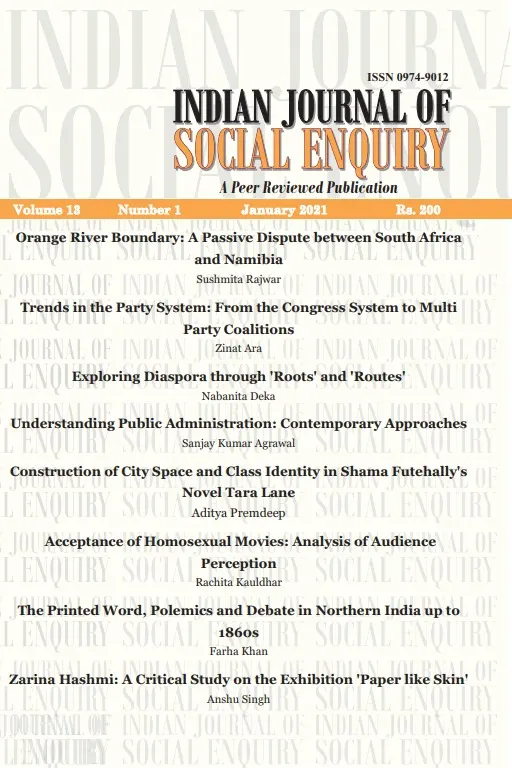
Volume 13 Issue 1 Cover

Issue Details:

Volume 13 Issue 1
Published:Sep 2, 2026

Editorial: Jan. 2021

Welcome to the 2021 issue of Indian Journal of Social Enquiry. This issue showcases the remarkable breadth and depth of contemporary research across multiple disciplines. From cutting-edge applications of machine learning in climate science to the revolutionary potential of quantum computing in drug discovery, our featured articles demonstrate the power of interdisciplinary collaboration in addressing global challenges.

We are particularly excited to present research that bridges traditional academic boundaries, reflecting our journal's commitment to fostering innovation through cross-disciplinary dialogue. The integration of artificial intelligence with environmental science, the application of blockchain technology to supply chain management, and the convergence of urban planning with smart city technologies exemplify the transformative potential of collaborative research.

As we continue to navigate an era of rapid technological advancement and global challenges, the research presented in this issue offers both insights and solutions that will shape our future. We thank our authors, reviewers, and editorial board members for their continued dedication to advancing knowledge and promoting scientific excellence.

Prof Gitanjali Chawla
Editor in Chief
Indian Journal of Social Enquiry

Articles in This Issue

Showing 8 of 8 articles
Research PaperID: IJSE1130001Pages 7-21Open AccessOpen Access

Orange River Boundary: A Passive Dispute between South Africa and Namibia

Sushmita Rajwar

The demarcation of the boundaries in the African continent has been a result of the colonial decisions and were done most of the times without taking the Africans into any consideration. This led to many arbitrary borders which later gave rise to border conflicts due to several reasons but mainly because of the contention on the accessibility to some resources present near the border. Orange River Boundary Conflict between South Africa and Namibia is one such border conflict that has raised issues with regard to utilization of water resources from the Orange River. Grazing rights of the local Nama population and diamond mining rights in the region has caused several disagreements leading to failed talks and conclusions. This paper attempts to analyze the Orange River disputed boundary, displacement of the Namas into the neighbouring regions due to the conflict and the sharing of the resources of the Orange River by Namibia and South Africa.

African continentBorder conflictNama populationOrange RiverWater resources
2 views
1 downloads

Contributors:

 Sushmita Rajwar
Research PaperID: IJSE1130002Pages 22-33Open AccessOpen Access

Trends in the Party System: From the Congress System to Multi Party Coalitions

Zinat Ara

Indian democracy has been operating for over seven decades which has shaped the party system. This paper analyses the different trends in the Indian party system. The focus is on the current phase which shows a tilt towards a stable equilibrium.

PartyDemocracyParty systemElections Nation buildingOpposition party
2 views
1 downloads

Contributors:

 Zinat Ara
Research PaperID: IJSE1130003Pages 34-42Open AccessOpen Access

Exploring Diaspora through 'Roots' and 'Routes'

Nabanita Deka

Diasporas are essentially travellers occupying an in-between space. In this context then, the idea of diaspora involves the idea of departure. This idea of departure however is often fraught with tension, anxiety, trauma, memory, separation, (dis)placement, (dis)location and (dis)ease.The paper thereby is an attempt to explore this idea of diaspora using Vijay Mishra's idea of diasporic imaginary to examine Indian diasporic communities. In doing this, the paper will use Subhash Ghai's movie Pardes (1997) as a trope to further understand concepts of 'old' and 'new' diaspora

DiasporaIndian diasporaTraumaMemoryIdentity
2 views
1 downloads

Contributors:

 Nabanita Deka
Research PaperID: IJSE1130004Pages 43-52Open AccessOpen Access

Understanding Public Administration: Contemporary Approaches

Sanjay Kumar Agrawal

Several fields in social sciences such as Public Administration are characterised by the diversity of approaches to study the phenomena critical to their disciplinary foci. Understanding the complexity of the subject of public administration and political process in real terms is not an easy task. For that, it needs to be studied from all possible methodological and analytical frameworks to get proper insight of its problems in order to bring suitable solutions. Accordingly, with a perspective to study the multiplicity of dimensions of a subject critically and realistically, the diversity of methods along with techniques and approaches (traditional, modern and contemporary) were evolved over a period of time. These differing approaches, over the years, also reflect the changing priorities, value systems and conceptual innovations that go into the constant reinvention of the discipline. As such, approaches are the methods of investigation and critical examination of the evolution, themes, foci and overall structure of a subject. That way, the major approaches to the study of public administration are classified into three main categories of traditional, modern and contemporary approaches. Initially, the first two approaches were quite helpful in the study of the subject when it was in the stage of infancy and there was not much of complexity and inter-disciplinarity in it. However, as and as the fields of enquiries started becoming wide-ranging, complex and interdisciplinary in nature, the traditional and modern approaches were faced with their inherent limitations, giving way to the contemporary approaches. Accordingly, in this paper a detailed account of the contemporary theoretical explorations in the emerging trends in Public Administration is provided. Amongst the contemporary theoretical explorations in the emerging trends in Public Administration, development management and new public service stand out prominently as conceptual categories. This paper covers two significant theoretical constructs of Development Management and NPS which represent important landmarks in the post-New Public Management phase of the theoretical progression of Public Administration as a discipline. However, the ideological locale as well as the functional objective of the two stand in sharp contrast to each other. Indeed, development management and NPS have been able to set new trends in understanding the institutional machinery as well as functional dynamism of public administration in current times.

ApproachesMethodsDevelopment managementNew public service
2 views
1 downloads

Contributors:

 Sanjay Kumar Agrawal
Research PaperID: IJSE1130005Pages 53-63Open AccessOpen Access

Construction of City Space and Class Identity in Shama Futehally's Novel Tara Lane

Aditya Premdeep

Post LPG (liberalization, privatization, and globalization) phase the divide between poor and rich has increasingly widened specifically in the Indian cities. Mumbai is no different. In fact, indiscriminate industrialisation and urbanisation have sharpened the distinction. Indeed, some of the most expensive and luxurious housing societies coexist side by side with some of the most deprived and overcrowded slums in Mumbai. Futehally's novel Tara Lane shows this ambivalence of the Mumbai city very realistically. This paper makes an attempt to study the reconstruction of the contemporary city space and broad class division in the Mumbai city as portrayed in Futehally's novel.

City SpaceClass conflictShama FutehallyUrbanization
2 views
1 downloads

Contributors:

 Aditya Premdeep
Research PaperID: IJSE1130006Pages 64-74Open AccessOpen Access

Acceptance of Homosexual Movies: Analysis of Audience Perception

Rachita Kauldhar

Cinema is one of the most influential artistic tools that reflects society and simultaneously impacts it. Indian cinema, one of the largest cinema industries in the world, has been varied, creative and largely heterosexual. However, the past decade has witnessed the legalisation of homosexuality in India and increased representation of homosexual characters in the cinema, creating a positive social change and greatly contrasting the long existing social prejudices towards homosexuality. This research focuses on how homosexual movies have been received by audience of various age groups. The study was conducted on a sample of 100 respondents belonging to various age groups, through an online survey. A positive variation in the reception of homosexual movies was noted among the respondents. The findings showed that representation in cinema and legalisation of homosexuality was one of the most credited factors for variation in the audience reception of homosexual movies.

CinemaHeterosexualHomosexualAudiencePerception
2 views
1 downloads

Contributors:

 Rachita Kauldhar
Research PaperID: IJSE1130007Pages 75-87Open AccessOpen Access

The Printed Word, Polemics and Debate in Northern India up to 1860s

Farha Khan

Christian missionaries used printing facilities in a major way for the purpose of Evangelization. They were trying to reach the 'elite' audience, especially the Muslims, by translating New Testament, Biographies of the Christian Saints and other literature in Arabic, Persian and Urdu languages. Apart from the Translations, the original tracts were also composed in these languages, some of them with highly objectionable content. The intent was to make them Muslim friendly by imitating the Muslim way of writing. Nevertheless, the colonial administrators kept a check on the use of printing facilities by the 'natives' through various legislative laws and regulations. In spite of these safeguards, the Indians especially the Muslims made full use of the new technology, owned numerous printing units and published a number of newspapers, polemical tracts and works of theologian literature. Certain hitherto little-known aspects can be studied on the basis of the material obtained from archival records and missionary registers to take up questions: how far the printing venture of the missionaries had the tactic support of the Government of East India Company? Did the Government of East India Company really stand against the religious zeal of the missionary societies so that it could claim pursuing the policy of non-interference in matters of religion? Some data is also available to see how the 'Natives' especially the Muslims were aware of these complexities'. How far they were making use of these facilities and of modern printing technology, to run counter propaganda and produce polemical literature of their own?

PrintPolemicsLiteratureMissionariesUlemaCompany
2 views
1 downloads

Contributors:

 Farha Khan
Research PaperID: IJSE1130008Pages 88-99Open AccessOpen Access

Zarina Hashmi: A Critical Study on the Exhibition 'Paper like Skin'

Anshu Singh

Indian art consisted of many distinct artistic styles where artists blended traditional and western art traditions and created art depicting the rapid change in the society and even in the art styles. Zarina Hashmi is a semiabstract artist who stepped into the Indian art world to express the after effects of partition indicative of migration from India to Pakistan. Her relationship and engagement with paper has been very unique. The involvement of Paper in her artworks is surrounded by themes like exile, isolation and displacement evoking her inner feelings. Through paper she identifies her belongingness which she compares with skin. The study enquires about the artworks created by Zarina Hashmi and related to home revolving around paper which were exhibited in the popular exhibition 'Paper like Skin' at Hammer Museum, Los Angeles featuring approximately 60 artworks. It focuses on few of the important artworks which reflect the artist's nostalgic memories back at home in India. The concept of using Paper as the common medium in most of the artworks has been studied here. The paper also focusses on the observation that the medium Paper has been an essential element during the artist's journey. Zarina being the strong woman of her times has been able to distinguish her longing for a real home; detached from all the temporary houses she resided in. The process of her learning art depicts her attachment with Paper, whom she personifies and compares her with her own life situation. The interpretation done through the artworks indicate that the artist did not choose to return back to her real home in India as she could not erase the pain and suffering, she underwent during partition. The faded memories in her mind where she was separated from her home and her childhood memories are quite visible through her artworks.

DisplacementExileHomePartitionPaper
2 views
1 downloads

Contributors:

 Anshu Singh
Whatsapp